
A streamlined UGC production process makes each handoff clear, reduces avoidable revisions and tracks assets from brief to performance. Start by identifying the biggest bottleneck, then use a five-stage pipeline to guide production and measurement.
When briefs, feedback and files are scattered across channels, even a strong creative idea can lose momentum. A consistent workflow gives creators and brand teams shared expectations. Simple tracking shows where time is lost and which content offers useful learnings.
This guide explains five ways to improve UGC production: identify coordination bottlenecks, train teams with clear procedures, measure performance against useful metrics, build a five-stage pipeline and brief creators so they know what to deliver. The goal is a process that supports creative quality and reliable execution without adding unnecessary complexity.
Key Takeaways
- Map each production handoff to find where coordination slows delivery, then tackle the bottleneck with the greatest impact.
- Give teams clear procedures for briefs, feedback, file organisation and quality checks so each asset moves forward consistently.
- Track creative performance against a baseline and use comparable metrics to decide what to refine, scale or pause.
- Structure production as a five-stage pipeline, with clear ownership and approval points at every step.
- Brief brands and creators around the same goal, audience, deliverables and feedback process to reduce avoidable revisions.
Manual UGC production capacity and coordination bottlenecks
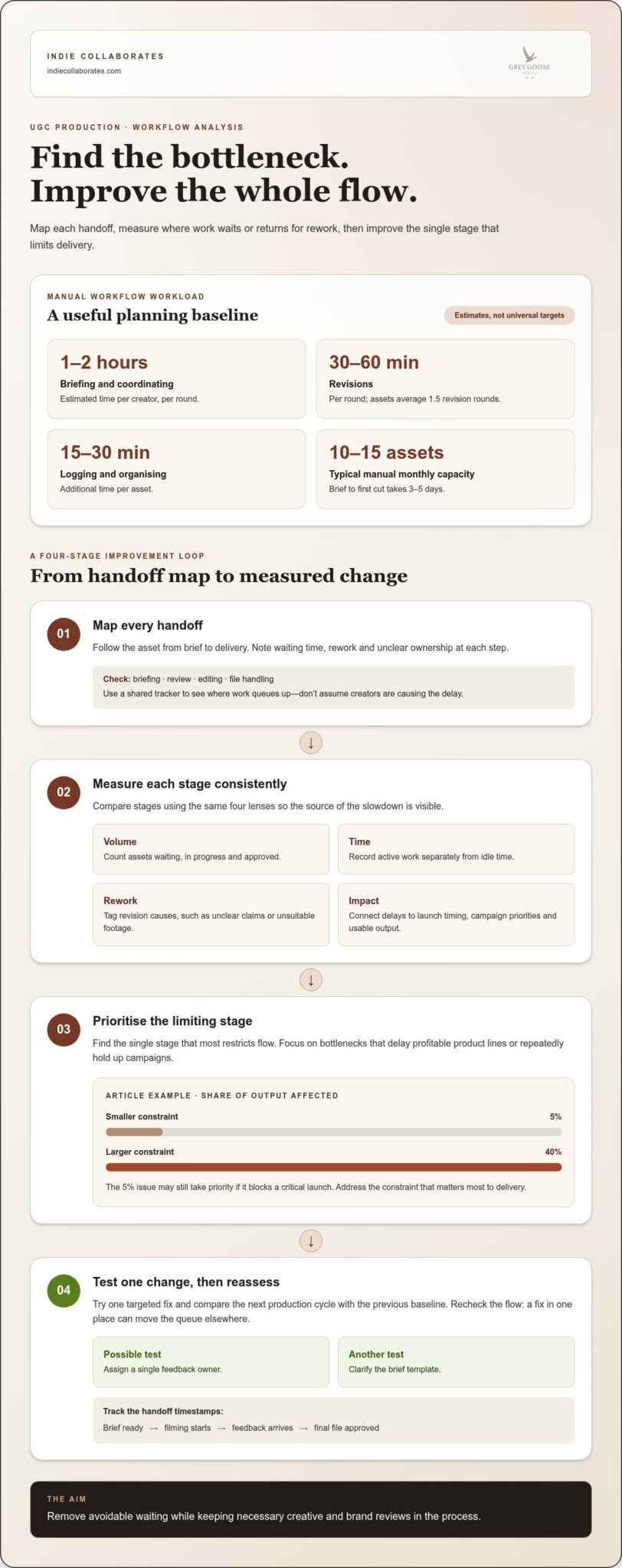
A manual UGC workflow can consume more team time than the finished videos suggest. Briefing and coordinating one creator takes an estimated 1-2 hours per creator per round. Revisions add 30-60 minutes per round, and assets average 1.5 revision rounds. Logging, storing and organising each asset takes another 15-30 minutes. These tasks compete with creative development, approvals and campaign analysis.
That workload shapes practical capacity. Manual systems typically allow in-house teams to manage 10-15 assets per month, while brief-to-first-cut production takes 3-5 days. Those estimates are useful planning signals, not universal targets. Track the hours and waiting time for each stage in your own workflow. For example, record when a brief is ready, when filming starts, when feedback arrives and when the final file is approved.
UGC production differs from influencer marketing and in-house content in its primary output. UGC focuses on creator-made assets that a brand can use in paid or organic content. Influencer marketing also draws on a creator’s audience and distribution, while in-house content is produced by the brand’s team, which has direct control over creation and scheduling.
Use workflow analysis to find where work queues up instead of assuming creators are causing delays. Map every handoff from brief to delivery, noting waiting time, rework and unclear ownership. A creator may submit on schedule, but an asset can stall when approvers provide conflicting feedback. A shared tracker can show whether briefing, review, editing or file handling takes the longest.
The Theory of Constraints offers a focused way to respond: identify the single most limiting stage, improve it, then reassess the flow. Prioritise bottlenecks that delay profitable product lines or repeatedly hold up campaigns. A constraint affecting 5% of output deserves less attention than one affecting 40%, unless the smaller issue blocks a critical launch. Implementing a fix at the wrong stage can simply move the queue elsewhere.
For a practical bottleneck analysis, compare each stage using the same measures:
- Volume: count assets waiting, in progress and approved.
- Time: record active work and idle time separately.
- Rework: tag revisions by cause, such as unclear claims or unsuitable footage.
- Impact: connect delays to launch timing, campaign priorities and usable output.
Then test one change, such as assigning a single feedback owner or clarifying the brief template. Compare the next production cycle with the previous baseline. A streamlined UGC production process should remove avoidable waiting without skipping necessary creative or brand reviews.
2. Workforce training and standard operating procedures
A standard operating procedure turns a creative workflow into repeatable actions without flattening a creator’s style. Document each handoff, owner and approval condition, then train the team using a sample brief and asset. For example, coordinators can practise checking product details, recording usage permissions and naming files before delivery. Keep instructions in one shared workspace so creators and reviewers use the same version.
Train teams to make decisions, not just follow software steps. Reviewers should know which feedback is essential, who can approve claims and when to return a video for changes. Use a short checklist for audio, lighting, captions, framing and brand requirements. Then run a calibration exercise: have two reviewers assess the same asset and compare their feedback. Shared standards help prevent contradictory notes and unnecessary editing.
What tools automate UGC creator discovery, approvals and delivery? Use creator databases or campaign platforms to organise discovery, workflow tools to route briefs and approvals, and digital asset libraries to store final files. Set clear status labels and permissions so each team member can see the next action without searching through message threads.
- Discovery: filter creator records by audience, content style and campaign needs.
- Approvals: assign reviewers, capture comments against specific versions and record sign-off.
- Delivery: centralise approved files, usage details and final captions.
What are the risks of using AI-generated or unlicensed UGC? AI-generated content can misrepresent a real customer experience or show an inaccurate product demonstration. Unlicensed footage, music, images or likenesses can lead to rights disputes and prevent a brand from using an asset as planned.
Build a rights and review checkpoint into the SOP before production starts. Record who created each asset, what permissions cover its use, and which channels or edits are approved. For AI-assisted material, label the workflow internally and carefully review factual claims, visual details and voice. A human reviewer should compare each product demonstration with the actual product and approved brand information.
Workflow KPIs show whether training changes output. Track cycle time, first-pass approval, revision causes and assets delivered against the campaign plan. Review these measures consistently, then coach the stage with recurring errors. Manufacturing teams often use standard procedures to improve workflow efficiency; the same principle helps UGC teams reduce handoff confusion while preserving creative judgement. A manufacturing example of a 12% cycle-time reduction also shows why process changes should be measured against a baseline, not assumed successful.
For Singapore teams balancing brand review with creator flexibility, a creator content strategy can help connect content goals with practical production guidance. Keep the SOP focused: define the standard, train against real examples, and revise it when performance tracking identifies a repeat issue.
3. Production tracking and performance analysis
Track each UGC asset from concept through delivery and paid performance. Give every file a consistent identifier linked to its creator, hook, angle, format and campaign. This lets the team compare like with like instead of treating each video as an isolated result. A shared tracker can show production status alongside impressions, clicks, conversions and spend.
How can businesses measure UGC campaign performance and ROI? Connect each creative variant to campaign metrics such as click-through rate (CTR), cost per acquisition (CPA) and return on ad spend (ROAS). Compare the results with a defined baseline and business objective, and use attribution consistently to assess contribution.
Test hooks systematically. Prepare at least five hook variants for each asset batch, and compare the opening’s ability to stop viewers. One suggested rule is to pause a hook at 500 impressions if its Thumb Stop Rate remains below 25%. A Thumb Stop Rate above 35% and CTR above 2% are example winning criteria, not universal guarantees. Evaluate Hook Hold Rate at fifteen seconds, with a rate above 40% identified as another example threshold.
Interpret thresholds as decision aids, not substitutes for context. Audience, placement, product and campaign objective can change what a useful result looks like. The research recommends testing at least three hooks per angle and three angles per campaign, targeting 20 variations per product launch. Keep each variant’s labels and test conditions clear, so the machine of ongoing optimisation has reliable inputs.
- Before launch: record the creative hypothesis, target audience and baseline.
- During testing: compare variants under consistent campaign conditions.
- After review: document the decision, learning and next creative change.
Use performance data to guide revisions, not simply to replace a low-performing asset. If viewers leave early, test a clearer opening or a different pace. If attention holds but clicks remain weak, review the call to action, product explanation and audience fit. Pause assets when CTR falls 15-20% from their peak, then examine frequency, message fatigue and competing variants before deciding what to change.
Performance can inform production decisions as well as media choices. Underoutfit’s case-study results report a 47% higher CTR, while other reported outcomes include lower acquisition costs and stronger ROAS. Treat these as examples, not forecasts. Review results continuously, preserve the strongest learning in the next brief, and compare post-change performance against the original baseline to see whether the adjustment helped achieve the campaign goal.
4. A five-stage UGC ad production pipeline
A five-stage pipeline gives every asset a clear route from campaign idea to usable creative. It also helps teams identify decisions that slow delivery, rather than simply asking creators to work faster. For manual production, the brief-to-first-cut estimate is 3-5 days. Final delivery may take longer when feedback, approvals or revisions add extra steps.
Stage one, define the creative direction. Start with the campaign goal, intended audience and product details. Specify the key message, desired action, format and required deliverables. Separate essential brand requirements from creative guidance so creators know what must remain accurate and where they can bring their own voice. A clear brief gives every later review a shared reference point.
Stage two, select and prepare creators. Match creators to the audience, product and delivery style. The production team can audition creators and assess whether they feel comfortable on camera. Before filming, share the agreed concept, product information and practical instructions. This preparation can uncover misunderstandings early, before they lead to unusable footage or production delays.
Stage three, film with direction. Give creators clear performance guidance and support the recording process with attention to lighting and audio. A natural delivery still needs to communicate the intended message. Capture the required scenes and product details against the brief, and review footage while production is underway. Early checks make corrections easier than discovering missing content during editing.
Stage four, edit and review. Edit the video and add captions, then assess it against the brief. Check that the message is clear, product details are accurate and audio is understandable. Keep feedback specific: identify the moment, issue and requested change. Consolidated comments from a responsible reviewer help prevent conflicting instructions and unnecessary revision cycles.
Stage five, approve and deliver. Confirm that required brand reviews are complete, then organise approved files with useful labels. Include the final version and relevant campaign details in the delivery record. This creates a dependable handoff to media and creative teams, making it easier to see which asset is ready for testing and which still needs action.
Across all five stages, name an owner and completion condition for each handoff. Track dates, versions, feedback and approval status in one workflow. If stage four repeatedly causes delays, examine editing capacity or review clarity before changing creator selection. The right improvement depends on the actual constraint. A reliable pipeline can move faster while protecting creative quality, supporting campaign strategies and connecting asset performance with business goals such as profit.
Use this structure as a working system, not a fixed script. After each campaign, compare planned and actual handoffs, then adjust the stage causing the most friction. This continuous learning loop helps teams preserve effective practices and improve the next production cycle.
5. Brand onboarding and briefing
A structured onboarding conversation turns a brand’s campaign goal into usable creative direction. Start by asking what the content must achieve: explain a product, address a customer concern or prompt a specific action. Then identify the audience, channel, campaign objective and measure of success. For example, a product demonstration needs different footage from content focused on customer reactions.
Record the product facts creators can use, including features, limitations and approved descriptions. Separate mandatory information from optional talking points so creators know what must stay accurate and where they can interpret the message naturally. A brand selling skincare might require correct application instructions while leaving the opening hook and personal delivery to the creator.
Clarify asset requirements before production begins. Specify format, orientation, key scenes, captions, call to action and delivery method. Describe the intended use of each asset, such as paid advertising or organic social content, and record permissions and any agreed usage limits. This gives brand and creator teams a shared reference instead of leaving them to rely on assumptions during filming or approval.
Set the review workflow during onboarding. Name the person who consolidates feedback, identify who approves product claims and agree how comments will be shared. A single document or online workspace makes communication easier to retrieve than scattered paper notes or message threads. Ask reviewers to distinguish essential corrections from preferences, then group feedback by timestamp or scene. Specific direction helps creators act without guessing which opinion takes priority.
Brand onboarding should also account for increasing campaign complexity. A brand testing several concepts needs a brief that labels each angle and explains how the versions differ. For example, one concept might address convenience while another focuses on product ingredients. Keep the core product facts consistent across both, then note the intended audience and learning goal for each variation. This structure helps teams interpret results later.
Close onboarding by confirming that the brief is usable. Ask the creator or production lead to summarise the message, deliverables and approval route in their own words. Resolve any mismatch before filming. Store the final brief with campaign assets, and record later changes with dates and owners. This creates a clear reference if a new reviewer joins or the brand reuses a successful strategy.
For brands shaping campaign goals into practical creator guidance, a creator content strategy can help connect briefing decisions with production needs. Use the onboarding discussion to align what the brand wants to say with what creators can demonstrate credibly and clearly.
Indie Collaborates: Influencer Marketing Campaigns
Indie Collaborates can support teams that need creator-led production or campaign management beyond their in-house capacity. Its Scalable UGC Production creates creator-led content for paid ads, organic social and creative testing. For campaigns that also need creator reach, Influencer Marketing Campaigns offer a complementary approach. Campaign Performance Reporting helps teams review results and apply those learnings to future creative decisions.
Turn to Indie Collaborates when you have a clear campaign goal but need support connecting it with creators, content production or performance review. The right starting point depends on whether your priority is producing more assets, running an influencer campaign or understanding campaign results.
To discuss your creator campaign needs, contact Indie Collaborates.
Make your next campaign a learning opportunity
Treat each campaign as an investment in better creative decisions, not just a batch of deliverables. A streamlined UGC production process can help your team turn audience response into sharper briefs and more purposeful experiments over time. Start by choosing a campaign goal, deciding what you need to learn and aligning production around that learning.
If you want support putting this approach into practice, Indie Collaborates offers Scalable UGC Production for creator-led assets, Influencer Marketing Campaigns to connect content with creator reach, and Affiliate Programmes for performance-oriented partnerships. The best fit depends on whether your priority is content production, influencer activity or affiliate growth.
Bring your campaign objective and creative needs into the conversation, then explore a practical next step with a team that works across the creator economy. Contact Indie Collaborates to discuss your goals and build momentum for your next campaign.
Frequently Asked Questions
What is streamlining and how is it done?
Streamlining means removing unnecessary effort while preserving the checks that protect quality. Start by observing how a campaign moves between people and tools, then identify duplicated work, unclear ownership or avoidable waiting. For example, if campaign details are copied into separate documents, create one shared source of truth. Test the change on a small project, gather team feedback and keep it only if it improves the workflow.
What is the best way to streamline processes?
Improve one clearly defined problem at a time. Choose an outcome, such as fewer incomplete submissions, and record how the current process performs. Then change one element, such as the brief template or approval route, and compare the next project with the baseline. This makes it easier to identify what helped. Document the revised method so the team can apply it consistently and move on to the next improvement.
What is a streamlined UGC production process?
A streamlined UGC production process coordinates creator-made content, approvals and learning from campaign results. It connects the creative brief to the final asset and its performance data, so teams can trace why a concept was produced and how it performed. Use consistent asset labels, such as product, audience and creative angle, to make useful content easier to find for future campaigns.
What are the steps in a UGC content production workflow?
A typical workflow moves from campaign direction to creator preparation, filming, editing and final approval. Add a decision gate at each handoff: confirm the concept before filming, check required footage before editing, and verify the final file against its intended use. This catches mismatches while they are easier to address. After publishing, connect each asset’s label to its results so future creative planning can build on specific audience responses.
How do brands brief and onboard UGC creators efficiently?
Give creators a concise brief explaining the audience, product facts, campaign objective, desired action and creative boundaries. Include an example of the intended tone and details that must not change, such as a product feature or approved wording. Clarify how feedback will be delivered and who makes the final decision. Before production begins, ask the creator to summarise the key message in their own words to uncover misunderstandings early.
