
What if your next creator video weren’t a standalone post, but one part of a story your audience could follow? Brand storytelling with UGC works best when each asset contributes to a clear narrative, rather than sitting alone in a content library. The challenge is creating that connection without scripting away the creator’s voice.
If your UGC feels disconnected, or your briefs make genuine experiences sound like polished ads, you’re not alone. Creators need a clear direction; audiences need stories that reflect their questions, needs and decisions. A strong framework can serve both without forcing every creator into the same format or tone.
This practical guide shows you how to plan a repeatable UGC story system, choose narrative formats that fit your campaign objectives, and brief creators with enough context to keep content aligned while leaving room for authentic expression. You’ll also learn how to evaluate each story against your brand goals and audience needs, so individual assets can build a consistent narrative across paid, organic and creative-testing use cases.
Key Takeaways
- Start with an audience tension and a clear brand promise, then identify the proof and next step that can shape a meaningful story.
- Match the UGC format to the message and the question your audience needs answered, rather than defaulting to testimonials.
- Brief creators on the audience, purpose, approved claims, deliverables and usage context, while leaving room for their own interpretation.
- Brand storytelling with UGC becomes more consistent when multiple creator stories share a narrative foundation without repeating the same perspective.
- Review each asset for story clarity, relevance, claim accuracy and creator credibility, then assess results against the campaign objective.
What Brand Storytelling with UGC Actually Means for Your Brand
Brands need messages people can recognise across campaigns. Audiences, meanwhile, respond to creator perspectives that feel grounded in real experiences. The challenge is to connect those needs without turning every piece of content into the same polished brand script.
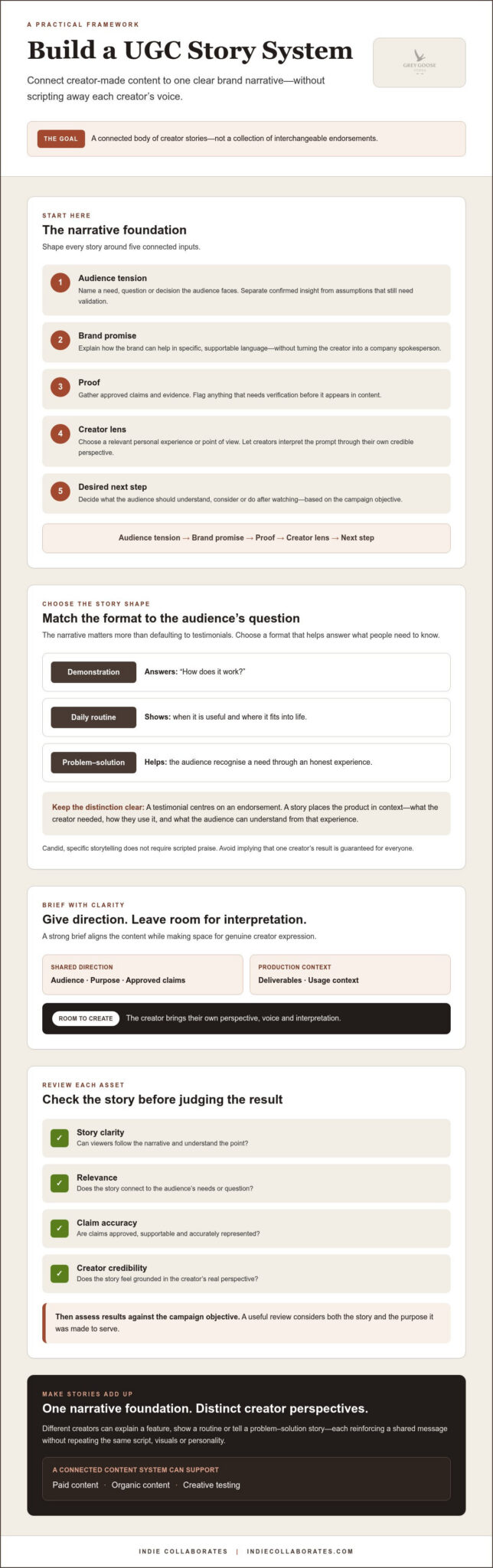
Brand storytelling with UGC is the practice of shaping creator-made content around a clear brand narrative and audience insight, while preserving each creator’s genuine perspective. User-generated content can take many forms, not just customer reviews or testimonials. A creator might demonstrate how a product works, include it in a daily routine, or tell a problem-solution story that helps viewers understand where it fits in their lives.
The key is the narrative, not a single format. A product demonstration can answer “How does it work?” while a routine can show when it’s useful. A problem-solution story can help an audience recognise a need, provided it reflects the creator’s honest experience and doesn’t promise a guaranteed outcome.
How UGC storytelling differs from a testimonial
A standalone testimonial often centres on an endorsement: the creator says they like a product. A story places that product in context, such as a creator explaining what they needed before showing how they use it in a routine. The creator brings their perspective, the audience’s needs shape the situation, and the brand supplies the message or proof to communicate. Positive storytelling doesn’t require scripted praise; it can be candid and specific without claiming the same result for everyone.
Why coherent stories matter across creator content
Separate assets feel connected when they return to a shared message, such as making a complicated choice easier to understand. That consistency doesn’t mean identical scripts, visuals or creator personalities. One creator might explain a feature; another might show it in a daily routine. Each brings a distinct lens while reinforcing the same narrative direction. For broader planning, explore this creator content strategy framework.
This guide turns that principle into a practical process. First, establish the narrative foundation before briefing creators. Then compare story formats against audience questions and work through production and review. Finally, check whether each asset is clear, relevant, credible and suited to its campaign purpose. The goal is a connected body of creator content, not a collection of interchangeable endorsements.
Build the Narrative Foundation Before Briefing UGC Creators
A useful creator brief starts with a person’s situation, not a catalogue of features. Picture someone comparing meal-planning apps because weeknight decisions feel rushed. That tension gives the story a human starting point; a feature list alone doesn’t explain why the audience should care. Brand storytelling with UGC is easier to plan when the brand first defines the role it can credibly play in that moment.
Work through these five foundations before you approach creators:
- Audience tension: Identify a need, question or decision the audience faces. Use customer research and creator insights where available, and label assumptions that still need validation.
- Brand promise: State how the brand can help, in language that’s specific and supportable. Keep the creator in the role of an independent storyteller, not a company spokesperson.
- Proof: Gather approved claims and evidence, such as product information or a substantiated feature. Flag any statement that needs verification before it appears in content.
- Creator lens: Consider which personal experience or point of view could make the story relevant. The creator should interpret the prompt through their own credible perspective.
- Desired next step: Decide what the audience should understand, consider or do after watching. Keep the action appropriate to the campaign objective.
Find the audience tension and brand role
Translate a broad ambition such as “make everyday life easier” into a question someone might genuinely ask: “How can I plan dinner when my schedule changes?” Then define the brand’s role in answering it. Research can guide that choice, but distinguish confirmed audience insight from a working hypothesis. Use creator feedback or further research to test the latter before treating it as fact.
A usable story brief names the audience, tension, message, evidence and desired action, giving the creator enough context to make an informed interpretation. That’s the strategic spine. Build around it with two clear layers:
- Required anchors: The approved message, substantiated claims, essential context, deliverables and any constraints.
- Creative choices: The creator’s opening, examples, setting, wording and storytelling approach, unless a specific requirement makes one of these non-negotiable.
Turn positioning into creator-friendly story prompts
Abstract values become more useful when they point to something observable. Instead of asking a creator to “show convenience,” invite them to demonstrate how they fit a product into a routine or explain a choice they made. Supply approved claims and supporting evidence, and flag wording that needs substantiation. For production planning, see this scalable UGC production guide.
A consistent narrative doesn’t require identical creator performances. It requires shared anchors and room for distinct interpretations. If your team needs a structured approach to creator-led production, explore Indie Collaborates’ creator services.
Choose a UGC Story Format That Fits the Message
The right format depends on what the audience needs to understand, not which trend is gaining attention. Use a simple selection test: can this structure answer a real audience question clearly, and can the creator show or explain it credibly? Treat the format as a storytelling tool, not a promise of reach or results.
| Format | Strongest use case | Audience question | Likely limitation |
|---|---|---|---|
| Demonstration | Showing a feature, process, or product in use | “How does this work?” | Can feel instructional or feature-heavy without a meaningful context. |
| Routine | Placing a product in a recurring activity or situation | “How might this fit into my day?” | May lack a clear point if the routine doesn’t connect to an audience need. |
| Before-and-after | Illustrating a visible change or sequence | “What changes when I use this?” | Needs an honest, representative comparison; avoid implying universal outcomes. |
| Problem-solution | Explaining a relevant challenge and a credible response | “Could this help with a problem I recognise?” | Falls flat if the creator can’t authentically speak to the problem or response. |
| Creator perspective | Sharing a personal observation, choice, or point of view | “What does someone with this experience think?” | May not communicate practical product details unless supported by clear context. |
Match the story structure to the audience question
Choose a demonstration when people need to see how something works. Use a routine or context-led story when the value depends on a recurring situation. A before-and-after can make a change easier to follow, but only when the comparison is fair and the claims are supportable. Use problem-solution storytelling only if the creator can credibly describe both the challenge and their response. These choices make brand storytelling with UGC more relevant and give reviewers concrete criteria: audience fit, clarity, credible evidence and accurate claims.
Adapt the narrative across short-form platforms
TikTok, Instagram Reels and YouTube Shorts are distinct publishing environments, so don’t assume one edit will work equally well everywhere. Keep the central message and approved claims consistent, then adapt the opening, pacing, framing, captions and visual emphasis to the intended placement and audience. A demonstration might open with the item in use; a creator-perspective story might begin with the question that prompted their experience. Treat each version as a creative execution to review, not a guarantee of performance.
Evaluate the finished story against its purpose: does the opening establish the situation, does the format answer the audience question, and does the creator’s perspective feel credible? Then assess campaign-specific outcomes using measures chosen for that objective. A format can be compelling and still be the wrong fit if it obscures the message.
Brief, Produce, and Review UGC Without Losing Creator Authenticity
A reliable workflow gives creators enough direction to deliver the intended story, then checks the finished asset without demanding identical performances. Clear message boundaries and creative freedom serve different functions: boundaries protect accuracy and narrative focus, while freedom lets creators express the story in a way that feels natural to them.
Use five stages to move from intent to publishable content:
- Brief: Set out the audience, story purpose, approved claims, required deliverables, usage context and constraints.
- Creator interpretation: Invite the creator to propose how they’ll bring the story to life, including any relevant personal experience or setting.
- Concept or draft review: Check the planned direction early enough to flag factual gaps or a mismatch with the audience need.
- Production: Let the creator deliver in their own voice, while keeping the agreed message anchors in view.
- Final checks: Review accuracy, narrative clarity, brand fit, creator credibility, permissions and disclosure before publication.
Write a brief that leaves room for a real creator voice
Describe the story you want to tell, not every sentence the creator should say. For example, ask them to show how a product fits into a particular routine rather than dictating a scripted introduction and reaction. Mark required facts and approved claims separately from optional hooks, locations and personal details. Ask creators to flag any claim or scenario that doesn’t reflect their genuine experience, so the team can adjust the approach rather than manufacture a testimonial.
Make the usage context explicit, too. Clarify where the content may appear and how it may be used, such as for organic social, paid advertising or creative testing. Confirm the necessary permissions for those uses with the responsible campaign team before production or publication.
Review content for story quality and responsible claims
Review for substance, not uniformity. Does the opening establish a situation the intended audience recognises? Does the story resolve clearly? Are product claims accurate, supported by evidence and consistent with approved guidance? Does the creator sound credible in the context of the story? If an answer is no, offer focused feedback on the issue instead of rewriting the creator’s entire delivery.
Before publishing, have the responsible campaign team verify usage rights, disclosures, applicable platform policies and current requirements for each channel. Requirements and platform features can change, so check them for the planned placement rather than relying on an old brief. A structured production process can help teams coordinate these steps; explore scalable UGC production with Indie Collaborates.
Connect Brand Storytelling with UGC to a Sustainable Creator Programme
A repeatable narrative can guide a series of creator assets without making them feel like copies. Keep the core audience need and brand message steady, then let creators explore different situations, formats and points of view. One story might show a product in a daily routine; another might explain a decision behind using it. The connection comes from shared narrative anchors, not identical delivery.
To make the programme sustainable, assess every asset against both story quality and campaign purpose. Check:
- Story clarity: Can the audience follow the situation and understand the intended message?
- Audience relevance: Does the story address a need or question that matters to the intended audience?
- Claim accuracy: Are statements consistent with approved, supportable brand guidance?
- Creator credibility: Does the creator’s perspective feel appropriate and genuine in context?
- Campaign-specific outcomes: Does the asset contribute to the objective defined before launch?
Views or engagement can describe attention and interaction, but they don’t prove business impact on their own. First define the campaign objective, then choose a measurement method that reflects it. For example, a campaign designed to encourage product consideration may call for different measures than one focused on driving site visits. Interpret results against that goal, not as a universal verdict on the story format.
Learn from creator content without overgeneralising
Compare audience responses across concepts, creators and channels in light of the original objective. Note which hooks, situations or explanations merit further testing, but don’t label one execution a winning formula for every audience. Combine performance reporting with qualitative creator and audience insights where available; together, they can help explain what happened and shape the next round of stories.
When managed UGC production can help
Researching audience needs, coordinating creator production and reviewing performance can stretch an internal team’s capacity. Indie Collaborates offers creator-led UGC production, creator insights and research for audience-specific content, creator content strategy, and campaign performance reporting. Its UGC production supports paid ads, organic social and creative testing, while creator insights can help shape content for specific audience segments.
With brand storytelling with UGC, consistency is a framework for learning as much as a way to align assets. Refine the narrative as you gather evidence, while leaving creators room to bring their own perspective. If your team is planning a creator programme, explore creator-led UGC production with Indie Collaborates and discuss your content needs.
Build Your Next Creator Story with Purpose
Brand storytelling with UGC works best as a repeatable narrative system, not a set of disconnected endorsements. Start with an audience need and a clear brand message, then choose story formats that answer real questions. Give creators accurate claims and firm boundaries, but leave them room to interpret the story in their own voice.
Keep the narrative consistent across assets without making every creator sound the same. Review each story for clarity, relevance, accuracy and credibility, then measure it against the campaign objective. Views and engagement can offer useful context, but they aren’t proof of business impact without a defined goal and measurement approach.
Indie Collaborates’ creator-led UGC production supports paid ads, organic social and creative testing. The IC Inner Circle is a paid creator community with a specialized jobs board for brands, agencies and HR teams.
Explore creator-led UGC production with Indie Collaborates and discuss how a structured creator process could support your content needs. With a clear narrative and genuine creator perspectives, your next story can build on the last while staying true to your audience.
Frequently Asked Questions
What is brand storytelling with UGC?
Brand storytelling with UGC is the practice of shaping creator-made content around a clear brand narrative and audience insight while preserving the creator’s perspective. It can include demonstrations, routines, creator reflections and problem-solution stories, not only testimonials. The brand provides the message and evidence; the creator brings a personal lens; the audience’s needs help determine which story is useful. Together, these elements make individual assets feel connected without requiring identical scripts.
How do you use UGC to tell a brand story?
Start with an audience situation or question, then define the brand’s role, the message to communicate and the evidence that supports it. Choose a story format that answers the audience’s question, and brief creators on the purpose, approved claims, deliverables, usage context and constraints. Leave room for their interpretation. Before publishing, check that the story is clear, relevant, accurate and credible, then assess it against the campaign objective.
Can UGC storytelling work without scripted creator content?
Yes. A creator can follow a clear story direction without reciting dialogue written by the brand. Provide prompts that describe the audience, situation, message and required facts, then let the creator decide how to express them. For example, ask them to show how a product fits into a routine rather than dictate their words and reactions. Review the content for accuracy and narrative clarity, not whether it matches a word-for-word script.
What are the best UGC formats for brand storytelling?
The best format depends on the audience’s question. Use a demonstration to show how something works, a routine to place it in a recurring situation, or a creator-perspective story to share a personal observation. Before-and-after and problem-solution formats can help explain a change or challenge, but the creator’s experience and any claims must be credible and supportable. No format guarantees reach or results, so choose based on story purpose and audience relevance.
How do you measure whether UGC storytelling is effective?
Define the campaign objective first, then select measures that reflect it. For a campaign focused on site visits, for example, assess relevant traffic measures; for a campaign focused on awareness, use measures suited to that goal. Review story clarity, audience relevance, claim accuracy and creator credibility alongside performance data. Views and engagement can show attention or interaction, but they don’t establish business impact unless you connect them to a defined objective and measurement method.
How much creative freedom should UGC creators have?
Give creators freedom over their wording, delivery, examples and visual choices, while setting firm boundaries around approved claims, required facts, deliverables and usage conditions. The balance depends on the campaign, but a useful brief separates mandatory message anchors from optional creative choices. Ask creators to flag scenarios that don’t reflect their experience. This protects credibility while helping the brand maintain a recognisable narrative across different creator voices.
Should every UGC asset follow the same brand story?
Every asset should support a coherent narrative, but it doesn’t need to tell the same story in the same way. Keep shared elements such as the audience need, brand promise and approved claims consistent, then let creators explore different situations, formats and perspectives. One asset might demonstrate a feature while another shows a routine. This creates connection across the content without making creators, scripts or visuals interchangeable.
When should a brand work with a UGC production partner?
A partner may be useful when audience research, creator selection, production coordination or campaign reporting exceeds your team’s capacity. Indie Collaborates offers creator-led UGC production, creator insights and research for audience-specific content, creator content strategy, and campaign performance reporting. Its UGC production supports paid ads, organic social and creative testing. Consider whether this support fits your needs, and confirm the scope and deliverables that apply to your campaign.
