
The strongest creator partnerships aren’t built on a long creator list. They’re built on a dependable operating model. When choosing a Brand influencer collaboration agency, ask whether it can connect the right creators with clear campaign ownership, well-managed content and meaningful measurement.
Choosing an agency can be difficult. Providers may describe similar performance goals while offering very different levels of strategy, creator sourcing and operational support. You need to know who makes key decisions, how much control your team retains and how campaign contributions will be reported, not just hear broad promises about results.
This guide offers a practical framework for assessing agency fit before you commit. Learn how to compare agency models, assess creator alignment and clarify responsibilities across strategy, partnerships and content. You’ll also find ways to review campaign workflows, transparency and reporting, so you can connect creator activity to business objectives. The aim is to choose a collaboration model that fits your needs now and can adapt as your priorities change.
Key Takeaways
- A Brand influencer collaboration agency should offer a clear operating model, not just access to creators. Assess how its role differs from a platform, talent representation or social account management.
- Creator fit depends on more than audience size. Consider credibility, brand suitability and whether the creator’s content supports your campaign objective.
- Compare DIY, platform-supported and managed agency models based on the time, expertise, communication and reporting your team needs.
- Before signing, clarify scope, creator selection criteria, approvals, timing, campaign ownership and reporting expectations.
- Match support to your priorities, whether you need influencer campaigns, UGC production, affiliate programmes or creator content strategy.
What a Brand Influencer Collaboration Agency Actually Does
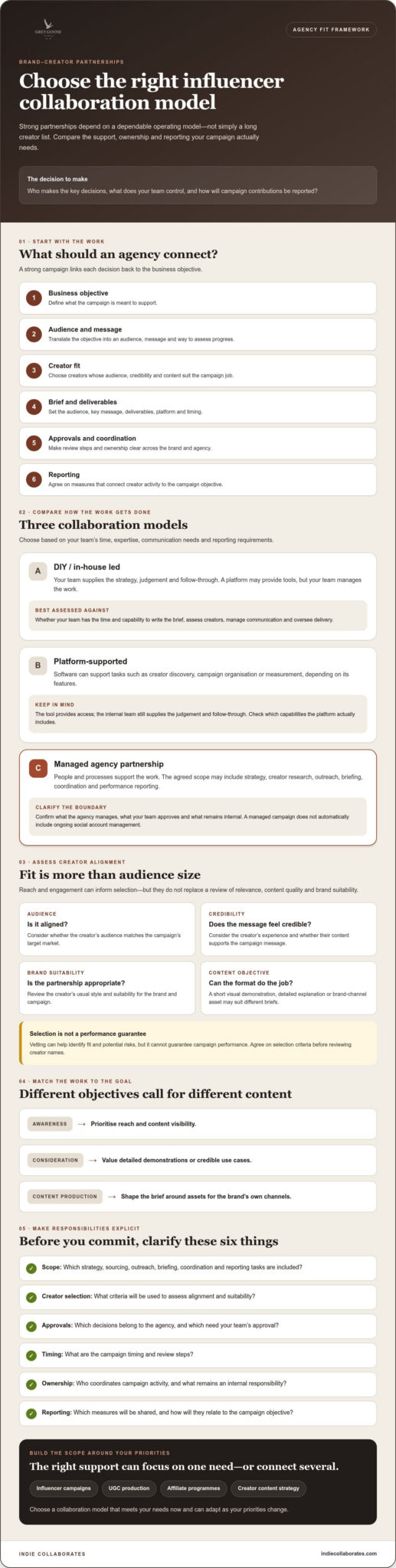
A Brand influencer collaboration agency is a strategic and operational partner that helps a brand plan creator collaborations, identify suitable creators, coordinate campaign activity and assess results. Unlike a self-serve platform, an agency brings people and processes to the work. The agreed scope determines which tasks it manages.
Influencer marketing involves more than finding a profile and arranging a post. As the overview of Influencer marketing describes, it centres on creators influencing an audience’s relationship with a brand or product. An agency turns that broad idea into a campaign shaped by a specific business goal, audience and content approach.
For example, a brand seeking awareness may prioritise reach and content visibility, while a campaign focused on product consideration may value detailed demonstrations or credible use cases. Those goals shape creator selection, deliverables, reviews, approvals and reporting measures. The agency’s role is to connect those decisions in one coherent workflow, not simply provide a list of names.
Which parts of a creator collaboration can an agency manage?
Depending on the agreement, an agency may manage strategy, creator research, outreach, briefing, coordination and performance reporting. Some engagements focus on a specific need, such as creator-led UGC production or affiliate activity. Others cover more of the campaign process. Confirm what the agency owns, what your team approves and what remains an internal responsibility.
Campaign management is not the same as ongoing ownership of a brand’s social channels. A creator campaign may include content made for a brand or a creator partnership, but that doesn’t mean the agency manages your accounts, publishing calendar or day-to-day community interactions. Define this boundary early to avoid mismatched expectations.
When does a brand need more than an influencer platform?
A platform primarily provides software for tasks such as creator discovery, campaign organisation or measurement, depending on its features. It can suit experienced teams with the time and capability to write the brief, assess creators, manage communication and oversee delivery themselves. The tool provides access; the internal team supplies the judgement and follow-through.
A managed agency partnership may help when a campaign involves multiple creators, several content formats or connected activities that need coordination. Human-led planning and delivery oversight can keep briefs, approvals and reporting aligned, while the brand retains agreed decision rights. Before choosing a model, list the work your team can reliably manage and the gaps a partner should fill.
How an Influencer Collaboration Agency Connects Strategy, Creators, and Content
A well-structured creator campaign starts with a business objective, not a shortlist. The agency and brand translate that objective into an audience, a message and a way to assess progress. Those choices guide creator selection, the brief, deliverables, approvals and reporting, so each part of the campaign serves the same purpose.
For example, a brand seeking awareness may prioritise creators whose audiences align with its target market and whose content earns attention in a credible way. A consideration campaign may need creators who can explain a product in context. A content production brief may instead focus on assets for the brand’s own channels. Reach and engagement can inform selection, but neither replaces a review of audience relevance, content quality and brand suitability.
How does creator selection connect to campaign objectives?
Match the creator profile to the job the content needs to do. Review audience alignment and the creator’s usual style, then consider whether their experience and format support the campaign message. A short visual demonstration may suit one brief; a detailed explanation may better serve another. Vetting can help identify fit and potential risks, but it can’t guarantee performance. Agree on selection criteria before reviewing creator names.
Once creators are selected, make the brief actionable. Set out the audience, key message, deliverables, platform, timing, approval steps and reporting measures. For public endorsements, brands should also consider disclosure expectations in the relevant markets. The FTC guidelines on endorsements offer a reference for disclosure principles. Confirm the requirements that apply to your campaign separately.
How do UGC and affiliate programmes fit the collaboration model?
Creator content can be commissioned for a brand’s use or created as a partnership intended for the creator’s own audience. These are different use cases, so confirm where the content will appear and what usage permissions are agreed. User-generated content (UGC) can be briefed for paid advertising, organic social or creative testing, giving teams assets to assess across different placements and messages.
Affiliate programmes add a trackable sales pathway. Creators share tracked links or codes, and the programme records agreed actions against those identifiers. Before launch, align on commission structures, attribution rules and reporting, including how to handle cases where a customer interacts with more than one source. This makes results easier to interpret and expectations clearer for both brand and creator.
A Brand influencer collaboration agency can connect these workstreams, from creator strategy and content production to campaign reporting, according to the agreed scope. If you’re mapping those needs, explore creator collaboration support as one possible starting point.
Agency, Platform, or DIY: Which Collaboration Model Fits Your Brand?
The right model depends on your team’s capacity and the work that needs to get done. DIY keeps decisions close to the brand, a platform provides software to support execution, and a managed agency partnership adds agreed human-led support. None is automatically the best choice. Compare the options by who owns the process, where specialist expertise sits and how results will be reviewed.
| Consideration | DIY | Platform-supported | Managed agency |
|---|---|---|---|
| Internal time | High. Your team handles each task. | Still needed to run the workflow and act on platform tools. | Some execution may be delegated, depending on scope. |
| Specialist capacity | Must exist in-house or be developed. | Software supports tasks, but doesn’t replace human judgement. | May add specialist support in the agreed work areas. |
| Creator communication | Owned by your team. | Usually handled by your team using platform workflows. | May be coordinated by the agency, subject to the agreement. |
| Process ownership | Brand-led from brief to review. | Brand-led, with software supporting steps. | Shared or delegated as responsibilities are defined. |
| Reporting | Your team collects and interprets results. | Tools may organise or display campaign data. | Reporting responsibilities and cadence should be agreed. |
When can a brand manage creator collaborations in-house?
DIY can work for a small, clearly defined test when an experienced team has time for creator research, outreach, negotiation, briefing, approvals and tracking. It also gives the brand direct control over decisions and communication. Before starting, assign an owner to each step and decide how the team will record deliverables and results.
Capacity is often the pressure point. As a programme adds creators or content formats, coordination and review can become harder to keep consistent. If campaign responsibilities start competing with other priorities, reassess whether your current model can support the workload.
When does a managed agency partnership make sense?
Agency support may fit when a brand lacks capacity or specialist experience in a defined area, such as creator strategy, campaign operations, UGC production or performance reporting. External support is useful only when its scope and accountability are clear. Specify deliverables, decision rights, approval points, reporting measures and review cadence, then check that they address your actual bottleneck.
A Brand influencer collaboration agency shouldn’t be chosen on broad promises alone. Ask who owns each task, what your team must provide and how progress will be assessed. For a more detailed planning framework, see this guide to outsourced influencer campaign management.
How to Evaluate a Brand Influencer Collaboration Agency Before Signing
Choose a partner through a clear process, not a polished pitch alone. A Brand influencer collaboration agency should explain how its proposed scope connects to your goals, who owns each decision and what evidence you’ll receive to assess the work.
What should a brand include in its agency brief?
Give agencies enough context to propose a realistic approach. State your audience, business objective, relevant channels, expected deliverables and timing. Name approval stakeholders, share brand guidelines and exclusions, and outline content usage needs and any disclosure instructions for the campaign’s markets. Explain which measurement tools you use and what your team expects to review. A clear brief makes proposals easier to compare.
Which questions reveal whether an agency is accountable?
Ask for specifics, not broad assurances. Who communicates with creators and manages the project? Who reviews content, gives final approval and escalates issues? What does the reporting cadence look like, and how does the agency define each proposed measure? Request a sample reporting structure, with sensitive information removed if needed, so you can judge whether it answers your team’s questions.
Use this evaluation sequence before agreeing to a partnership:
- 1. Align on the objective. Define the business goal and audience, then agree on what the campaign can reasonably measure.
- 2. Confirm the scope. List deliverables, creator sourcing responsibilities, communication ownership, approvals, timing and any work your team will handle.
- 3. Review selection criteria. Ask how creators will be assessed for audience fit, content quality, brand suitability and campaign purpose. Clarify who signs off on the shortlist.
- 4. Set governance and measures. Agree on decision rights, escalation routes, reporting cadence and metric definitions before launch.
- 5. Plan the review. Decide when results will be assessed and how learnings will inform future creator selection or campaign iterations.
Separate outputs, such as agreed creator content and completed deliverables, from outcomes, such as sales or brand consideration. An agency can be accountable for agreed work, process and reporting, but no partner can guarantee audience response or business results. Establish how you’ll interpret contribution, including attribution limits, before the campaign begins. For a deeper framework, read this guide to measuring influencer marketing ROI.
Ready to assess your campaign requirements and reporting needs? Explore creator campaign support as you shape your brief.
How Indie Collaborates Supports Brand-Creator Partnerships
Indie Collaborates helps brands connect creator activity to specific campaign needs. Its services include influencer campaigns, creator-led content and affiliate activity, alongside creator content strategy and performance reporting. The right starting point depends on your priority: what should creators help the business achieve, and what support does your team need to deliver it?
Creator sourcing is one part of this broader model. The IC Inner Circle is a vetted creator community that can support discovery, but membership doesn’t guarantee that a creator will suit a particular brief or deliver campaign results. Selection still needs to reflect your audience, objectives and content requirements. Choose the services that fit your needs rather than treating every offering as essential.
Which Indie Collaborates service fits your immediate priority?
- Coordinated creator partnerships: Influencer marketing campaigns bring creator strategy and campaign performance reporting together for brands that need structured collaboration and a way to review activity.
- Creator-led assets: Scalable UGC production supports teams developing content for paid advertising, organic social or creative testing. For more on planning this work, explore the scalable UGC production guide.
- Ongoing affiliate activity: Creator affiliate programmes can support brands building a tracked creator salesforce, with programme elements including recruitment, tiered commissions and payout tracking.
- Strategic direction: Creator content strategy can help brands clarify how creator content supports campaign priorities before deciding which execution services to use.
These needs can be distinct or connected. A brand may need campaign coordination for a specific partnership, while another may prioritise reusable content or an affiliate structure. Discuss the scope and responsibilities for each requirement so the partnership reflects your goals and internal capacity.
What are practical next steps for a potential partnership?
Before discussing a programme, outline your objective, audience, available internal resources and preferred scope. Note what your team can own, such as approvals or channel planning, and where you need support, such as creator strategy, UGC production, affiliate activity or campaign reporting. This gives both sides a clear basis for discussing fit, deliverables and expectations before you commit.
A Brand influencer collaboration agency should be treated as a working partner, with responsibilities and measures agreed in advance. If you’re ready to discuss what your brand needs, discuss your creator collaboration goals with Indie Collaborates.
Choose a Creator Partnership Model You Can Build On
The right Brand influencer collaboration agency brings more than creator access. It aligns campaign goals with creator fit, clear responsibilities and reporting that helps your team assess contribution. Before signing, define the work you need, the decisions you’ll retain and the measures you’ll use to review progress.
Indie Collaborates supports brands with influencer campaigns, creator-led UGC production, affiliate programmes and creator content strategy. Its IC Inner Circle includes over 1,600 vetted creators. Affiliate programme support includes recruitment, tiered commissions and payout tracking. These resources can support a partnership, but the right scope depends on your objectives and internal capacity.
Start with a focused brief, then discuss how a potential partner could meet your needs. Discuss your creator collaboration goals with Indie Collaborates and take the next step with clarity.
Frequently Asked Questions
What does a brand influencer collaboration agency do?
A Brand influencer collaboration agency helps a business plan and coordinate partnerships with creators. Depending on the agreed scope, its work may include translating campaign objectives into a creator strategy, sourcing and vetting creators, coordinating briefs and approvals, and reporting on campaign activity. Some agencies also offer creator-led content production or affiliate programme management. Before starting, clarify deliverables, decision rights, responsibilities and how results will be measured.
Is hiring an influencer collaboration agency worth it?
It may be worthwhile if your team lacks the time, specialist skills or operational capacity to run creator partnerships consistently. Compare the agency’s proposed work with what your team can already manage, then consider whether the scope addresses a genuine gap. For example, you might need support coordinating creators or producing UGC, but not broader campaign management. Agree on measures and reporting expectations before deciding whether the partnership is justified.
How do I choose the right influencer agency for my brand?
Start by defining your audience, objective, channels and internal capacity. Then compare agencies on creator selection criteria, scope, communication, content usage, reporting and relevant experience. Ask who owns each task, who approves content and how the agency will assess performance. A suitable partner should explain its operating process and how it fits your needs. Don’t choose solely on follower counts, broad promises or the size of a creator list.
How can a brand measure influencer collaboration results?
Choose measures that match your campaign objective before launch. Depending on the brief, these could include agreed deliverables, reach, engagement, content performance, tracked traffic, conversions or affiliate sales. Confirm how each metric is defined, which data sources will be used and how often results will be reported. Separate directly observed campaign activity from broader business changes that can’t be confidently attributed to one creator partnership.
How much does an influencer collaboration agency charge?
Agency fees depend on the agreed scope, campaign duration, number of creators, deliverables and level of management. A proposal may cover a broad programme or a narrower need, such as UGC production or affiliate operations. Ask for an itemised outline of responsibilities, exclusions and reporting rather than relying on a generic rate. Then compare proposals against your objectives, required support and the internal workload each option leaves with your team.
Can one agency manage influencer campaigns, UGC, and affiliate programmes?
Some agencies offer all three, but services and how they connect vary by provider. Confirm that the partner can support your specific requirements, who will coordinate each workstream and how communication and measurement will be handled. Influencer campaigns, UGC production and affiliate programmes have different deliverables and success measures. For example, affiliate activity may involve recruitment, tiered commissions and payout tracking, while UGC may focus on creating assets for paid or organic use.
What should I ask an agency before starting a creator campaign?
Ask how creators are selected, which tasks the agency manages and who handles communication, approvals and project coordination. Clarify timelines, content usage, disclosure guidance for relevant markets and reporting cadence. Request definitions for proposed metrics, and ask how issues such as missed deliverables or changing requirements are handled. Finally, find out how campaign learnings may inform future creator choices. Clear answers help you assess whether the proposed process fits your team.
