
The cheapest UGC quote can become the most expensive option if it leaves you with content you can’t reuse. Cost effective UGC content solutions aren’t simply about paying less per video. They’re about getting the right creative, deliverables and usage rights for the channels you need.
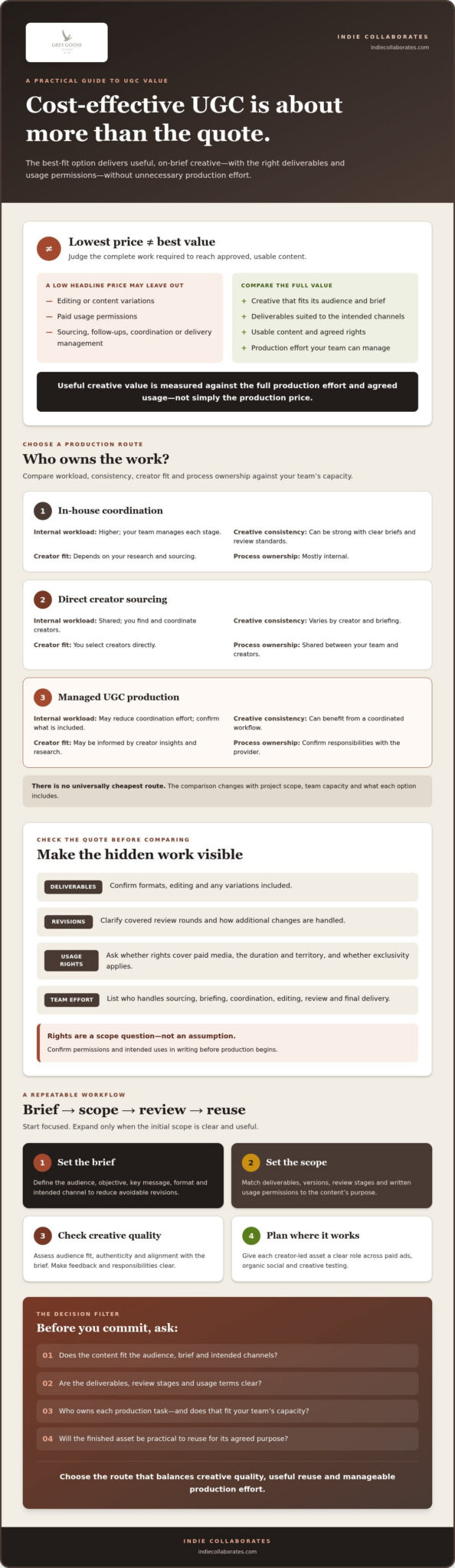
If you’re unsure whether to source creators yourself, use a platform or work with a managed production provider, compare the work each option leaves with your team. A low headline price may exclude editing, variations or paid usage, while producing every asset from scratch can stretch your budget without adding useful creative range.
This guide will help you compare production options by total value, assess the cost drivers that shape a quote and check quality before you commit. You’ll also learn how to plan briefs, rights and review stages so each creator-led asset has a clear role across paid ads, organic social and creative testing. The goal is a repeatable process that balances quality with efficient, reusable production, not a pile of inexpensive clips.
Key Takeaways
- Judge production value by useful, reusable creative and the effort required to deliver it, not by the lowest quote.
- Compare in-house coordination, direct creator sourcing and managed production against your team’s capacity and need for consistency.
- Use a quality checklist to assess audience fit, authenticity and brief alignment, then confirm usage permissions in writing.
- Build Cost effective UGC content solutions around a focused brief and initial scope before expanding formats or creator participation.
- Match your production route to your workflow, and consider how creator insights can inform content for paid ads, organic social and testing.
What Makes UGC Content Solutions Cost-Effective for Brands?
Cost effective UGC content solutions create useful, on-brief content without unnecessary production effort. The goal isn’t simply to choose the lowest quote or reduce creator compensation. It’s to understand what the work includes, how well the content fits its intended audience and channels, and whether you can make practical use of the finished assets. User-generated content (UGC) can take many forms; for brands commissioning creator-led assets, value depends on matching the format and production scope to a clear purpose.
Define the intended use before comparing proposals. A video planned for organic social may need different edits or permissions from one intended for paid media and creative testing. Content volume, versions, review rounds and usage terms all shape what a quote delivers. A single asset with broad reuse potential may be more useful than several pieces that don’t fit your channels or brief.
“Cost-effective UGC is content whose usable creative value justifies its full production effort and agreed usage, not simply the lowest production price.”
Which UGC production costs should buyers assess?
Look at the full workflow, not just creator production. Depending on the arrangement, your team may need to handle sourcing, briefing, coordination, editing, review and final delivery. Ask each provider to list what they’ll manage and what your team must own. Compare those responsibilities alongside the quoted deliverables, so a low fee doesn’t conceal work your team will need to absorb.
- Confirm the deliverables, formats and editing included.
- Clarify how many revision rounds are covered and how additional changes are handled.
- Ask whether usage rights cover paid media, for what duration and territory, and whether exclusivity applies.
Rights are a scope question, not an assumption. Confirm permissions and intended uses in writing before production begins.
Why can a lower-cost UGC quote cost more effort?
A lower quote may leave sourcing and follow-ups to your team, along with quality checks, creator coordination and delivery management. That can be a sensible trade-off for a small, straightforward project with clear internal ownership. For a broader scope or a team with limited capacity, the time required to manage each stage can change how the offer compares.
Brief quality matters, too. If the audience, key message, format or channel is unclear, creators may interpret the assignment differently, leading to avoidable revisions or assets that aren’t usable. Define the objective and requirements upfront, then compare options based on both production price and the work needed to reach approved, usable content. No route is always cheaper; value depends on project scope, team capacity and what’s included.
How to Compare UGC Production Routes Without Sacrificing Quality
The right production route depends on your team’s capacity, creative needs and preferred level of process ownership. Compare each option using the same criteria, rather than assuming a larger creator pool or a lower quote will automatically deliver better value.
| Route | Internal workload | Creative consistency | Creator fit | Process ownership |
|---|---|---|---|---|
| In-house coordination | Higher: your team manages each stage | Can be strong with clear briefs and review standards | Depends on your research and sourcing | Mostly internal |
| Direct creator sourcing | Shared: you find and coordinate creators | Varies by creator and briefing | You select creators directly | Shared between your team and creators |
| Managed UGC production | May reduce coordination effort; confirm what’s included | Can benefit from a coordinated workflow | May be informed by creator insights and research | Confirm responsibilities with the provider |
Access to creators is only one part of production. Research helps identify relevant perspectives; a clear brief turns those insights into content direction; production coordination and quality checks help keep deliverables aligned. Before choosing a route, ask who owns each stage, how feedback is handled and what you’ll receive at delivery. For a deeper look at planning repeatable production, see this guide to scalable UGC production services.
When does in-house UGC coordination make sense?
In-house coordination can suit a team with established creator relationships, clear review standards and enough capacity to manage the workflow. Include staff time in your comparison: sourcing, briefing, follow-ups, reviewing content and organising deliverables all take effort. A low external fee may still require substantial internal ownership.
When is managed UGC production worth considering?
Managed production may suit teams that want structured support coordinating creator-led content and production. Before committing, confirm who leads communications, manages approvals and owns each deliverable. Indie Collaborates is one option to evaluate: its scalable UGC production includes creator insights and research, with content intended for paid ads, organic social and creative testing. Explore its UGC production services and assess whether the scope fits your needs.
Cost effective UGC content solutions come from matching the route to your actual workflow. Compare responsibilities and deliverables side by side, then choose an arrangement your team can support without compromising creator fit or creative quality.
How to Evaluate UGC Quality, Rights, and Reuse Before You Buy
A polished asset isn’t automatically the right asset. Evaluate whether it speaks to the intended audience, feels credible, communicates clearly and follows the brief. Then assess usage permissions separately. Strong creative can still be unsuitable for a planned channel if the agreement doesn’t allow that use.
Use this checklist to review a draft or sample:
- Audience relevance: Does the creator’s perspective feel appropriate for the people you want to reach?
- Authenticity: Does the delivery sound natural, rather than overly scripted or unlike the creator’s voice?
- Clarity: Can viewers understand the key message and see or hear the product or service clearly?
- Brief alignment: Does the content meet the agreed objective, format and platform context without missing required points?
Separate creative approval from permission to publish. “Content reuse depends on the rights agreed in writing and the channels those rights cover.” A piece intended for organic social may not automatically be cleared for paid media, adapted edits or future campaigns. Plan possible uses early, then confirm the permissions needed for each one.
What should a UGC brief specify to reduce rework?
Give creators a clear framework: identify the audience, objective, key message, platform context and required formats. Include essential product details and any points that must be addressed, but leave room for the creator’s natural phrasing and delivery. Before production, decide who reviews the work, how feedback will be shared, when it’s due and what the approval criteria are. Clear ownership helps prevent conflicting notes and avoidable revisions.
Which usage-rights questions should brands ask?
Don’t assume standard rights are included. Ask the provider to document:
- Which channels and placements are permitted, including whether paid-media use is covered.
- How long the content may be used and which territories are included.
- Whether you may edit, crop, add captions or otherwise adapt the asset.
- Whether exclusivity applies, and what it restricts.
- Who secures creator permissions and whether approved edits or future reuse need separate approval.
For example, a brand may want to test a creator video as a paid ad, then publish an edited version organically. That plan only works if the agreed rights cover both uses and the adaptation. Confirm the scope for each proposed use in writing before production, and keep the approval and permissions record with the final files.
Cost effective UGC content solutions depend on assets that meet the brief and can be used where needed. A practical review checks both: is the content fit for purpose, and does the written agreement permit the intended use?
Build a Cost-Effective UGC Workflow: Brief to Testing
A repeatable workflow helps your team move from a business need to usable creator content, then carry learning into the next brief. Start with a focused scope. Expand into more formats or creator participation once you know what your team needs to produce and review.
- Set the objective. Decide what the content needs to support, such as explaining a product benefit, addressing a customer concern or generating creative options for a campaign.
- Research the audience. Identify the audience’s needs, language and relevant perspectives. Use those insights to shape content choices instead of relying on assumptions about what will resonate.
- Choose concepts and scope. Select a small set of concepts that connect to the objective. Define the initial formats, deliverables and intended channels, including whether content is for paid ads, organic social or creative testing.
- Brief creators clearly. Share the audience, purpose, key messages, platform context, required deliverables and usage requirements. Give essential direction, but avoid scripting every line so creators can communicate naturally.
- Review against agreed criteria. Assign review ownership before production. Check each asset for audience relevance, clarity, brief alignment and required deliverables, then consolidate feedback into actionable revisions.
- Record and apply learning. Track which approved assets were used, the context in which they were tested and what the team observed. Use those observations to inform future briefs, not as a promise that the next creative will perform the same way.
How should a brand plan an initial UGC production brief?
Start with the audience need and campaign purpose, then choose concepts that address them. State the deliverables, review process, timeline and usage requirements so providers can respond to a consistent scope. A useful brief makes priorities clear while leaving room for creator interpretation. That balance supports alignment without flattening the creator’s voice.
How can creative testing improve future production decisions?
Set learning questions before production. For example, decide whether you want to compare two message angles or test different openings, and confirm that the assets and permissions support the intended use. Keep a simple record of the creative, test context and observations. Patterns can guide the next round of content, while a single result should be treated as learning rather than a guarantee.
This measured approach helps make Cost effective UGC content solutions more repeatable: each brief has a purpose, and each review can contribute to better-informed decisions. For related planning principles, explore creator content strategy for conversion.
If you’re planning creator-led assets for paid, organic or testing use, explore creator content strategy as part of your production planning.
Choosing a UGC Partner: When Indie Collaborates Fits Your Needs
The right production model depends on what your team can manage and where support is needed. Internal production may suit brands with the time, creator relationships and processes to handle sourcing, briefing and review. Direct creator sourcing gives your team control over selection, but also leaves coordination and quality checks on your plate. Managed UGC production is worth considering when you need structured support across creator-led content and production.
Cost effective UGC content solutions should fit your workflow, not force it into a fixed model. Before choosing a partner, consider which stages your team can own consistently and where research, creator insights or production coordination would help. The best fit depends on your scope and capacity, not the size of a creator network alone.
What does Indie Collaborates bring to UGC production?
Indie Collaborates provides scalable UGC production with creator insights and research to inform audience-specific content planning. Content is produced for paid ads, organic social and creative testing, so brands can plan assets around their intended use. Its IC Inner Circle is a paid community of over 1,600 vetted creators, offering relevant creator-access context. Community access alone, however, doesn’t determine whether a creator or production approach suits a particular brief.
As you evaluate the fit, ask how creator research informs selection and content direction for your audience. Confirm the proposed scope, deliverables and workflow directly, rather than assuming that every project includes the same elements.
What should brands clarify before starting a UGC project?
Use an initial discussion to explain your objectives, audience, intended channels and internal capacity. Then clarify responsibilities before committing. A useful conversation should establish:
- Scope: What production work is included, and what does your team need to provide?
- Creator selection: How will creators be considered for the audience and brief?
- Deliverables and approvals: What assets are proposed, who reviews them and how is feedback handled?
- Usage rights: Which channels, paid uses, durations and territories are permitted? Confirm terms in writing.
- Reporting: Who tracks or reports on campaign performance, and what information is included?
These questions help you compare support against your actual needs, without assuming that a provider’s process or rights terms suit every project. If you’re assessing whether coordinated UGC production fits your plans, discuss your UGC content requirements.
Turn Your UGC Plan Into a Repeatable Process
Cost effective UGC content solutions aren’t defined by the lowest quote. They come from matching production support to your team’s capacity, agreeing on deliverables and usage rights, and planning content for the channels where you intend to use it. A clear brief and focused first scope also make it easier to review creative and apply learning to future production.
Indie Collaborates’ scalable UGC production includes creator insights and research to inform content for specific audience segments. The content is intended for paid ads, organic social and creative testing. Its IC Inner Circle connects brands with a community of over 1,600 vetted creators, offering relevant creator access as part of the wider ecosystem, not a promise of campaign outcomes.
Before deciding whether managed support fits, outline your objective, audience, intended channels and internal capacity. Then clarify scope, deliverables, approvals, usage rights and reporting responsibilities. A focused discussion can help you identify the right next step for your production needs.
Discuss your UGC content requirements and take a confident first step towards a more intentional creator content process.
Frequently Asked Questions
What makes a UGC content solution cost-effective?
A UGC content solution is cost-effective when its usable creative value justifies the total production effort and agreed rights. Look beyond the production quote to assess creator sourcing, coordination, editing, review, deliverables and internal staff time. Also consider whether the content fits its intended audience and channels. An asset that can be used as planned may offer better value than a lower-priced piece that requires extra work or can’t be used where you need it.
How can a brand reduce UGC production costs without lowering quality?
Reduce avoidable work, not the care given to creators or the creative itself. Set a clear objective, audience, key message, required formats and usage needs before production begins. Keep the initial scope focused, consolidate feedback through a clear review owner, and ask providers to specify deliverables and revision rounds. These steps can help limit confusion and rework while preserving room for creators to deliver in a natural voice.
Is managed UGC production worth it for a small marketing team?
Managed UGC production may be worth considering if your team lacks capacity to coordinate creators, production stages and reviews. Compare the support offered with the work your team would otherwise need to handle, including sourcing, briefing, follow-ups and quality checks. Ask who owns communications, approvals and final delivery. For a small, straightforward project, direct sourcing may still suit your workflow if you have clear processes and available staff time.
What should be included in a UGC production brief?
A useful UGC brief states the audience, business objective, key message, platform context and required deliverables. Include relevant product details, intended channels, usage requirements, timeline, review responsibilities and approval criteria. Clarify which points are essential, but avoid scripting every word if a natural creator voice matters. Sharing these details before production helps creators understand the assignment and lets providers scope the work more consistently.
Can the same UGC content be used in paid ads and organic social?
It can be used across paid ads and organic social only if the agreed permissions cover both channels and any planned adaptations. Don’t assume that approval for one use includes another. Confirm permitted platforms, paid-media use, duration, territories and editing rights in writing. Also consider whether a single version fits each placement. The content may need adjustments for different formats, even when the usage agreement allows reuse.
How should brands compare UGC production providers?
Compare providers against the same scope and responsibilities. Ask what’s included for creator sourcing, research, briefing, production coordination, editing, revisions and final delivery. Clarify who selects creators, manages approvals and secures usage permissions. Then assess whether the process suits your team’s capacity and whether the proposed content aligns with your audience and intended channels. A like-for-like comparison makes it easier to evaluate overall value, not just the headline quote.
How many UGC videos should a brand produce for a campaign?
There’s no universal video count that suits every campaign. Start with the objective, audience, channels and specific learning questions, then define a manageable initial scope your team can brief and review well. If you plan to test creative, decide which messages or openings you want to compare and confirm that each asset supports that test. Use what you learn to shape later production, rather than producing more videos without a clear purpose.
