
A creator’s following isn’t always the point. Creator-generated content for brands is commissioned content made for a brand’s own channels, including paid ads and e-commerce, rather than content the creator must post to their audience. The brand sets the brief and goals; the creator brings production skills and an authentic perspective.
That distinction matters. A campaign designed to reach an audience differs from one intended to produce flexible creative assets, and each should be evaluated according to its purpose. Start with what the content needs to achieve.
This article explains how creator-generated content works, which formats brands use across advertising and e-commerce, and how to assess performance against campaign objectives. You’ll also learn how flat fees, retainers, hourly rates and deliverable-based payments differ, and which factors shape the right model for a project in Singapore. The aim is a clearer framework for commissioning content, evaluating its contribution and aligning creator compensation with the work involved.
Key Takeaways
- Separate content made for a brand’s channels from influencer partnerships that include creator posts, then align the brief with the campaign goal.
- Match formats such as ad creative, product photography and e-commerce assets to where customers will encounter them.
- Evaluate content against its intended role, using performance data to guide creative testing and future iterations.
- Choose a payment model that reflects the agreed deliverables, production scope and intended usage.
- Explore Scalable UGC Production for creator-made assets or Influencer Marketing Campaigns when a campaign also needs creator promotion.
WTF is brands’ new investment in creator-generated content?
Creator-generated content is commissioned for a brand’s channels, while influencer marketing typically includes a creator publishing to their own audience. Brands set the brief and campaign goals, then use the resulting assets across paid and organic marketing.
Creator Content Versus Influencer Marketing
Creator-generated content for brands centres on production; influencer marketing typically combines a creator’s content with access to their audience. A creator can make an ad without posting it on their own account, so selection can prioritise production skills over follower count.
For brands in Singapore, the benefit is access to creator-led assets for owned channels without building every piece through a full production crew. This model can also extend an influencer marketing budget by separating content production from audience promotion.
Using Creator Content Across Channels
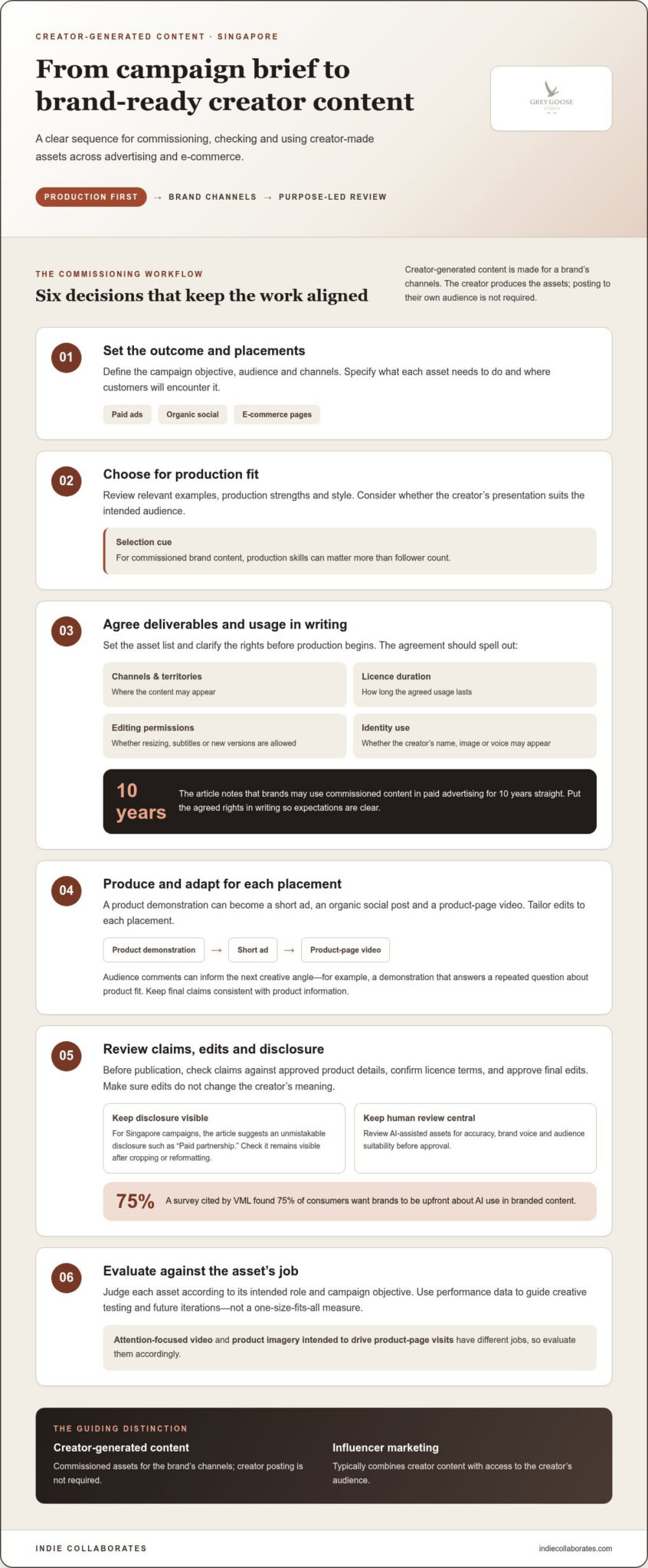
Cross-channel use means adapting creator assets for the places customers encounter a brand, such as paid ads, organic social posts and e-commerce pages. A product demonstration, for example, can become a short ad and a product-page video, with edits suited to each placement.
Plan these uses in the campaign brief. Specify the channels, the purpose of each asset and how the creative should be adapted for its placement. This gives creators a clear production target and helps teams evaluate content according to its intended role.
Creator Vetting and Campaign Planning
Vetting means matching a creator’s production strengths and style to the brief, rather than relying on follower count alone. Review relevant examples, consider whether their presentation suits the intended audience, and agree on deliverables before production begins.
To run a campaign, define its objective, audience and channels; brief the creator; agree on deliverables and usage; then review and approve the assets. This sequence gives both sides a shared standard for the work and supports useful performance reporting after launch.
AI can support changing creative needs, but human review remains central to brand trust. VML advises human oversight for accuracy and brand voice, and says AI-generated assets should pass through review and approval before publication. A survey cited by VML found 75% of consumers want brands to be upfront about AI use in branded content.
For marketing visuals based on text briefs, a team can use AI to draft variations, then have editors select, refine and approve suitable options. For example, a brief describing a product, audience and campaign mood can guide initial visual concepts. A human reviewer can check accuracy, tone and suitability before the visuals reach consumers.
Professional creator content for ads and e-commerce
A creator can produce commercial-ready assets for advertising and online shops without promoting them to a personal audience. For example, a product demonstration can be edited into a paid ad, an organic social post and a product-page video. Each output serves a different point in the customer journey.
For Singapore campaigns, make the commercial relationship clear to consumers. A practical approach is to include an unmistakable disclosure, such as “Paid partnership,” where viewers can readily see it, and carry that direction into the brief and approval process.
Commissioned content also needs clear usage terms. State the channels, territories, editing permissions and licence duration in the agreement. Creator-generated content commissioned by a brand is generally owned by the brand, and brands may use commissioned content in paid advertising for 10 years straight. Put the agreed rights in writing so the creator and brand share the same expectations.
Usage rights matter when a campaign expands beyond its original plan. A clip made for one local social placement may later be considered for a global e-commerce page or a new paid campaign. The agreement should identify permitted placements and whether editing, resizing, subtitles or new versions are allowed. Specify whether the creator’s name, image or voice can appear in those versions.
Audience comments can sharpen the next creative brief. If shoppers repeatedly ask how a product fits, works or compares, turn that question into a clear content angle. For example, a brief might request a close-up demonstration, spoken explanation and caption addressing the fit question. Comments can guide the creative, but final claims still need to match the product information.
Risks include inaccurate product claims, unclear rights, edits that change a creator’s meaning, and disclosures that viewers overlook. Reduce them with a review sequence: check claims against approved product details, confirm licence terms before production, and approve final edits before publishing. Keep the disclosure visible in the final format, including when a video is cropped or reformatted.
For AI-assisted visuals, treat a text brief as a starting point, not the finished asset. Editors should review generated options for accuracy, brand voice and audience sensitivity before approval. VML recommends human oversight and review workflows for AI-generated content; this is especially useful when visuals depict products or make performance claims. A consistent campaign brief and content plan can align creator output, editing and usage from the outset.
Performance data and continuous optimization
Measure each asset against the job it was made to do. A creator video intended to hold attention needs different evaluation from a product image built to drive product-page visits. Set the campaign objective first, then select platform and business metrics that show whether the content is doing that job.
For a short-form video on TikTok or Instagram, review the opening, watch time, completion rate and engagement. For an e-commerce asset, compare product-page visits, add-to-cart activity and purchases. These measures reflect different stages of the customer journey, so don’t treat a view as proof of a sale.
Use a consistent workflow to connect creative choices with results. Record the asset, format, audience, placement and campaign objective alongside its performance. If a product demonstration gets attention but few clicks, test a clearer call to action; if a product-page video gets visits but few purchases, review whether it answers shoppers’ questions.
Compare like with like. A vertical video and a static product image serve different placements, while an organic post and paid ad reach audiences under different conditions. Evaluate each format against its own objective and comparable placements. Avoid declaring a winner based on one result or a different audience mix.
- Attention: Review video views, watch time and completion to assess whether the opening and pacing hold interest.
- Interaction: Track comments, saves, shares and clicks to see how audiences respond and what prompts action.
- Commerce: Connect product-page visits with add-to-cart activity and purchases where those measures are available.
- Creative: Compare versions with one clear change, such as the opening shot, product angle or caption.
Change one major creative element at a time. For example, keep the product and audience constant while testing two openings. This helps show whether the hook influenced results. If several elements change together, the campaign data can show which version performed better, but not why.
Record disclosure and placement details in the same report. A visible paid-partnership label, for example, is part of the public-facing creative and can affect how consumers interpret it. Keeping that context alongside performance figures helps teams compare assets fairly and maintain transparent campaign records.
Turn each reporting cycle into a decision: keep the strongest creative approach, refine underperforming elements, or develop a new version based on audience response. A structured campaign performance reporting process makes those choices easier to communicate across creative, marketing and commerce teams, while grounding future briefs in observed results.
Social graphics, ad creatives, and product photography
Creator-produced visuals serve different purposes across a campaign. A social graphic can explain a promotion, an ad creative can demonstrate a product, and product photography can show details shoppers need before buying. Set the strategy around the placement and audience first, then brief the creator on the visual output each channel requires.
For an Instagram graphic, specify the message, product, brand elements and action you want viewers to take. A graphic promoting a skincare product, for example, might highlight a verified product benefit and direct shoppers to its product page. Keep text concise and legible, especially when the asset appears on a mobile screen.
Ad creatives need a clear visual sequence. A creator could begin with a familiar use case, show the product in action, then end with its main benefit. This gives the audience context before the sales message. Ask for alternate openings or captions when testing different approaches, while keeping the core product claim consistent.
Product photography should answer practical shopping questions. For a bag, that could mean showing the interior, closure, material texture and how it looks when carried. A close-up communicates detail; a wider image shows scale and styling. Include the intended product-page placement in the brief so framing supports the customer’s decision.
Production planning affects how useful each asset becomes. Share brand references, approved product details, the intended audience and placement requirements before the shoot. For example, a creator photographing a reusable bottle needs clear guidance on its design and features, plus direction on whether the composition should leave space for a headline.
Prepare distinct versions for each planned use instead of stretching one composition across every channel. A social post, paid ad and commerce page may need different crops, text treatments or product emphasis. Define the required versions and editing permissions in the brief, then review each final file in its intended placement before publication.
A practical creative brief can specify:
- Objective: Explain whether the asset should build awareness, encourage engagement or support product consideration.
- Format: Name the deliverable, such as a product close-up, lifestyle image or demonstration video.
- Visual direction: Provide references for lighting, setting, product visibility and brand style.
- Review criteria: Check product accuracy, readability, framing and fit for the intended channel.
Finally, connect production choices to the campaign strategy. If an influencer-style testimonial suits social engagement, brief the creator on a natural product experience; if shoppers need more detail, prioritise clear product images. Defined creative direction focuses editing and helps each asset serve its intended role.
CGC payment models
Creator-generated content can be paid for through a flat rate, retainer, hourly rate or payment tied to deliverables. The right model depends on the work commissioned, the creator’s role and the agreed scope for each asset. For a TikTok product demonstration, for example, the payment agreement should distinguish content production from any request to publish the video on the creator’s account.
Four ways to structure payment
- Flat rate: Set one fee for a defined project. This suits a brief with agreed outputs, such as a product video and accompanying still images.
- Retainer: Agree ongoing compensation for recurring work. This can support a continuing content programme with regular briefs and production cycles.
- Hourly rate: Pay for time spent on work such as planning, filming or editing. Define which activities count so both sides understand the scope.
- Deliverable-based: Tie payment to specified outputs, such as a set of edited product photographs or a finished ad creative.
These models aren’t interchangeable. A flat rate can simplify a one-off assignment, while a retainer can suit recurring production. Hourly payment ties compensation to time, so clear task boundaries matter. Deliverable-based payment links the fee to agreed outputs, making scope especially important when revisions or alternate edits are involved.
The cost of creator-generated content varies with the deliverables and the creator commissioned. A project involving product research, filming, editing and multiple versions differs from a brief for a single, simple asset. Pricing depends on the project and is provided after a quote request; relevant factors include the creator, production scope, deliverables and usage requirements.
Define the work before agreeing compensation
Write down what the payment covers: the creative concept, production, editing, revisions and final files. Specify whether the creator must publish content or only deliver assets to the brand. If TikTok publication is part of the assignment, separate it from content creation in the agreement.
Usage rights also affect the scope. Record where the brand may use the content, how long the licence lasts, and whether paid advertising or edited versions are included. Clear terms help creators understand the commercial use and give agencies a consistent basis for coordinating campaign standards.
For recurring work, align payment milestones with the workflow, such as approval of the brief, delivery of a draft and acceptance of final assets. A well-defined Creator Content Strategy can connect those deliverables to campaign needs. If you’re structuring creator compensation around a content programme, plan your creator content strategy around the outputs and usage your campaign requires.
Indie Collaborates: Influencer Marketing Campaigns
Indie Collaborates connects campaign goals with creator-led production and promotion. Choose Influencer Marketing Campaigns when you need creators to publish content to their audiences, or Scalable UGC Production when the priority is creating assets for brand channels. Affiliate Programmes support campaigns built around creator-led sales, while Campaign Performance Reporting helps teams assess results and inform future decisions.
When a project needs clearer direction, Creator Content Strategy can align briefs, formats and campaign objectives before production begins. Choose an approach based on whether your priority is reach, reusable creative assets or affiliate-driven sales.
To discuss a creator campaign aligned with your objectives, contact Indie Collaborates or visit indiecollaborates.com.
Turn your next creative brief into a learning loop
Creator-generated content for brands can become more valuable when each campaign informs the next. Start by choosing a business question your upcoming content should help answer, then define what evidence would guide your next creative decision. This keeps production connected to commercial priorities rather than treating assets as isolated deliverables.
Before finalising the brief, align the people shaping the work around its audience, intended use and decision criteria. A shared direction lets creators bring their perspective while keeping the campaign focused on what the business needs to learn or achieve. Use those priorities to guide the next creative opportunity, not just the next individual asset.
Indie Collaborates supports different objectives through Influencer Marketing Campaigns, Scalable UGC Production and Affiliate Programmes. Choose based on whether your priority is creator-led promotion, brand-ready content or an affiliate sales model.
If you’re ready to shape a creator campaign around your goals, discuss creator content with Indie Collaborates. A focused starting point can help your team build momentum with confidence.
Frequently Asked Questions
Do Long-Term Creator Partnerships Actually Perform Better?
Long-term creator partnerships can build familiarity, but they don’t automatically outperform one-off collaborations. In the cited Deloitte survey, 70% of people who engage with creators returned to the same creators. That finding indicates creator loyalty, not guaranteed campaign results. Compare repeated collaborations against your objective: look for stronger audience response, consistent brand fit and useful learning across briefs. Continue the relationship when each collaboration adds value, not simply because it lasts.
How Long Does a Creator Campaign Really Take?
A creator campaign typically takes about a month from kickoff to the first content going live. The schedule depends on brief clarity, creator selection, product access, production, review and revisions. A product launch with several stakeholders may need more approval time; a single asset with an agreed brief may move more smoothly. Set internal review dates early and allow time for edits before fixing the publication date.
How does CGC work and how is it different from user-generated content (UGC)?
CGC is brand-commissioned creator content, while user-generated content usually describes material customers or users create from their own experience. For example, a creator may receive a brief to film a product tutorial, while a customer independently posts an unprompted review. Commissioned work has a defined objective and review process; organic user content begins with the user’s own motivation and may not follow a campaign brief.
So who’s asking for CGC?
Brand teams request CGC when they need creative assets without requiring every creator to publish to a personal following. Paid-media teams may need alternative hooks; e-commerce teams may want demonstrations or product-detail clips; regional marketers may need versions tailored to different audiences. The request often begins with a content gap, such as a product page lacking a clear use-case demonstration or an advertising team needing fresh creative options.
What is creator-generated content (CGC) for brands?
Creator-generated content (CGC) is brand-commissioned content made by a creator for the brand’s marketing use. For example, a homeware brand could commission a creator to demonstrate how a storage product fits into a small apartment, then use the approved video in its campaign. The brand and creator agree on the brief, output and usage, making the result planned marketing material rather than an unsolicited customer post.
How does creator-generated content differ from influencer marketing and UGC?
CGC pays for creative production for brand use; influencer marketing commonly includes distribution to the creator’s own audience. UGC describes a broader category of user-made content, including organic customer posts. A creator could produce a tutorial for a brand’s product page without posting publicly, or publish a sponsored post as part of an influencer campaign. The distinction is the agreed work: production, distribution, or both.
How much does creator-generated content cost in Singapore?
Creator-generated content costs in Singapore depend on the creator and agreed deliverables, not a universal rate. A single edited asset differs from a package requiring research, filming, multiple formats, revisions or extended usage rights. Payment models can include a flat rate, retainer, hourly rate or deliverable-based fee. The price depends on the case and is given after a quote request; scope and usage shape the estimate.
How can brands measure the ROI and performance of creator-generated content?
Measure ROI by connecting content spend to the outcome the campaign was designed to produce. For sales-focused work, compare attributable revenue with campaign costs and review conversion actions, not views alone. For awareness or consideration, use engagement quality, qualified visits or product-page actions as supporting signals. Tag links consistently, separate paid placements from organic distribution, and assess each asset against the same campaign objective before shifting budget.
