
A strong UGC video can attract attention, but can your team explain what made it work and use that insight in the next brief? Data backed UGC production turns creative decisions into a feedback loop: audience insight shapes the content, and campaign results inform what to test next.
Creator work can feel authentic while still serving a clear strategy. The challenge is connecting audience needs, creative choices and meaningful performance signals, rather than judging content by instinct or surface-level engagement alone.
This article offers a practical framework for making that connection. Learn how to turn audience and creator insight into focused briefs, structure tests so variations can be compared, and choose measures that help explain performance. It also covers how a production partner can bring research and creator-led execution together, grounding the process in audience perspectives while keeping campaign goals in view.
Key Takeaways
- Data backed UGC production connects audience evidence, creator input and campaign results in a repeatable learning loop.
- Start with the decision your team needs to make, then gather relevant evidence and turn it into a clear creative hypothesis.
- Choose an in-house, one-off or managed production approach based on your research needs, creator fit and capacity to carry learning forward.
- Match each performance measure to the content objective. Keep attention, engagement, conversion and business outcomes distinct.
- When assessing a production partner, ask how research informs creator selection and how audience insight reaches the brief.
What Data-Backed UGC Production Means for Brand Teams
User-generated content broadly refers to content created by people rather than brands. For brand teams, creator-led content is more useful when its direction reflects what a specific audience needs to know, feel or do.
Data backed UGC production is creator-led content shaped by relevant audience evidence and assessed against a defined purpose. Evidence might include customer questions, feedback, audience research or campaign results. The purpose could be to explain a product benefit, address a common concern or encourage a particular action.
Adding tracking to content produced without a hypothesis isn’t the same thing. Metrics can show what happened, but without a clear brief and objective, they may not explain why an asset resonated or what to change next. Evidence informs creative choices; it doesn’t guarantee campaign results. Audience response is affected by factors beyond the content, so use findings to guide decisions rather than treat them as universal proof.
Which decisions can audience data inform?
Research can surface the questions, motivations and objections that matter to a particular audience. For example, prospective customers may need a product demonstration, while existing customers want reassurance about ease of use. Those signals can shape the content angle, the proof point to include and the creator criteria in the brief.
If customers often ask how a product fits into a daily routine, the brief could prioritise a realistic use-case demonstration. Creator selection can then focus on who can communicate that experience credibly. Research should give creators useful direction, not prescribe every word. Their voice and context help make the content feel human and relevant.
How data-backed UGC differs from volume-led production
Producing a large batch of assets without a clear hypothesis can create more content to review without clarifying the creative decision. Asset count alone doesn’t establish audience relevance or business value. Purposeful variations, by contrast, explore a specific question, such as whether a product demonstration or a customer-problem opening better supports the campaign objective.
That distinction matters when considering scalable UGC production services. Scale can help a team create content for different needs, but the strategic starting point is knowing what each variation should test or communicate. With a defined purpose, the team can evaluate the work more meaningfully and carry useful learning into future briefs.
How the Data-Backed UGC Production Feedback Loop Works
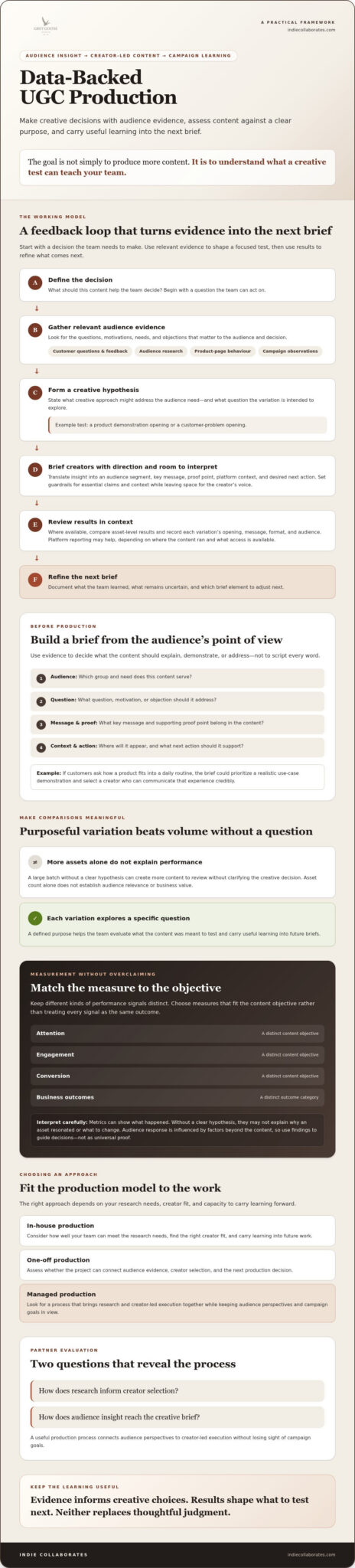
A useful feedback loop connects what a team knows before production with what it learns after launch. Define the decision the content should support, gather relevant evidence, form a testable hypothesis, brief creators, review the results and refine the next brief. Every creative test should begin with a question the team can act on.
Pre-production research and post-launch performance signals serve different purposes. First-party data, such as product-page behaviour or customer enquiries, can show where people need more information. Customer feedback can reveal how they describe a need or objection in their own words. Campaign observations help the team assess how published variations performed in their particular context. This is one practical application of data-driven marketing: using evidence to inform strategy, not replace judgement.
Turn audience evidence into a focused creative brief
Translate the evidence into a brief that identifies the audience segment and the question, motivation or objection the content should address. Specify the key message, supporting proof point, platform context and desired next action. If feedback shows that people are unsure how a product works, for example, the brief might prioritise a clear demonstration over a broad brand introduction. Give creators guardrails for essential claims and context, while leaving room for their voice and interpretation.
Connect campaign signals to the next production decision
Once content is live, review asset-level results where available. Record the context for each variation, including its opening, message, format and audience. Meta Ads Manager, TikTok analytics or other platform reporting can help teams examine relevant signals, depending on where the content ran and what access is available. Don’t treat one result as a definitive explanation. Document what the team learned, what remains uncertain and which brief element to adjust next.
- Define: What decision should this content inform?
- Research: Which audience evidence is relevant to that decision?
- Hypothesise: What creative approach might address the audience need?
- Brief and evaluate: What should creators deliver, and which signals will help assess it?
- Refine: What should change, stay consistent or be explored in the next brief?
In Data backed UGC production, the learning record is as valuable as the individual asset. Linking research, brief choices and performance observations helps teams build on evidence without assuming one result will apply everywhere. Brands looking to connect creator insight with production can explore creator-led UGC production as part of their process.
Which UGC Production Approach Fits Your Evidence and Goals?
The right production model depends on where your team needs support. An in-house team may already have audience insight and production capacity. A one-off commission can suit a tightly defined need. Managed creator-led production can coordinate research, sourcing and execution. As UGC increasingly functions as a performance channel, the useful question is not simply how to make more content, but how to connect creative decisions with evidence and learning.
Decision rule: Choose the approach that fills your biggest gap across research, production and measurement, while giving your team a practical way to carry learning into the next brief.
Use this comparison to assess fit, not to assign a universal winner:
- In-house production: Research is strongest when the team can access and interpret audience evidence. Creator fit depends on internal sourcing, while consistent briefing and continued learning rely on clear team processes.
- One-off creator commissions: A focused brief can make creator fit and delivery straightforward for a narrow content need. Research depth and continued learning may vary, especially when each commission is managed separately.
- Managed creator-led production: A suitable partner can coordinate audience and creator research with production. Assess how the partner explains creator fit, carries insight into briefs and supports your approach to evaluating content.
When in-house or one-off creator production may be enough
In-house production can work well when your team understands the audience, has the skills and capacity to create content, and can maintain a consistent brief and review process. One-off commissions may suit a specific, well-defined asset, such as a demonstration of one product feature. The main risk is fragmented learning. If the brief, variation and outcome aren’t recorded together, the next project may start from scratch.
When managed data-informed production adds value
Managed production may add value when research, creator sourcing and content development need coordinated ownership. Ask a prospective partner what evidence informs creator selection and how audience insight shapes the brief. Indie Collaborates combines audience and creator research with creator-led UGC production. Its content is created for uses including paid ads, organic social and creative testing. For channel-specific considerations, refer to the existing guide to high-performing UGC for paid social.
Whichever model you choose, define who owns the brief, how creator input is incorporated and where the team records what it learns. That continuity matters more than choosing a production model based on asset volume alone.
How to Measure Data-Backed UGC Without Mistaking Correlation for Proof
Start with the content objective, then choose measures that reflect the response you want. A video designed to build awareness needs different indicators from one intended to encourage a product-page visit or purchase. In Data backed UGC production, a metric is useful when it helps assess the creative hypothesis, not simply because it appears in a platform dashboard.
Keep measurement categories distinct. Attention can be assessed through relevant reach or viewing signals. Engagement includes responses such as comments, saves or shares, depending on the platform. Conversion measures actions such as clicks or purchases where tracking is available. Downstream business measures, such as revenue or customer retention, sit further along the customer journey and may be influenced by many other factors. These signals can inform one another, but they aren’t interchangeable.
Choose metrics that match the creative hypothesis
If the hypothesis is that a clear opening helps more of the intended audience keep watching, use viewing signals available on the chosen platform. If the goal is to prompt consideration, meaningful engagement or click-through may be more relevant. For a conversion-focused asset, review tracked conversion signals alongside the campaign objective and measurement setup.
UTM parameters can help identify campaign traffic in Google Analytics 4 when they suit the setup. Check that tagging, links and analytics configuration are in place before launch. Missing or inconsistent tracking can make results difficult to interpret, even when the creative itself is clear.
Use creative testing to make cautious decisions
Test a defined creative element, such as the opening line or proof point, while keeping other conditions as consistent as practical. Record the audience, placement, spend context and observation period alongside results. A difference between two assets may reflect the creative, but it could also reflect the offer, delivery conditions or audience exposure.
One test can provide a useful signal, not universal proof. Avoid claiming that a creative change caused an outcome unless the test design supports that conclusion. For broader context on interpreting campaign returns, refer to the existing guide on measuring influencer marketing ROI.
- Before launch: Write down the objective, hypothesis and primary measure.
- During review: Compare like with like and note any differences in delivery or context.
- After review: Record what the results suggest, what remains uncertain and what to test next.
Clear measurement depends on suitable creative and a thoughtful evaluation process. Explore creator-led UGC production to see how audience insight and creator input can inform content for creative testing.
How to Evaluate a Data-Backed UGC Production Partner
A partner should explain the connection between audience evidence, creator choice and the content brief, not just how assets are produced. Use a simple evaluation sequence: review the research approach, assess creator fit, examine how briefs are developed, clarify production and review steps, then agree how learning will be captured.
Reporting needs particular care. Ask how the proposed scope distinguishes assets delivered from platform results and broader business outcomes. These are different layers of information, and responsibility may sit with different teams or tools. Clarify what the partner reports, what your team measures internally and what campaign data you’ll need to provide. This helps prevent assumptions about measurement from becoming a gap after production begins.
Questions to ask before commissioning UGC
Before confirming a brief, ask how the partner gathers audience and creator insight, what evidence informs creator selection, and how those insights shape the creative direction. Then confirm the practical scope: intended platforms, deliverables, usage needs, review steps and reporting ownership. Finally, check that the proposed process fits your team’s capacity to analyse results and use them in future campaign decisions.
- Research: What audience and creator insight informs the approach?
- Creator fit: How are creators matched to the audience, message and content context?
- Briefing: How are the key insight, message and proof points shared with creators?
- Production: What deliverables, platforms and review steps are included?
- Learning: What is reported, by whom, and how can results inform the next brief?
How Indie Collaborates connects research and creator-led production
Indie Collaborates’ UGC production incorporates creator insights and audience-segment research into creator-led content development. Content can support paid ads, organic social and creative testing. The IC Inner Circle is a vetted community of over 1,600 creators that can support creator sourcing.
As you assess Data backed UGC production, look for a clear explanation of how research informs creator selection and the brief, along with an agreed boundary between production and campaign measurement. A strong fit complements your team’s workflow while leaving creators room to deliver the message in their own voice.
Explore Indie Collaborates’ UGC production and discuss the content objectives your team wants to address.
Make Your Next UGC Brief More Evidence-Led
Better creative decisions start before production. Define what you need the content to do, use audience evidence to guide the brief, and give creators room to bring their own voice and perspective. Then assess results against the objective, keeping attention, engagement, conversions and wider business outcomes distinct.
Data backed UGC production isn’t about treating one campaign result as proof that a creative approach will always work. It creates a clearer learning cycle: research informs the work, measurement offers signals, and those signals help shape the next decision. When choosing a production partner, check how insight informs creator selection and briefs, and agree what reporting the process includes.
Indie Collaborates brings creator insights and audience research into UGC production for paid ads, organic social and creative testing. If your team wants to connect audience understanding with creator-led execution, explore creator-led UGC production with Indie Collaborates. Start with one clear question, then build on what audience and campaign evidence can teach you.
Frequently Asked Questions
What is data-backed UGC production?
Data-backed UGC production is creator-led content production informed by audience or campaign evidence and assessed against a defined objective. Evidence can shape the intended audience, message, creator brief and later creative decisions. It doesn’t mean data writes the content or guarantees results. The process is most useful when a team records what it learns and uses that learning to make a specific next decision, such as refining a brief or testing a different content angle.
How do you measure the performance of UGC content?
Start with the content objective, then choose platform and business measures that reflect the response you want. Awareness, engagement, clicks and conversions describe different outcomes, so don’t treat them as interchangeable. Where possible, review asset-level results alongside audience, placement and campaign context. Tracking tools may help connect content to actions, but attribution has limits: one result alone doesn’t prove that the creative caused the outcome.
Which metrics matter most for UGC ads?
The most useful metrics depend on the campaign objective and the decision your team needs to make. Reach or viewing signals may help assess awareness, while clicks and conversions can be relevant to response goals when tracking is available. Interpret each measure in context, including platform, audience and campaign conditions. A metric matters when it helps your team decide what to retain, revise or investigate, not simply because it’s visible in a dashboard.
Can data-backed UGC still feel authentic?
Yes. Research can clarify audience needs and guide a brief without dictating every word or gesture. Share relevant product facts, the intended audience, message boundaries and content objective, then leave room for the creator’s own language and perspective. Authenticity can’t be established by a metric alone. Review whether the content feels credible, fits the creator’s voice and speaks to the audience in a relevant way.
How can a brand test different UGC concepts?
Begin with a clear hypothesis about one creative element, such as the opening, message or format. Change that element while keeping other conditions as consistent as practical, and record the audience and placement. Use relevant platform reporting to assess the result, while noting what remains uncertain. Treat a test as evidence for the next decision, not a universal rule. For more detail, see the guide to UGC creative testing strategy.
Should a brand produce UGC in-house or work with a production partner?
In-house production may suit a team with established audience research, creator relationships and production capacity. A partner may help coordinate creator insight, sourcing, briefing and content delivery when those capabilities are limited or need to work together. Compare the proposed scope, learning process and reporting responsibilities with your team’s workflow. Choose the model that fits your needs, rather than assuming either approach will guarantee stronger performance.
