
What if creator selection, content production and campaign reporting worked as one connected process instead of separate tasks? For brands coordinating internal teams, creators and platforms, End to end influencer marketing services can bring those moving parts together, from the strategic brief to performance review. The aim isn’t simply to get content published. It’s to connect each decision to a clear business objective.
That coordination matters when creator research takes time, content production lacks a consistent process, or campaign results are difficult to interpret. A managed approach can connect audience insights with planning, creator partnerships, delivery and reporting, while keeping the brand’s goals at the centre. Influencer campaigns, scalable UGC production and affiliate programmes can each meet different needs, but each requires clear direction and useful measurement.
This article explains what end-to-end campaign management covers, how to assess whether the model suits your needs, and what your team should contribute, from audience priorities to approvals and success measures. You’ll also learn how to prepare a campaign that connects creators, content and execution with meaningful business outcomes, then use performance insights to inform future decisions.
Key Takeaways
- End to end influencer marketing services connect creator research, campaign execution and performance learning in one coordinated workflow.
- Set clear objectives and audience priorities early, and agree which campaign decisions your brand needs to own.
- Assess accountability beyond reach and engagement by looking at deliverable tracking, reporting and how teams use campaign learnings.
- Prepare essential inputs, including internal owners and approval processes, then refine campaign details collaboratively during planning.
- Choose the right mix of influencer campaigns, UGC and affiliate activity to support your marketing objectives.
Why End-to-End Influencer Marketing Services Matter for Brands
Creator activity can look busy without advancing a clear business objective. A creator may publish an appealing post, but if the brief, audience choice and success measures aren’t aligned, the brand can be left with content and engagement that are difficult to interpret or act on. End-to-end influencer marketing services connect those decisions, so creator work is planned as part of a campaign rather than treated as a series of isolated placements.
Gaps often appear at hand-offs. One team identifies creators, another writes the brief, stakeholders review content across separate channels, and reporting arrives after campaign details have become difficult to reconstruct. The brand then spends time reconciling versions, chasing approvals and matching posts to results. Clear coordination can reduce avoidable work and improve oversight, though it can’t guarantee a particular commercial outcome.
What brands mean by end-to-end influencer marketing
At its core, the model connects planning, creator partnerships, campaign delivery and performance review. Creator research and content planning should start with the agreed objective, whether that’s building awareness, supporting a launch or producing assets for further testing. Creator selection and campaign activity should serve that purpose, not simply add another post to the content calendar.
Influencer marketing can take different forms, but managed campaign services focus on creator and campaign work: defining the approach, coordinating delivery and reviewing performance. This differs from social account management, which concerns a brand’s ongoing channel operations, and traditional PR, which focuses on media relations. A joined-up creator campaign doesn’t mean every marketing function sits within one service.
Where fragmented campaign execution creates friction
Unclear ownership slows even straightforward tasks. If the brand, agency and creator each assume someone else owns a decision, a brief can stall, feedback can arrive in conflicting versions, or a deliverable can be missed. Agreeing who sets objectives, consolidates feedback and signs off content gives everyone a clear route from planning to publication. The brand retains key business decisions, while campaign coordination keeps the work moving between them.
Fragmentation can also weaken learning. If creator selection, content requirements and reporting are handled separately, a team may struggle to connect a creative choice with the response it received. The next campaign then starts with scattered notes rather than usable insight. A connected workflow makes it easier to review delivery against the original objective and carry relevant observations into future planning.
In practical terms, end-to-end campaign management coordinates the work from objectives and creator selection through delivery and review, while keeping brand decisions and accountability clear. That’s the difference between buying isolated creator posts or content assets and managing a campaign with a defined purpose. Integration creates a more coherent process, not a promise of reach, sales or any other specific result.
Influencer Marketing: From Brief to Learning
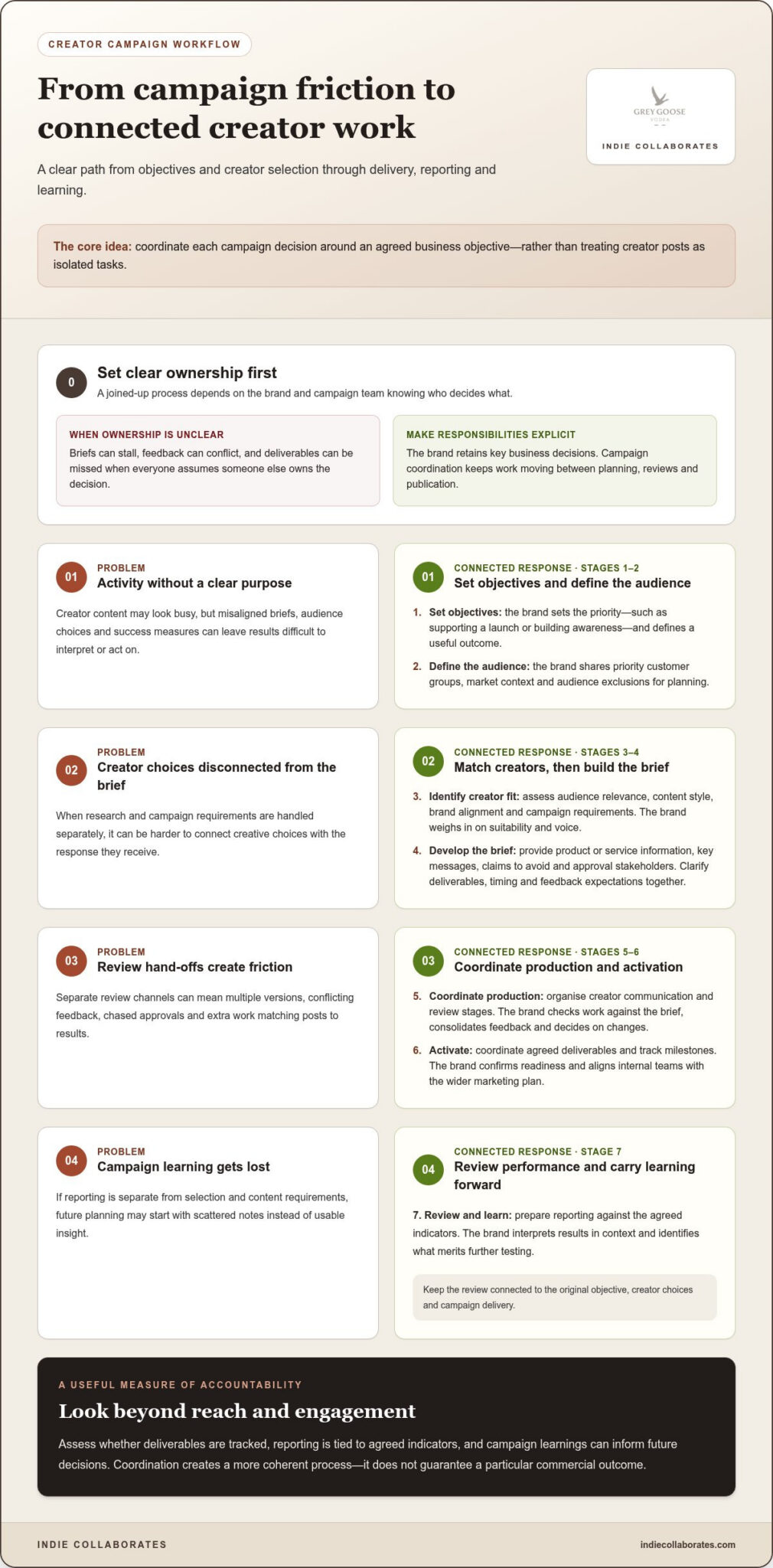
A well-run creator campaign connects decisions instead of treating the work as a list of unrelated tasks. At each stage, the campaign team can organise research, communication and delivery; the brand supplies business context, makes strategic choices and approves work. End to end influencer marketing services are most useful when those responsibilities are clear from the start.
Here’s how the lifecycle works, and where the brand’s input matters:
- Set objectives. The campaign team helps translate the business goal into a focused purpose and relevant indicators of progress. The brand sets the priority, such as supporting a launch or building awareness, and defines what a useful outcome means.
- Define the audience. Audience research and relevant insights inform campaign planning. The brand contributes its priority customer groups, market context and any audience exclusions that should guide the work.
- Identify creator fit. Research potential creators against audience relevance, content style, brand alignment and campaign requirements. The brand weighs in on suitability, category considerations and the qualities that feel right for its voice.
- Develop the brief. Set out campaign requirements so creators have clear direction. The brand provides essential product or service information, key messages, claims to avoid and approval stakeholders. Together, clarify deliverables, timing and feedback expectations.
- Coordinate production. Organise creator communication, content requirements and review stages. The brand reviews work against the agreed brief, consolidates feedback and makes decisions on changes, rather than leaving creators to resolve conflicting comments.
- Activate the campaign. Coordinate agreed deliverables and track milestones. The brand confirms readiness, aligns relevant internal teams and ensures campaign activity supports the wider marketing plan.
- Review and learn. Prepare performance reporting against the agreed indicators. The brand interprets results in context, identifies what merits further testing and helps shape the next brief or creator choices.
This division of work keeps collaboration practical: the campaign team creates structure around the process, while the brand remains accountable for its objectives, approvals and business decisions. Clear inputs early on can prevent late changes. For example, confirming who can approve messaging before production starts gives creators a consistent route to feedback.
Review should connect measures to purpose. If awareness is the priority, relevant indicators may differ from those used to assess audience response or content suitability for further use. Reach and engagement can add context, but they shouldn’t replace the measures agreed for the campaign. A performance-based influencer marketing framework can help teams consider how objectives, compensation and measurement fit together.
Reporting should inform the next cycle. Record which audience insights shaped creator selection, which content approaches aligned with the brief and where execution could be clearer. That learning gives the next campaign a stronger starting point without assuming that past performance guarantees future results. Brands seeking coordinated planning and delivery can explore managed creator campaign services as one way to organise this process.
How to Assess Accountability Beyond Reach and Engagement
Reach and engagement can show that creator content attracted attention, but they don’t explain on their own whether campaign activity supported the brand’s objective. To assess accountability, look for clear ownership, agreed measures and reporting that helps the team decide what to do next. End to end influencer marketing services should make responsibilities and measurement visible, not hide them behind a single report or agency relationship.
What accountable campaign management should make visible
Before work begins, the brand and campaign team should know who owns the brief, creator coordination, approvals, deliverable tracking and reporting. The brand remains responsible for business priorities and key decisions; coordinated management makes hand-offs and progress easier to follow. Indicators should fit the objective: awareness may call for different evidence than consideration or conversion. Agree on definitions and available data before launch so results can be interpreted in context.
Activity metrics show what happened; business-relevant indicators show whether campaign activity supported its agreed purpose.
How to compare integrated and fragmented operating models
The distinction is practical. In a fragmented setup, each hand-off can create gaps in ownership or documentation. In an integrated workflow, agreed responsibilities, creator details, deliverables and reporting criteria stay connected. Use this comparison to assess how a campaign is organised, not to assume that a particular operating model guarantees performance.
| Area | Disconnected execution | Integrated, accountable workflow |
|---|---|---|
| Ownership | Briefing, approvals and creator communication sit with different people, with unclear hand-offs. | Owners and decision-makers are identified for each stage. |
| Creator fit | Selection may be based on availability or surface-level audience size, with limited connection to the objective. | Audience relevance, content style and campaign requirements guide creator evaluation. |
| Deliverable tracking | Requirements and status updates are scattered across messages or documents. | Agreed deliverables, approvals and milestones are documented in a shared workflow. |
| Reporting cadence | Results arrive without clear links to the brief or agreed indicators. | Reporting follows the agreed measures and gives teams context for reviewing progress. |
| Applying learning | Observations remain informal, so the next campaign starts with limited continuity. | Teams record useful findings and apply them to future briefs and creator choices. |
Documentation is more than administration. A current brief, consolidated feedback and a record of deliverables help brand and creator teams work from the same information. They also make it easier to understand what a report can and can’t tell you. Attribution isn’t always certain: measurement depends on the campaign objective, the indicators agreed in advance and the data available. Reporting should explain those limits rather than imply every outcome can be traced to a single creator.
For a deeper look at measurement approaches, the article on measuring influencer marketing ROI can help teams consider how to assess campaign value. The immediate test is practical: can everyone involved explain who owns each decision, what success is being assessed against and how the findings will inform the next campaign?
Preparing Your Brand for End-to-End Creator Campaigns
A campaign is easier to plan when your team agrees on what it needs to achieve and who can make decisions. Before briefing creators, align the business objective, audience, key message and internal approval process. These foundations help a campaign partner develop a workable plan while leaving room to refine creator selection and content ideas together. End to end influencer marketing services work best when the brand arrives with clear priorities, not a script for every creative choice.
Set campaign priorities and internal responsibilities
Start with a short set of essential inputs. Name one primary objective, describe the audience you want to reach, identify the central message and note any practical or brand constraints. Then assign an internal owner for feedback and a final decision-maker for approvals. If legal, product or other internal teams need to review content, identify their role early and consolidate their input through a clear process.
Other details can take shape during planning. Creator profiles, content concepts and the precise mix of deliverables can be developed collaboratively once the campaign partner understands the brief. The brand should set boundaries, such as required messages and claims to avoid, while creators bring their own voice and perspective. The aim isn’t to remove oversight or dictate every line. It’s to give creators a clear framework for making content that feels natural and remains aligned with the campaign.
Choose the right creator service mix for the brief
Match the format to the work the campaign needs to do. Influencer partnerships may suit a brief centred on creator-led storytelling and audience connection. UGC production can be relevant when the priority is developing creator-made assets for paid advertising, organic social or creative testing. Affiliate activity may fit an ongoing creator-driven sales focus, where recruitment and programme structure support that objective. These approaches can complement one another, but the brief should explain why each is included.
If you’re considering more content volume or structured creative testing, a scalable UGC production guide can help you explore that need in greater depth. For a sustained focus on creator-driven sales, a managed creator affiliate salesforce guide is a useful next topic. Keep the campaign brief focused on the decision at hand; detailed channel mechanics can be worked through during planning.
Before kickoff, check that the team can answer four questions: What is the campaign meant to support? Who is it for? Who approves the work? Which creative decisions can creators shape? Clear answers help planning move forward with fewer avoidable revisions and a better balance between brand safeguards and creator expression.
Indie Collaborates brings creator strategy and managed campaign coordination together to help brands turn those inputs into an organised brief and delivery plan. Plan a managed creator campaign around your business priorities.
How Indie Collaborates Connects Influencer Campaigns, UGC, and Affiliate Services
Creator services work best when each has a defined role in the brand’s plan. A campaign partnership, a set of creator-made assets and an affiliate programme all involve creators, but they address different needs. Indie Collaborates connects these options with creator strategy and campaign performance reporting, helping brands choose an approach based on their objectives rather than treating every creator activity as interchangeable.
Match the service to the campaign need
Managed influencer campaigns suit brands seeking planned creator partnerships with campaign-level coordination. Creator research and strategic planning help align the partnership with the intended audience and campaign purpose, while performance reporting gives the team a basis for reviewing activity against agreed objectives.
UGC production is relevant when a brand needs creator-led content for paid advertising, organic social or creative testing. The focus is producing assets for those uses, rather than assuming every piece of UGC is also an influencer endorsement or campaign placement. Brands can define the content need and intended use, then shape the creative direction collaboratively.
Affiliate programme management supports sustained creator-driven sales activity. Its components include creator recruitment, tiered commissions and payout tracking. This is a different operating model from a campaign centred on a specific set of creator partnerships, even though both can contribute to a broader marketing plan.
These services can be considered separately or in combination, depending on the brief. A brand may prioritise creator partnerships for a campaign, need UGC assets for testing, or focus on an ongoing affiliate programme. The useful question is which activity supports the objective and how the work will be reviewed, not simply how many formats can be included.
What a connected partner relationship can support
Indie Collaborates’ IC Inner Circle includes more than 1,600 vetted creators, providing a community for relevant creator research and campaign planning. That community sits alongside the work of understanding the brief, coordinating campaign execution and reviewing performance. Clear objectives and brand input guide which creators and service mix are relevant, while reporting helps inform future decisions.
Indie Collaborates provides managed influencer campaigns, creator content strategy and performance reporting, scalable UGC production for paid advertising, organic social and creative testing, and affiliate programme management with creator recruitment, tiered commissions and payout tracking.
This gives brands a practical way to connect services without blurring their purpose. End to end influencer marketing services can link creator research, strategy, delivery and performance learning, while UGC and affiliate activity support their own defined campaign needs. The right mix depends on the brand’s objective and the inputs it brings to planning.
Discuss an end-to-end creator campaign with Indie Collaborates.
Make Your Next Creator Campaign a Clearer Step Forward
Your next move doesn’t need to be a larger campaign. Start by choosing one business priority, deciding what evidence would help you assess progress, and identifying who will make key decisions. That gives your team a practical foundation for exploring End to end influencer marketing services and shaping a creator plan around what the business needs now.
Bring those priorities into a discussion with Indie Collaborates. A focused conversation can help clarify which campaign approach fits, what your team needs to prepare, and how planning can connect to meaningful review. The objective isn’t to remove every uncertainty from creator marketing; it’s to make informed decisions and build a process your team can learn from.
Discuss an end-to-end creator campaign with Indie Collaborates and take the first step towards a more deliberate creator strategy. With clear priorities and the right collaboration, your next campaign can give your team a stronger basis for what comes after.
Frequently Asked Questions
Is end-to-end influencer marketing suitable for a small brand?
Yes, End to end influencer marketing services can suit a small brand when the scope fits its goals, resources and campaign complexity. A lean team preparing a product launch, for example, might benefit from creator research and briefing support while handling approvals internally. Another brand may need help with only a specific stage. Start by defining the campaign goal, then shape the level of support around the work your team can realistically manage.
How much do end-to-end influencer marketing services cost?
There’s no single fee for every campaign because cost depends on scope, complexity, creator requirements, content needs and management responsibilities. Compare proposals by mapping the work included, how creator compensation is treated, what reporting is provided and which tasks stay with your team. Make sure you’re comparing similar scopes: a coordination fee for a focused activation isn’t directly comparable with a broader programme that includes content production and ongoing management.
Can influencer marketing services include affiliate marketing?
Yes, an influencer campaign can be paired with an affiliate programme when a brand wants to develop ongoing creator-led sales activity. For example, a defined campaign could introduce an offer while an affiliate arrangement supports continued promotion beyond that activation. They serve different purposes, so clarify whether your priority is a specific campaign or a continuing sales channel. The programme structure should suit how your team plans to manage creator relationships and evaluate sales activity.
What happens if creator content does not perform as expected?
Review the result against the campaign’s original purpose before deciding what to change. A post with modest engagement may still offer useful learning about its message, format or audience response. Compare the creative with the brief, examine the performance data available and note any distribution factors that may have shaped the result. Then choose one specific element to adjust in a future activation. Treat each result as evidence to assess, not a promise that the next version will perform better.
How long does it take to launch an influencer marketing campaign?
Launch timing varies according to campaign scope, creator selection, content requirements, approvals and scheduling. A single activation with a straightforward review path may involve fewer dependencies than a multi-creator programme with several deliverables. Work backwards from your target launch date: identify approval owners, content review points and any materials creators need, then build a schedule around those dependencies. This helps surface bottlenecks early without relying on a universal campaign timeline.
Is influencer marketing only useful for product launches?
No, creator partnerships can support objectives beyond launches, such as explaining a product feature, answering common audience questions or sustaining attention around an established brand. For instance, a brand could brief creators to make a complex use case easier to understand rather than announce something new. Decide what you want the audience to understand, feel or do, then choose a suitable creator approach and measures that reflect that purpose.
