
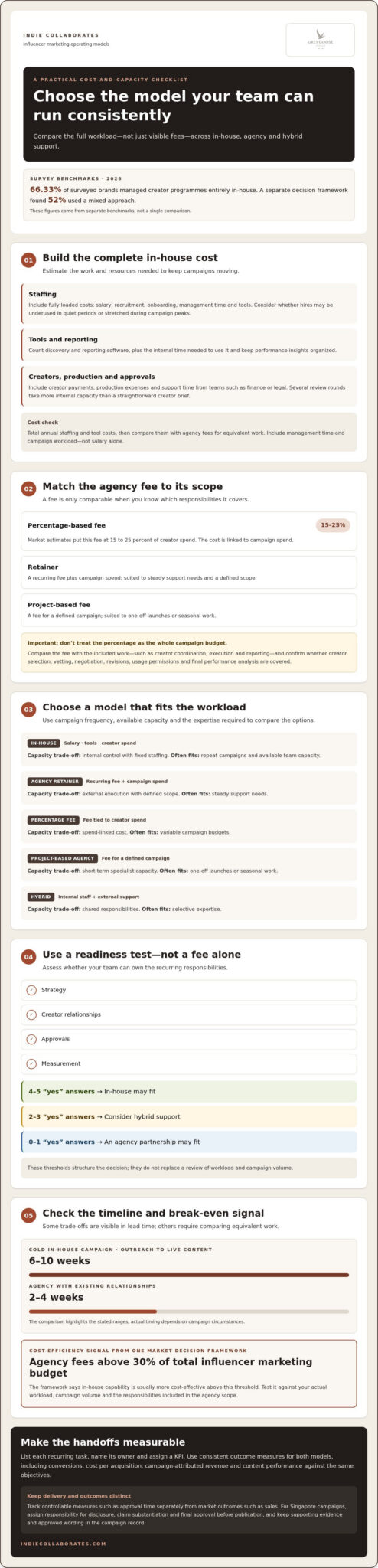
The best choice is the model your team can run consistently, not automatically the one with fewer visible fees. In 2026, 66.33 percent of surveyed brands managed creator programmes entirely in-house. A useful in-house vs agency influencer marketing cost benefit analysis weighs that option against the agency’s capacity and specialist support.
Cost matters, but a useful comparison goes beyond salary and agency fees. Internal time, creator workflows, campaign volume, reporting needs and ownership of programme data all affect the value each model delivers.
This comparison explains the trade-offs, from creator discovery and production to performance reporting. You’ll see when an in-house team, an agency or a hybrid setup may fit, then use a practical decision guide to match the approach to your brand’s resources and goals.
Key Takeaways
- Compare the full operating cost of each model, including staff time and the work needed to keep campaigns moving.
- Match your setup to your team’s capacity: build internally, outsource execution, or split responsibilities through a hybrid approach.
- Assess where specialist support can strengthen creator discovery, vetting, production and reporting without adding unnecessary internal workload.
- Set clear campaign handoffs and data access so your team can retain continuity and use performance insights effectively.
Agency costs and cost efficiency for smaller brands
In Singapore, in-house influencer marketing costs depend on salaries, tools and campaign expenses, not a single standard total. Spending varies with role scope, software needs, creator fees and campaign volume. A practical in-house vs agency influencer marketing cost benefit analysis starts by separating these cost categories.
Build your estimate from three parts: fully loaded staffing costs, discovery and reporting tools, and creator payments plus production expenses. Include time from teams such as finance or legal when they support approvals. A campaign with several review rounds, for example, uses more internal capacity than a straightforward creator brief.
Agency fees may use retainers or a percentage of creator spend. Market estimates put percentage-based fees at 15 to 25 percent of creator spend. Compare that fee with the responsibilities covered, such as creator coordination, execution and reporting. Don’t treat the percentage as the whole campaign budget.
| Option | Cost basis | Capacity trade-off | Best fit |
|---|---|---|---|
| In-house | Salary, tools, creator spend | Internal control; fixed staffing | Repeat campaigns and available team capacity |
| Agency retainer | Recurring fee plus campaign spend | External execution; defined scope | Steady support needs |
| Percentage fee | Fee tied to creator spend | Spend-linked cost | Variable campaign budgets |
| Project-based agency | Fee for a defined campaign | Short-term specialist capacity | One-off launches or seasonal work |
| Hybrid | Internal staff and external support | Shared responsibilities | Selective expertise |
Fully loaded staffing costs go beyond salary. Include recruitment, onboarding, management time and tools. A hire may be underused during quieter periods, while a small team may struggle during campaign peaks.
To compare options, total annual staffing and tool costs, then compare them with agency fees for equivalent work. One market decision framework says in-house capability is usually more cost-effective when agency fees exceed 30% of the total influencer marketing budget. Use the in-house vs agency influencer marketing cost benefit analysis to test that threshold against your workload and campaign volume.
Choose the option that covers the actual workload at a sustainable cost, not just the lowest visible fee.
In-house or agency: who should run your influencer marketing?
Base your choice on recurring workload, internal skills and the level of control your team needs. In Singapore, make paid relationships clear, support advertising claims with evidence and review content before publication.
Build-versus-Buy Decision Frameworks
Building means investing in people, processes and creator relationships that remain inside the business. Buying agency support gives you external execution capacity without assigning every campaign task to employees. A 2026 benchmark reported that 66.33 percent of surveyed brands managed creator programmes entirely in-house, while a separate decision framework found 52 percent used a mixed approach.
Use a readiness test to assess whether your team can own strategy, creator relationships, approvals and measurement. If four to five answers are yes, an in-house model may fit; two to three suggest hybrid support, while zero to one points towards an agency partnership. These thresholds help structure the decision, but do not replace a workload review.
In-House and Agency KPIs
In-house KPIs should show whether internal capability is becoming more effective. Track on-time campaign delivery, repeat creator relationships, cost per acquisition and team hours per activation. For agencies, measure delivery quality and agreed outputs alongside campaign results, reporting completeness and responsiveness to approved briefs.
Use consistent outcome measures for both models. Compare conversions, cost per acquisition, campaign-attributed revenue and content performance against the same objectives. Separate controllable delivery measures, such as approval time, from market outcomes, such as sales, so teams are not judged on factors they cannot directly control.
The CMO Survey reported a median 25 percent share of digital marketing activities performed by external agencies, partners and services. That figure describes digital marketing broadly, not a target for influencer programmes. Use it as context, then compare your team’s actual workload and required expertise.
Singapore campaign briefs should assign responsibility for disclosure, claim substantiation and final approval before creators publish. Keep supporting evidence and approved wording in the campaign record so internal reviewers and external partners follow the same process.
For a final decision, list each recurring task, name its owner and assign a KPI. Choose an in-house, agency or hybrid model based on where capability and accountability can sit most clearly.
Creator discovery, vetting, production and reporting
For Singapore campaigns, compare agency speed and creator access with the time your team needs to build relationships. A cold in-house campaign can take 6 to 10 weeks from outreach to live content, compared with 2 to 4 weeks for an agency with existing relationships. That difference matters when a launch date is fixed.
Agency fees may cover creator discovery, vetting, negotiation, campaign coordination, production and reporting. Deliverables depend on the agreed scope, so compare responsibilities line by line. Confirm whether creator selection, content revisions, usage permissions and final performance analysis are included.
Annual creator spend alone does not determine the break-even point. Compare agency fees for the required workload with internal staffing, tools and management time. Then account for campaign frequency, creator volume and production complexity. An internal team may become more cost-efficient as recurring work grows, while project-based external support can suit fluctuating demand.
Discovery and vetting require research, audience-fit assessment and coordination. In a 2026 benchmark, creator discovery and vetting was the most commonly outsourced function, at 19.44 percent. Content production was second, at 15.28 percent. These figures point to specific functions brands may outsource, rather than proving that one model always performs better.
Creator relationships also shape negotiation and cash flow. Brands negotiating with an unrepresented creator for the first time may overpay by 20 to 40 percent. Stacked payment terms can extend a net 60 payment period to 150 days for creators. Map approval dates, invoice timing and payment responsibilities before a campaign begins.
Reporting is often easier to retain internally when a team already owns measurement systems. Reporting and analytics was the least outsourced function in the benchmark, at 6.9 percent. Keep campaign objectives, tracking definitions and result formats consistent across internal and agency work. That lets you compare creator performance and cost per acquisition without changing measurement methods between campaigns.
Data ownership and campaign handoffs
Before bringing influencer marketing in-house, agree who controls campaign records, creator communications and reusable content. In Singapore, document access, responsibilities and asset-use permissions in the campaign workflow and relevant agreements.
Start with a handoff inventory that includes creator contact history, selection rationale, briefs, approval records, agreed deliverables, usage permissions, payment status and performance reports. A new internal manager, for example, should be able to see which creator approved a draft, what edits remain and where final assets are stored.
Distinguish account access from ownership rights. A brand may hold campaign reports, while content-use permissions remain governed by the creator agreement. Record permitted channels, campaign periods and any limits in an accessible tracker, then assign an internal owner to each item.
For a Singapore business transitioning from an agency, transfer work in stages: map recurring tasks, assign internal owners, document processes and run a campaign with shared responsibilities. Review the handoff after each campaign, addressing gaps in access, approvals or reporting before the next stage.
Seasonality should shape the operating model. Brands with 70% or more of sales in Q4 may benefit from agency flexibility to scale resources for peak periods. An internal team can retain strategy and ongoing creator relationships, while external support absorbs production or coordination spikes.
Use a handoff checklist before each campaign launch:
- Confirm who can access creator records, campaign files and reporting dashboards.
- Record approval owners, deadlines, payment status and escalation steps.
- Store final content with its usage permissions and performance results.
- Schedule a post-campaign review to update the process and responsibilities.
Clear ownership protects continuity when staff or partners change. To plan a campaign workflow with defined responsibilities, map your influencer campaign handoff.
Indie Collaborates: Influencer Marketing Campaigns
Indie Collaborates can support teams that need campaign execution, creator content or affiliate support without building every capability in-house. Its Influencer Marketing Campaigns provide external campaign management, while Scalable UGC Production develops creator-led content for campaign needs.
For a more focused need, Creator Content Strategy can shape the approach, and Campaign Performance Reporting can support clearer measurement. Affiliate Programmes provide another option when creator partnerships need to contribute to tracked sales activity. These services can suit teams with limited internal capacity or established teams seeking specialist support for selected work.
If you’re weighing internal ownership against external execution, contact Indie Collaborates to discuss your influencer marketing needs.
Make your next campaign a decision point
Treat your operating model as something to refine, not a permanent label. As campaign objectives, markets or internal priorities shift, revisit who should own each decision and where specialist support adds value. A practical in-house vs agency influencer marketing cost benefit analysis can guide that discussion, while evidence from your campaigns helps shape the next decision.
Before the next brief moves forward, agree on what success means, who approves the work and how results will inform the next campaign. This gives you a clear basis for adapting your approach without rebuilding the process each time. The right structure is one your team can sustain while continuing to learn.
Ready to discuss the approach that fits your needs? Contact Indie Collaborates and take the next step with confidence.
Frequently Asked Questions
How do in-house and agency influencer marketing costs compare at different campaign sizes?
For smaller or occasional campaigns, compare the full cost of internal coordination with the agency’s agreed scope, not just creator payments. As campaigns become more frequent, staff and tools may support repeated work, while external support can flex around specific projects. In Singapore, build each comparison in SGD and separate creator compensation, production, software and management costs.
What are the pros and cons of managing influencer marketing in-house versus hiring an agency?
In-house management gives you direct control over priorities, approvals and internal knowledge, but requires staff time and processes to keep work moving. An agency can provide campaign execution capacity and established workflows, though the brand must align briefs, approvals and measurement with an external team. A business with a small marketing team, for example, might keep approvals in-house while outsourcing campaign delivery.
How should businesses calculate influencer marketing ROI and compare cost per engagement or conversion?
Use the same campaign scope and attribution window for each model. Calculate cost per engagement by dividing total campaign cost by measured engagements; calculate cost per conversion by dividing total cost by attributed conversions. To calculate ROI, divide attributed revenue minus total campaign cost by total campaign cost. Include creator payments, production and staff time, and distinguish trackable sales from awareness outcomes.
When is it more cost-effective for a Singapore business to build an in-house influencer marketing team?
Building an in-house team makes more sense when recurring campaign work can keep dedicated staff productive and the business needs ongoing control of strategy, approvals and creator knowledge. Review the actual workload across a full planning cycle, including quieter periods and launch peaks. If specialist tasks are occasional, assign them selectively rather than creating permanent capacity the team cannot use consistently.
What hidden costs and risks should businesses account for when comparing in-house and agency influencer marketing?
Account for management time outside the campaign team, staff turnover, onboarding, delayed approvals and repeated content revisions. Consider operational risks too: unclear usage permissions can restrict content reuse, while weak tracking can make results difficult to attribute. Set responsibilities, approval stages and reporting definitions in writing before launch, and include them in both cost comparisons.
