
What if a campaign’s busiest report is still missing the result that matters? Influencer marketing for measurable results starts before the first post goes live. Views, likes and content volume show activity, but they don’t explain on their own whether a campaign built awareness, brought qualified visitors to your website or contributed to sales.
If you’ve struggled to connect creator content with business impact, you’re not alone. The right measures depend on what a campaign is designed to achieve and where your audience is in its decision-making journey. A clear objective gives every metric a purpose and helps teams assess performance without expecting one campaign to do everything.
This practical framework will help you set focused objectives, choose signals that reflect your intended outcome and connect content with meaningful next steps. You’ll also see how to use campaign reporting to identify what worked, refine creator partnerships and strengthen future activity. Connecting planning, creator selection, execution and analytics makes it easier to learn from each campaign and improve the next.
Key Takeaways
- Influencer marketing for measurable results begins with an objective tied to a real business outcome, not one metric applied to every campaign.
- Set the objective first, define the audience, choose relevant measures, then brief creators so each signal answers a clear campaign question.
- Compare attention, engagement, content and action metrics in context. A strong signal for one goal may say little about another.
- Record a baseline, monitor the agreed measures and review the surrounding context before deciding what to carry into your next campaign.
- Connect strategy, creator selection, execution and analytics reporting so campaign learning can inform future activity.
What does influencer marketing for measurable results actually mean?
Influencer marketing for measurable results means assessing a campaign against outcomes chosen in advance to support a stated objective, rather than treating one metric as proof of success. The right outcome depends on what the campaign is meant to do. A brand seeking greater awareness needs different evidence from one aiming to encourage consideration, produce reusable creator content or support sales.
For example, objectives could focus on:
- Awareness: Introducing a brand or offering to a relevant audience, with reach and views serving as signals of exposure.
- Consideration: Encouraging people to explore or learn more, with meaningful interactions or visits to a product page providing useful evidence.
- Content production: Developing creator assets for potential use across paid, owned and earned channels, then reviewing delivery and suitability against the brief.
- Sales: Prompting a purchase or other defined action, using trackable links, affiliate activity or attributed conversions where available.
These are different campaign purposes, not stages every campaign must follow. Influencer marketing can support varied applications, as outlined in this Influencer marketing overview. For each programme, choose measures that fit the objective, intended audience, platform and reporting needs. A signal that helps assess discovery on one channel may not show whether people considered an offer or acted on it elsewhere.
How are campaign outcomes different from campaign activity?
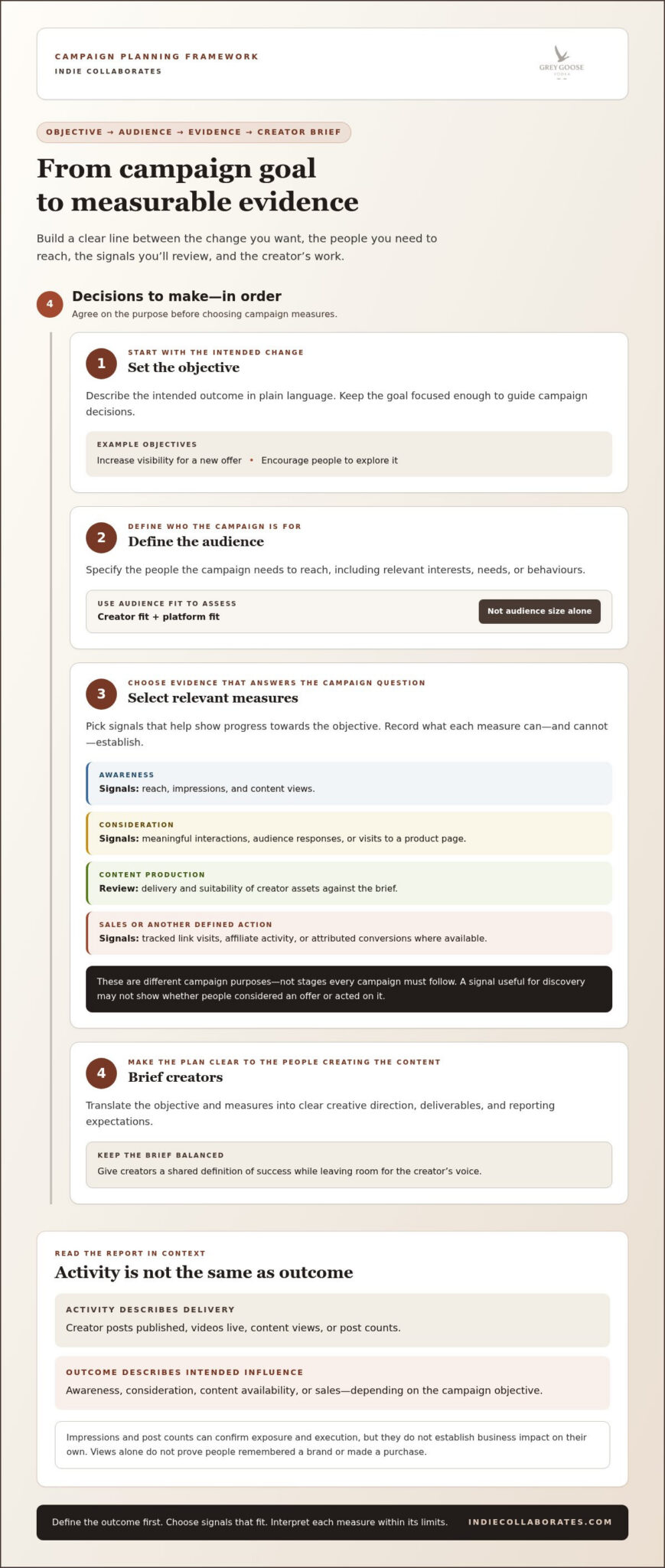
Activity describes what the campaign delivered: creator posts were published, videos went live or audiences saw content. Outcomes describe what the campaign intended to influence, such as awareness, consideration, content availability or sales. Keeping the distinction clear helps teams interpret reports instead of equating a busy campaign with a successful one.
Impressions and post counts can confirm exposure and execution, but they don’t establish business impact on their own. A high number of views doesn’t prove that people remembered the brand or made a purchase. Activity still provides useful context, particularly when reviewed alongside audience fit, content quality and the objective each post was designed to support.
Why should the campaign objective come first?
Start with the intended change, then agree on what evidence could reasonably indicate progress. This gives brand teams and creators a shared definition of success before content is developed. It also helps focus the brief and makes reporting easier to interpret, rather than selecting attractive metrics after a campaign and retrofitting them as proof.
For an awareness campaign, relevant evidence might include reach among the intended audience and views of creator content. For a conversion-focused campaign, a team may instead examine tracked link visits, affiliate activity or recorded purchases. Neither set guarantees a business result. Each answers a different question about campaign performance, and conclusions should reflect the evidence available.
That is the practical foundation of Influencer marketing for measurable results: define the outcome first, then select signals that show progress without confusing delivery with impact.
How to connect campaign objectives, measures, and creator briefs
A useful campaign plan creates a clear line from the business objective to the creator’s work and the evidence the team will review. Keep that line visible from planning through reporting. If a measure can’t help answer a specific question about progress, reconsider whether it belongs in the plan.
Work through these decisions in order:
- Set the objective. Describe the intended change in plain language, such as increasing visibility for a new offer or encouraging people to explore it. Keep the goal focused enough to guide decisions.
- Define the audience. Specify who the campaign needs to reach, including relevant interests, needs or behaviours. This helps teams assess creator and platform fit instead of relying on audience size alone.
- Select measures. Choose signals that help answer whether the campaign is progressing towards its objective. Record what each measure can show and what it cannot establish.
- Brief creators. Translate the objective and measures into clear creative direction, deliverables and reporting expectations, while leaving room for the creator’s voice.
Which measures fit awareness, consideration, and conversion goals?
For awareness, reach, impressions and content views can indicate visibility. For consideration, engagement and audience responses offer context about how people interacted with content, but don’t prove a change in intent. For conversion, tracked link visits, affiliate activity and sales-related reporting can help connect creator content with recorded actions. Choose measures based on the campaign question, not a universal benchmark.
Make each signal answer a question: Did the content reach the intended audience? Did people respond or seek more information? Were trackable actions recorded? This keeps reporting focused and makes gaps easier to diagnose. For deeper guidance on shaping content around a campaign goal, use this creator content strategy framework.
What should a measurable creator brief include?
A practical brief connects strategy with execution. State the objective and intended audience plainly, then explain the creator’s role: introducing a message, demonstrating an offering, answering an audience question or producing assets for wider channel use. Include the platform context, required deliverables, key brand-safety considerations and essential messaging. Clarify which measures the team will review, how results should be shared and when campaign learning will be discussed.
Be precise without scripting every detail. Creators need enough direction to understand the purpose and boundaries, alongside space to communicate naturally with their audience. Teams can bring these elements together through end-to-end influencer campaign planning, aligning the objective, creator selection, execution and reporting from the outset.
Which influencer marketing metrics show progress, and which can mislead?
A campaign report can contain plenty of numbers and still leave the central question unanswered: do these signals relate to the objective? Sort metrics by the kind of evidence they offer. Attention shows exposure, engagement captures responses, content measures assess the assets produced, and action tracks steps people take. One metric rarely tells the whole campaign story. Useful interpretation comes from connecting signals to the objective and their context.
| Signal type | Examples | What it can show | Where it can mislead |
|---|---|---|---|
| Attention | Reach, impressions, views | Whether content gained visibility and how broadly it was distributed. | Exposure alone doesn’t establish attention, audience relevance, purchase intent or sales. |
| Engagement | Comments, shares, saves, reactions | How audiences responded to or interacted with a post. | Interactions don’t necessarily indicate consideration or commercial impact. Their meaning depends on the content and audience context. |
| Content | Published assets, quality, suitability for reuse | Whether the campaign delivered content aligned with the brief and its intended channel role. | A post count doesn’t show whether assets are useful, on-message or appropriate for planned reuse. |
| Action | Tracked visits, affiliate activity, recorded sales | Whether measurable steps associated with the campaign were recorded. | Tracking gaps and other influences can limit what the data proves about why an action happened. |
What can awareness and engagement signals tell a brand?
Reach and impressions describe visibility, not proof that someone intends to buy. Engagement adds another layer: a thoughtful question or a relevant save may offer clues about audience interest, while a reaction count alone says little about motivation. Interpret responses alongside the creator, content and campaign aim. Platform definitions and reporting availability can differ, so don’t assume similarly named metrics are comparable across channels.
Engagement alone doesn’t prove commercial impact, but low engagement doesn’t automatically mean a campaign failed. If the objective is broad awareness, visibility may be more pertinent than comments. If the goal is audience response, examine the type and substance of interactions. In Influencer marketing for measurable results, a metric is evidence to interpret, not a verdict separate from its purpose.
How should teams interpret action and content signals?
For conversion-focused activity, tracked link visits, affiliate activity and sales-related reporting can show recorded actions associated with the campaign. Check what was tracked, over what period and whether the measure reflects the intended next step. These observations support a performance assessment, but don’t prove that creator content alone caused a purchase.
Content signals matter too. A team assessing creator assets can review whether they meet the brief, communicate clearly and suit their planned role across paid, owned or earned channels. Keep the distinction explicit: delivery and quality are campaign outputs; tracked audience actions are evidence of response. Together, they provide a more balanced view than either category alone.
How to review influencer campaign performance and turn learning into action
A useful review doesn’t stop at collecting platform results. It checks what the campaign set out to do, what the available evidence shows and what the team should adjust next. A consistent review process turns reporting into a decision-making tool and keeps conclusions proportionate to the evidence.
Use this sequence after a campaign:
- Establish a baseline. Record the relevant starting point before activity begins, such as existing audience visibility, engagement or tracked traffic. This gives the team a reference for comparison, not proof that any later change was caused by the campaign.
- Monitor agreed signals. Gather the measures selected during planning and use consistent definitions and reporting periods where possible. Note missing data or tracking changes instead of treating an incomplete view as a complete result.
- Review the context. Consider the creator, content format, platform, audience response and other relevant campaign conditions. A result may reflect several influences, so distinguish what was observed from what the team believes may explain it.
- Document learning. Capture the finding, the evidence behind it and a specific next step. This makes the review useful to the people planning creator selection, briefs and content direction for future activity.
How should a campaign report make results easier to interpret?
Organise the report around the original objective and the measures agreed for it. Present the results first, then add context, limitations and recommendations in clearly labelled sections. For example, report that tracked visits increased during the campaign as an observation. Don’t claim creator content caused the increase unless the evidence supports that conclusion. Concise, plain language helps stakeholders see both the signal and its limits.
A strong report connects each finding to a decision. If visibility was the priority, explain what the attention data indicates about exposure to the intended audience. If a tracked action was the goal, state what was recorded and where measurement coverage was limited. Deeper planning principles are explored in this performance-based influencer marketing framework.
How can teams use results to improve the next campaign?
Look for patterns worth testing, not instant rules. A creator’s audience response, a content format that held attention or a message that prompted questions may inform the next brief. Translate each insight into a clear adjustment, such as refining the audience description, testing a different opening or strengthening a call to action. Build on the learning through ongoing creator relationships, while evaluating each new campaign against its own objective.
Where content is a key output, scalable UGC production can develop creator-led assets for testing and a content library, then assess their suitability for planned channels. To connect campaign planning, execution and reporting, work with Indie Collaborates on influencer campaigns.
How Indie Collaborates connects creator campaigns with measurable outcomes
Strong campaign measurement depends on more than a report at the end. Strategy, creator selection, execution and analytics reporting need to work together, so each stage supports the campaign objective and gives the team useful evidence to review. Indie Collaborates manages influencer campaigns end to end, connecting planning and delivery with performance reporting.
That connection matters. A clear strategy sets the direction; creator selection aligns the partnership with the audience and campaign; execution brings the plan to life; and reporting helps teams understand what the campaign delivered. Brand-safety needs and measurement expectations can be considered as part of the process, rather than left until content is live. This creates a coherent foundation for Influencer marketing for measurable results, while recognising that reporting assesses performance, not guarantees a particular business outcome.
What does end-to-end influencer campaign management cover?
Strategy and creator selection establish the campaign foundation. Execution turns the plan into creator activity, while analytics reporting brings the results back to the original objectives. Because these stages are connected, campaign learning can inform future planning instead of sitting apart from creator partnerships and content decisions.
Effective campaigns also call for creative thinking and clear analysis. Ken Ong of Stanley praised Indie Collaborates’ creative ideas and detailed analytics reports. Those two elements serve complementary needs: content that can engage an audience and reporting that helps a team review campaign activity with greater clarity.
How can creator partnerships support ongoing growth?
One-off activity can serve a specific campaign, while longer-term creator relationships give brands and creators the opportunity to build on shared learning. Teams can use previous campaign insights to refine creator selection, strengthen future briefs and develop content that better fits the intended audience. Each new activation can still be evaluated on its own objective, without assuming past performance guarantees future results.
Creator content can also have a role beyond the original post. Depending on the campaign plan and content needs, UGC may support paid, owned and earned channels, helping teams consider how assets could contribute across their broader marketing activity. Connecting campaigns, scalable UGC production, creator partnerships and reporting helps keep those decisions aligned.
For brands looking to bring strategy, creator selection, execution and campaign reporting together, explore Indie Collaborates’ campaign solutions.
Make your next creator partnership a learning opportunity
Measurement is most valuable when it shapes what happens next. Treat each campaign as a chance to sharpen your understanding of the audience, test creative direction and build stronger creator relationships over time. That mindset makes Influencer marketing for measurable results a continuing practice, not a one-off reporting exercise.
Indie Collaborates connects strategy, creator selection, execution and analytics reporting in its campaign work. Ken Ong of Stanley has praised the team’s creative ideas and detailed analytics reports, reflecting the value of pairing thoughtful content with clear performance insight.
Your next step is to define the outcomes you want to pursue and the creator approach that fits. Explore Indie Collaborates’ influencer campaign solutions and start shaping a programme your team can learn from and build on.
Frequently Asked Questions
What does influencer marketing for measurable results mean?
Influencer marketing for measurable results means evaluating a campaign against a defined outcome, not simply counting content or audience activity. For example, if a launch aims to encourage product discovery, a team might review visits to the relevant product page alongside creator content delivery. This gives the report a practical focus: whether campaign evidence aligns with the intended outcome, without assuming the content alone caused a change.
Which metrics should I use to measure an influencer campaign?
Choose metrics that answer the campaign’s main question. For visibility, review reach, impressions or views. For audience response, examine comments, saves, shares or other available interactions. For action-focused activity, consider tracked visits, affiliate activity or recorded sales. Before comparing creators or platforms, check how each source defines its figures and whether the reporting period is consistent. A focused set of relevant measures is easier to interpret than a long list of disconnected numbers.
Can influencer marketing drive sales as well as brand awareness?
Yes, influencer campaigns can be designed to support awareness, sales or both, though those objectives call for different evidence. A campaign introducing a brand may assess visibility, while a product promotion can use trackable links, affiliate reporting or recorded purchases to review sales-related activity. If a campaign has both goals, state how each will be assessed in advance. Don’t assume increased visibility automatically translates into purchases.
How do you measure influencer marketing when a customer sees content but buys later?
Agree on an attribution approach before launch. Unique tracking links or creator codes can help connect some later purchases to campaign activity, provided tracking remains available during the agreed measurement period. Other useful context may include changes in direct visits or a post-purchase question asking how the customer heard about the brand. These signals offer clues, not perfect proof: people may encounter several influences before deciding to buy.
Are engagement metrics enough to prove an influencer campaign worked?
No. Engagement shows that people interacted with content, but it doesn’t establish that they remembered a brand, considered an offer or purchased. Interpret interactions in light of the campaign goal and the substance of the response. For example, a question about product details may be useful context for a consideration campaign, while a high reaction count alone may not reveal audience intent. Engagement is one signal, not a complete assessment.
How can brands connect creator content with campaign objectives?
Give each content piece a clear job. A creator explaining a new product may support understanding; a concise demonstration with a link may support visits or another trackable action. Match the creator, format and platform to the intended audience, then make the desired next step clear in the brief. Keep the creative direction appropriate to the goal: an awareness post doesn’t always need a hard sales message.
What should an influencer campaign performance report include?
Include the campaign objective, reporting period, participating creators, content delivered and the agreed measures with their data sources. Add notes on tracking coverage, platform reporting differences or other factors that may affect interpretation. For an action-focused campaign, identify which links or codes were used and what actions were recorded. End with decisions for the next activation, such as a message or format to test, rather than presenting metrics without context.
