
A list of popular creators isn’t an influencer marketing strategy. Influencer marketing strategy development starts with a more useful question: what should creator activity achieve for your business? Without a clear answer, teams can struggle to prioritise objectives, assess creator fit beyond follower counts, and connect content choices to campaign goals.
A creator may have an engaged audience and still be the wrong fit for your brand, objective, or intended channel. Even a strong partnership needs a defined role in the wider plan.
This practical framework will help you write a brief with measurable objectives, assess creators and platforms using consistent criteria, and match content approaches to the outcomes you want to evaluate. It also shows how to use campaign results to make better decisions next time, rather than treating each activation as a standalone effort. Whether you’re planning one campaign or coordinating creator activity across the country, use these connected steps to guide decisions before work begins.
Key Takeaways
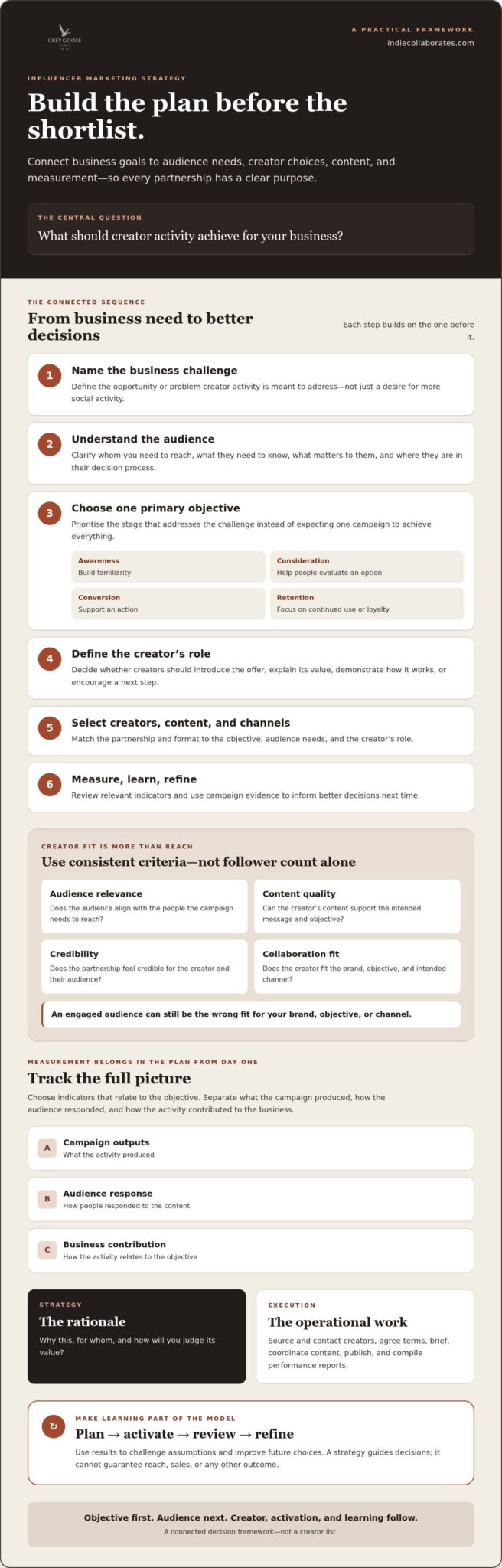
- Use influencer marketing strategy development to connect business goals with audience priorities, creator choices, content, and measurement.
- Turn a business challenge into a focused brief by choosing a primary objective and defining the role creator activity should play.
- Assess creators for audience relevance, content quality, credibility, and collaboration fit, not follower count alone.
- Match each objective to indicators that distinguish campaign outputs, audience response, and business contribution.
- Build a practical activation sequence, then use what you learn to make better decisions for future campaigns.
What influencer marketing strategy development should actually deliver
Influencer marketing strategy development should produce more than a creator shortlist. It should give your team a decision framework that connects business context, audience priorities, objectives, creator criteria, content direction, channels, and measurement. That framework helps explain why each partnership belongs in the plan and what you expect to learn from it.
For a broad overview of the discipline, What is influencer marketing covers its history and methods. The practical task for a brand is to make those methods serve a specific purpose. Strategy sets the rationale and boundaries; campaign plans translate them into action. A strategy can guide decisions, but it can’t guarantee reach, sales, or any other outcome.
What belongs in an influencer marketing strategy?
A useful strategy documents why creator partnerships matter, whom they should reach, and how the work will be evaluated. It should capture:
- Business context: the challenge or opportunity creator activity is meant to address.
- Audience priorities: whom you need to reach, what they need to know, and what matters to them.
- Objectives: the primary result to pursue, such as awareness, consideration, conversion, or retention.
- Creator criteria: the qualities that indicate audience, content, and brand fit.
- Content and channels: the kind of creator-led content and platforms suited to the objective.
- Measurement and learning: the indicators you’ll review and how findings will inform future decisions.
Make these choices clear enough to align stakeholders, but flexible enough to adapt when campaign evidence challenges an assumption. For example, if the goal is to increase consideration, prioritise creators whose subject matter and communication style can help explain a product. Then assess audience response against that goal. A large following alone can’t tell you whether the audience is relevant, the content feels credible, or the partnership supports the objective.
How strategy differs from campaign execution
Strategy answers why this, for whom, and how will we judge its value? Execution covers the operational work: sourcing and contacting creators, agreeing terms, briefing, coordinating content, publishing, and compiling performance reports. Both matter. Without a strategy, those tasks can become a checklist with no consistent rationale. Without execution, even a sound strategy stays on paper.
Use the strategy to connect each campaign decision back to the brief. Select creators for defined reasons, not reach alone. Give content a clear objective, then report on indicators that relate to it instead of treating one metric as the whole story. The sequence in this guide is objective, audience, creator, activation, and learning. Each step builds on the last, so teams can review and refine their activity without mistaking a plan for a promise of results.
Turn business goals into a focused influencer strategy brief
A useful brief begins with a business challenge, not a platform or a list of creators. Influencer marketing strategy development becomes more practical when each choice follows a clear sequence: identify what needs to change, understand whose behaviour matters, select a priority objective, then define the role creator activity can play.
Set objectives and define the audience
Work through these decisions in order:
- Name the business challenge. For example, a brand may need more people to understand a new product, rather than simply seeking more social activity.
- Describe the audience and its context. Go beyond broad demographics. What does the audience need to know? What questions might it have, and where is it in its decision process?
- Choose one primary objective. Awareness aims to build familiarity; consideration helps people evaluate an option; conversion supports an action; retention focuses on continued use or loyalty. Choose the stage that addresses the challenge instead of expecting one campaign to achieve all four.
- Set the creator’s role. Decide whether creators should introduce the offer, explain its value, demonstrate how it works, or encourage a next step. Match the role to the audience’s needs and the objective.
For instance, if people know a product exists but don’t understand how it fits their needs, a consideration-focused brief could ask creators to address relevant questions in their own style. If the priority is awareness, the brief may instead focus on introducing the product clearly to the intended audience. These are different jobs, even if both use creator content.
Build a brief that guides real decisions
Record the choices in a concise working document. Include the business challenge, primary objective, audience needs and decision stage, key message, creator role, channel purpose, content requirements, timing, and measurement approach. Add essential brand requirements and creative boundaries, but leave space for creators to communicate naturally. A brief that dictates every line can undermine the credibility and voice that made the partnership relevant.
Make assumptions visible, too. If the team believes audiences need a product demonstration before they’ll consider it, state that as a hypothesis and identify what audience response could help assess it. This turns the brief into a framework the team can refine with evidence, rather than a fixed script.
For more detailed planning around creator-led content, explore this creator content strategy framework. Brands shaping this work may also consider creator content strategy support as part of their planning.
Choose creators, platforms, and formats for strategic fit
Creator selection should follow the brief, not a popularity ranking. In influencer marketing strategy development, the strongest fit is a creator whose audience, content approach, and credibility support the campaign objective. A large following may offer reach, but it doesn’t show on its own whether the right people will see, trust, or act on the message.
Assess creator fit beyond follower counts
Review several signals together: audience alignment, content consistency, engagement context, credibility, and suitability for your brand. Look at the subjects a creator regularly covers and how their audience responds. Review examples of their content, including sponsored work, to see whether the message fits naturally with their usual voice. Audience data and engagement indicators are evidence to interpret, not automatic predictors of campaign results.
Apply the brief’s criteria consistently. If the aim is to help a defined audience understand a product, relevant expertise and clear explanations may matter more than broad reach. If the priority is discovery, assess whether the creator’s content naturally introduces topics to the audience you want to reach. Write down why each shortlisted creator fits the intended role. The question is not simply “Who is popular?” It’s “Who can credibly play this role for this audience?”
Match platforms and formats to the job
Instagram, TikTok, and YouTube offer different creative contexts, but none is universally best. Consider where your intended audience engages with relevant content, what format the objective calls for, and what each platform currently supports. Check platform features and publishing requirements before finalising the plan instead of relying on assumptions.
| Objective | Creator role | Possible content approach |
|---|---|---|
| Discovery | Introduce a relevant need or idea | Creator-led short-form content |
| Education | Explain or demonstrate a product | Detailed walkthrough or tutorial |
| Social proof | Share a credible personal perspective | First-person review or experience |
| Direct response | Make a next step clear | Focused call to action or affiliate content |
Choose the format based on the message and audience, then adapt it to the creator’s strengths and channel context. Influencer partnerships use a creator’s voice and audience relationship. UGC production creates creator-made assets for uses such as paid ads, organic social, or creative testing. Affiliate activity connects creator recommendations with a tracked purchase pathway. These approaches serve different roles, so define what the campaign needs before selecting a format.
For a deeper look at planning around measurable business contribution, explore performance-based influencer marketing. If you’re shaping a campaign brief, creator campaign support may be useful.
Make measurement and learning part of the strategy from day one
Measurement is most useful when it’s planned before creators publish, not added as a reporting task afterwards. In influencer marketing strategy development, each indicator should help answer a question in the brief: did the activity reach the intended audience, prompt a meaningful response, or contribute to a business outcome? No single metric tells the whole story.
Choose indicators that reflect the objective
Separate measurement into three layers. This makes it easier to distinguish what the campaign produced, how people responded, and what business contribution can be observed.
- Outputs: what was delivered, such as creator content published or campaign assets produced.
- Audience response: indicators such as qualified reach, attention, comments, saves, or clicks, depending on the objective and what the platform makes available.
- Business outcomes: relevant actions such as enquiries, sign-ups, or purchases, where the campaign setup supports reliable tracking.
For an awareness objective, define what “reaching the right people” means and select suitable reach or attention indicators. Confirm in advance whether the chosen platforms provide the data you need. For consideration, specify the response that would show interest, such as a visit to a product page. For conversion, agree on the action to track and how it will be attributed before activation.
Tagged links, affiliate links, discount codes, or platform reporting may help connect creator activity with audience actions, depending on the campaign setup and available tools. Set consistent naming conventions and confirm who will collect the data. Treat attribution as evidence, not perfect proof of causation: people may encounter several messages before acting, and a tracking method may not capture every influence.
Turn campaign evidence into the next decision
After the campaign, assess results against the original objective and document both what the evidence supports and what remains uncertain. Compare creators and formats using consistent definitions where possible, while recognising that audience, content, and platform context can affect results. A higher click count, for example, doesn’t automatically mean stronger business impact if the campaign’s main aim was awareness.
Record a practical conclusion: which audience response aligned with the objective, which content approach merits another test, and what tracking or briefing should change next time. Measurement improves the next strategy iteration by showing which choices to retain, revise, or test, while making the limits of the evidence clear.
If campaign coordination or reporting capacity is a challenge, review this guide to outsourced influencer campaign management. To plan a creator campaign with measurement built into the brief, explore influencer campaign support.
Put the strategy into practice with a clear operating model
A strategy becomes useful when everyone knows who makes each decision and what happens next. Influencer marketing strategy development should lead to a repeatable workflow, not leave teams to coordinate each activation from scratch.
- Align stakeholders: Confirm the business objective, audience, responsibilities, and approval owners.
- Confirm the brief: Agree on creator criteria, content direction, timing, measurement, and the boundaries creators need to know.
- Source and assess creators: Use the brief to guide outreach and evaluate potential partners for fit.
- Activate: Coordinate agreements, content reviews, publishing, and any agreed tracking.
- Review and learn: Compare evidence with the original objective, document decisions, and identify what to adapt for the next campaign.
Decide what to manage in-house and what to support
In-house coordination may suit a team with clear ownership and enough capacity to source creators, manage communications, review content, track activity, and report findings. Specialist support may help when those responsibilities compete with other priorities, a campaign involves multiple creators, or the brand is building a more structured programme. The right model depends on the strategy, available resources, and programme structure.
Indie Collaborates provides managed influencer campaigns that include creator content strategy and campaign performance reporting. Its UGC production supports paid ads, organic social, and creative testing, while affiliate programme management includes creator recruitment, tiered commissions, and payout tracking. These options serve different needs, so choose support based on the role creator activity has in your plan. Indie Collaborates does not provide social account management, traditional PR or media relations, or exclusive talent representation.
Use a repeatable review cycle
Set checkpoints before work begins: brief approval, creator-fit confirmation, content review, activation readiness, and post-campaign learning. At each stage, record the decision owner, required inputs, and what counts as approval. This simple operating discipline helps internal teams and creators work from shared expectations while preserving room for creator voice.
After activation, close the loop by recording what the evidence shows, what remains uncertain, and which choices should be retained or tested next. To discuss how strategy and execution support could fit your programme, start a conversation with Indie Collaborates.
Build a creator strategy you can learn from
Strong influencer marketing strategy development connects business priorities to creator choices, content, and measurement before a campaign begins. Keep the plan focused: choose a clear objective, select creators for strategic fit, and decide in advance how you’ll assess audience response and business contribution. Then use what the evidence can and can’t show to guide the next decision.
Execution support should fit your programme, not the other way around. Indie Collaborates brings together managed influencer campaigns, UGC production, and affiliate programme management, with access to the IC Inner Circle, a paid community of over 1,600 vetted creators. The right combination depends on your goals, resources, and operating needs.
Ready to turn your priorities into a coordinated creator plan? Discuss a creator strategy built around your goals. Start with a clear purpose, stay open to learning, and give each partnership a meaningful role in your wider marketing effort.
Frequently Asked Questions
What is influencer marketing strategy development?
Influencer marketing strategy development is the process of connecting a business objective to an audience, creator approach, content direction, channel role, and measurement plan. It gives a team a reason for its campaign choices before outreach or publishing begins. A useful strategy is specific enough to guide decisions, yet flexible enough to change when campaign evidence or business priorities shift. It’s a framework, not a guarantee of results.
How do you develop an influencer marketing strategy?
Start by identifying the business challenge and the audience response you want to support. Choose a primary objective, then create a brief that defines the audience, creator criteria, channel role, content needs, and measurement approach. Before activation, document your assumptions and decide how you’ll review the evidence. This sequence keeps creator selection and campaign activity connected to the original purpose, while making it easier to adjust future plans.
What should an influencer marketing strategy include?
An influencer marketing strategy should include business context, audience priorities, objectives, creator-selection criteria, channel roles, content direction, responsibilities, timing, and measurement. Include enough detail to guide decisions without prescribing every creative choice. Make assumptions clear, define what success would mean for the chosen objective, and leave room to learn from creators and campaign performance. This helps teams maintain a consistent rationale while adapting their approach as priorities or evidence change.
How do you choose the right influencers for a brand?
Begin with the audience and campaign objective, not a follower-count threshold. Assess whether a creator’s audience is relevant, the content is consistently strong, and the creator can communicate credibly within the brief. Consider engagement in context and check that the creator is suitable for your brand. Treat audience data and metrics as signals to interpret, not predictions of performance. Set these criteria before comparing individual creators.
Which platforms are best for influencer marketing?
There’s no universally best platform; the right choice depends on where your intended audience engages and what format supports your objective. Compare the creative context, audience behaviour, and practical campaign requirements for each option. Also check current platform features and reporting capabilities directly, since these can change. For example, a detailed explanation may need a different format and channel context from a campaign designed to introduce a product to new audiences.
How do you measure an influencer marketing strategy?
Choose indicators that match your objective and define them before activation. Awareness, consideration, and conversion call for different evidence, so reach or engagement alone won’t show the whole impact. Where the campaign setup allows, use consistent tracking methods such as tagged links or platform reporting. Compare results with the original brief, note what attribution can’t establish, and use supported findings to refine future creator, content, and channel choices.
Should a brand manage influencer marketing in-house or use an agency?
The choice depends on internal capacity, programme complexity, and the support required. An in-house team may coordinate a focused programme if it has time and skills for creator sourcing, coordination, content review, tracking, and reporting. An agency can support defined needs such as creator content strategy, managed influencer campaigns, UGC production, or affiliate programme management. Clarify the work first, then choose a model that fits. Neither guarantees better results.
