
By 2026, a “like” is no longer a valid currency; it’s a distraction. You’ve likely felt the pressure of rising Customer Acquisition Costs while staring at engagement reports that simply don’t translate to your bottom line. It’s an exhausting cycle of high spend and low transparency. We understand the frustration of trying to scale creator content for paid ads without a clear map for attribution. You need more than just visibility. You need a system where every dollar spent on performance based influencer marketing generates a predictable, trackable return.
This article provides the strategic framework you need to transition from vanity metrics to measurable revenue. We’ll show you how to build a performance-led creator ecosystem that acts as a scalable affiliate salesforce. This framework serves both the data-driven marketer seeking efficiency and the creative visionary demanding authenticity. By the end of this guide, you’ll know how to lower your CPA through trusted creative and secure the predictable revenue growth your brand deserves. We’re moving past the “why” and diving straight into the “how” of professionalized creator partnerships.
Key Takeaways
- Learn how to shift your focus from superficial engagement to measurable conversion by prioritizing creator partnerships that drive actual sales.
- Establish a robust framework for performance based influencer marketing that utilizes scalable UGC to fuel your paid social channels and lower your CPA.
- Compare fixed-fee, performance, and hybrid payment models to find the optimal balance for your brand’s growth and creator motivation.
- Implement a structured recruitment and vetting process to build a high-performing affiliate salesforce tailored to your specific niche.
- Understand the role of strategic architects in managing complex, cross-border campaigns and the necessity of end-to-end payout tracking.
What is Performance Based Influencer Marketing?
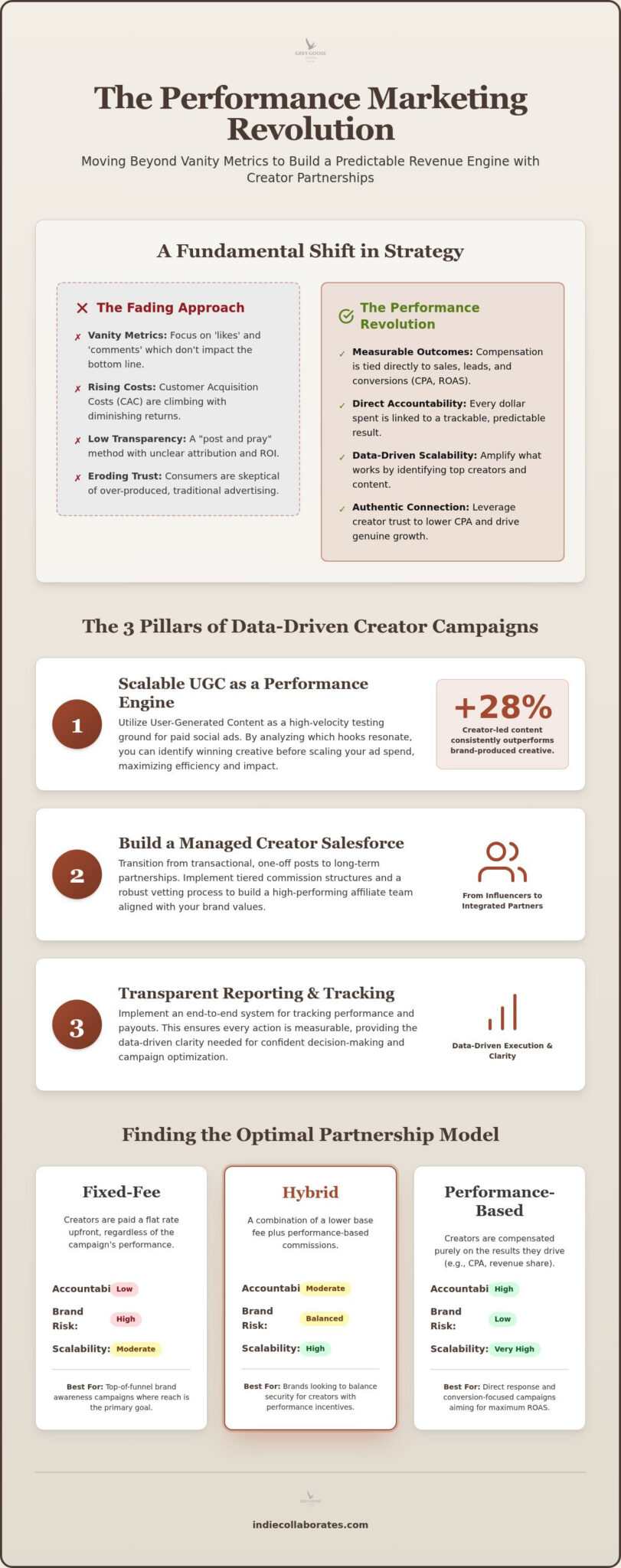
Performance based influencer marketing is a strategic evolution where creator compensation is tied directly to measurable outcomes. It moves beyond the era of paying for potential impressions. Instead, it focuses on realized value. By 2026, the digital space has matured. Brands no longer find solace in vanity metrics like “likes” or “comments” that fail to impact the balance sheet. This model ensures that every partnership serves a definitive purpose: driving sales, generating leads, or securing high-intent clicks. For a foundational influencer marketing overview, one can see how the industry has shifted from broad celebrity endorsements to a high-precision, results-oriented ecosystem.
Success in this framework requires a shared language of accountability. You’ll frequently encounter terms like CPA (Cost Per Acquisition) and ROAS (Return on Ad Spend), which act as the primary yardsticks for campaign health. Another vital component is whitelisting. This allows brands to run paid ads through a creator’s handle, blending authentic content with the precision of social platform targeting. This creates a powerful synergy. Brands gain the efficiency of performance data; creators receive the benefit of amplified reach and sustainable income.
Why Traditional Influencer Marketing is Falling Short
The old ways are fading. Consumers have developed a keen eye for over-produced, traditional advertising, leading to a significant erosion of trust. At the same time, standard Customer Acquisition Costs (CAC) on social platforms have continued to climb, making generic ad spend less viable. Many organizations still treat creators as a “side quest” or a secondary channel. This approach is a mistake. It limits growth and fails to leverage the deep community trust that creators have spent years building. Results matter. Transparency is non-negotiable.
The Core Benefits of a Performance-Led Model
Direct accountability is the cornerstone of this approach. Every dollar spent is linked to a trackable result, removing the guesswork from your marketing budget. This data-driven clarity allows for rapid scalability. Once you identify winning creators and high-performing content, you can amplify their reach with confidence. It’s about moving from a chaotic “post and pray” method to a structured, professionalized salesforce. Performance influencer marketing is the intersection of creative trust and data-driven execution. It offers a clear path toward long-term viability in a competitive digital environment.
The Three Pillars of Data-Driven Creator Campaigns
A resilient growth engine requires a foundation of structural integrity. In 2026, performance based influencer marketing relies on three core pillars that bridge the gap between creative expression and commercial viability: scalable UGC, managed affiliate programs, and transparent reporting. This triad ensures that every creator partnership is an investment rather than an expense. It transforms social media from a branding exercise into a predictable sales channel. By aligning these pillars, brands can finally move away from the uncertainty of “post and pray” tactics.
UGC as a Performance Engine
Creator-led content consistently outperforms brand-produced creative by 28%. This performance gap exists because creators understand the nuances of their platforms better than most internal marketing teams. We leverage this by using UGC as a high-velocity testing ground for paid social. By analyzing which hooks resonate on Meta and TikTok, we identify winning assets before scaling spend. You can master this process through The Guide to Scalable UGC Production Services.
Building a Managed Creator Salesforce
The transition from transactional posts to a managed creator salesforce is a hallmark of mature brands. This pillar involves building long-term partnerships through tiered commission structures that incentivize consistent performance. This framework balances the brand’s demand for ROAS with the creator’s need for a stable, professional partnership. Vetting remains a critical step. We ensure every creator aligns with your brand values while maintaining the engagement depth required for conversion. For a comprehensive roadmap, see our Managed Creator Affiliate Salesforce: 2026 Buying Guide.
Reporting serves as the final, critical pillar. By utilizing advanced performance influencer marketing strategies and metrics, we tie every piece of content to bottom-line revenue. This transparency fuels the synergy between organic reach and paid amplification. When an organic post converts, we whitelist it to reach a broader, targeted audience. This methodical approach turns creative trust into a scalable revenue driver. If you’re looking to professionalize your approach, explore how managed creator campaigns can secure your market position.
Evaluating Performance Models: Affiliate vs. Managed Seeding
Choosing the right execution model is a matter of aligning your tactical goals with your long-term vision. In 2026, the discussion around performance based influencer marketing has moved past simple commission checks. Brands must decide between pure affiliate structures, which prioritize immediate conversion, and managed seeding, which builds organic momentum through product-first outreach. Managed seeding acts as the strategic “soft launch” of a partnership. By sending products to vetted creators without a strict content mandate, you identify who genuinely loves the brand. This organic affinity becomes the foundation for more aggressive performance campaigns later. It’s a method that values relationship depth over transactional volume.
Cost structures vary significantly across the industry. Fixed fees provide certainty for creators but offer no safety net for the brand. Pure performance models, while attractive for ROI, often struggle to attract top-tier talent who require a baseline for their production time. This is where binary framing becomes essential. You must meet the tactical need for immediate sales while simultaneously building strategic brand equity. Finding this balance is the key to a sustainable creator ecosystem that doesn’t sacrifice brand integrity for a quick spike in revenue.
The Hybrid Model: Why it Wins in 2026
The hybrid model combines a base fee for content rights with performance-based bonuses for sales. It’s the most effective way to reduce friction for high-quality creators while maintaining strict brand accountability. The hybrid model is the gold standard for enterprise influencer marketing. It acknowledges the creator’s role as both a creative producer and a salesperson. This structure is central to the future of brand and creator collaborations, as it incentivizes long-term growth and rewards genuine advocacy rather than just reach.
Attribution and Payout Logistics
Scaling to hundreds of creators requires more than just spreadsheets. Multi-touch attribution is now the norm, as consumers rarely buy on the first interaction with a creator. You need custom tracking links and automated payout systems to manage this complexity without overwhelming your internal team. Reliable logistics ensure that creators are paid accurately and on time, which is the fastest way to build professional trust. To see how these logistics integrate into a broader plan, review our guide on Performance Influencer Marketing: 2026 Strategy. By professionalizing the “back office” of your creator campaigns, you free up your team to focus on high-level strategy and creative direction.
Building Your Managed Creator Salesforce: A Step-by-Step Implementation
Transitioning from experimental campaigns to a durable salesforce requires a shift in perspective. You aren’t just hiring a spokesperson; you’re recruiting a decentralized sales team. This implementation phase is where the strategic architecture of performance based influencer marketing becomes operational. It moves through five distinct stages of maturation to ensure that your creator ecosystem remains both profitable and scalable. Execution is the bridge between strategy and revenue.
- Step 1: Establish your attribution framework. Define your primary KPIs, such as ROAS or CPA, and ensure your tracking links are integrated with your ecommerce backend.
- Step 2: Recruit and vet your talent. Focus on niche alignment and engagement depth to ensure the audience is primed for conversion.
- Step 3: Deploy a creative strategy that balances direct response hooks with authentic storytelling. The content must stop the scroll while providing a clear reason to buy.
- Step 4: Scale your winning content. Identify the top-performing assets and amplify them through whitelisting and dark posting.
- Step 5: Continuous optimization. Use real-time performance reporting to refine your creator roster and creative briefs every week.
Recruitment and Vetting Strategies
We don’t look at follower counts in isolation. High volume doesn’t guarantee high intent. Instead, we audit engagement depth. This means looking at how a creator’s audience interacts with product recommendations. Our IC Inner Circle, a vetted community of over 1,600 creators, provides a foundation of quality. We analyze past content for visible purchase signals, such as comments asking for links or specific product questions. This ensures that the creators you partner with are already seen as trusted advisors within their specific communities.
Scaling with Paid Amplification
Organic reach is the testing ground; paid amplification is the growth engine. Once a creator’s post shows strong organic conversion, we turn it into an evergreen asset using Spark Ads or Partnership Ads. This allows us to reach audience segments far beyond the creator’s immediate followers. Dark posting is particularly effective here. It lets us test different hooks and audience segments without cluttering the creator’s public profile. By optimizing this content for direct response funnels, you turn a single piece of UGC into a high-performing ad that drives consistent sales. If your internal team is stretched thin managing these moving parts, our outsourced influencer campaign management checklist provides a definitive framework for transitioning to a structured, performance-led ecosystem. If you’re ready to build your own high-performance ecosystem, explore our managed creator campaigns today.
Why Performance-Led Agencies are the Future of Digital Growth
Managing a handful of creator relationships is manageable; orchestrating a national salesforce is a logistical feat. As we look toward the horizon of 2026, the role of the agency has shifted from a simple talent broker to a strategic architect. Performance based influencer marketing requires a level of infrastructure that most internal teams aren’t equipped to build. It demands specialized arms for UGC production, affiliate management, and enterprise-level reporting to ensure every stakeholder is aligned toward a single goal: measurable ROI. This structured approach provides clarity in a landscape that often feels chaotic.
A strategic architect acts as the bridge between ambitious brand goals and the diverse needs of creator talent. This isn’t just about managing schedules. It’s about professionalizing the entire ecosystem. By aligning these two distinct audiences, agencies create a stable environment where creative production and performance tracking coexist. This professionalization is what allows brands to move from experimental spending to predictable, long-term digital growth through performance based influencer marketing.
Navigating the Southeast Asian Creator Economy
The complexity of managing cross-border campaigns in Southeast Asia cannot be overstated. Each market brings unique regional nuances in social commerce and consumer behavior that require a localized touch. Success depends on a vetted creator network that understands these cultural triggers. You can explore these shifting dynamics further in our analysis of The Evolution of the Creator Economy Agency in Southeast Asia. Authentic resonance isn’t accidental; it’s engineered through deep local expertise.
The Indie Collaborates Advantage
We provide the stability and precision required to scale. Our partners gain access to the IC Inner Circle, a vetted community of over 1,600 creators, alongside a specialized jobs board for creative roles. This ensures high-quality talent is always within reach. Our end-to-end management handles everything from recruitment to payout tracking, allowing your team to focus on high-level strategy. We deliver the measurable results that justify executive-level budget decisions. By acting as your strategic partner, we turn the potential of the creator economy into a tangible, high-performing asset for your brand.
Secure Your Market Position in the Creator Economy
The transition from superficial engagement to measurable revenue isn’t just a trend; it’s the new standard for professionalized brands. By 2026, success requires a shift toward performance based influencer marketing that treats creators as a decentralized, managed salesforce. You’ve seen how to leverage the three pillars of UGC, affiliate programs, and transparent reporting to lower your CPA and secure predictable growth. This framework ensures that every creative partnership is a calculated investment in your brand’s long-term viability.
Professionalizing this ecosystem doesn’t have to be a solitary journey. We act as the strategic architect for your growth, offering specialized performance-led management arms and deep expertise in the Southeast Asian market. With a vetted community of over 1,600 creators in our Inner Circle, we provide the infrastructure needed to turn creative trust into commercial success. It’s time to move past the uncertainty of vanity metrics and start building a scalable engine for ROI. Build your high-performance creator ecosystem with Indie Collaborates and take the first step toward a more transparent, results-driven future. Your brand’s next phase of growth is ready to begin.
Frequently Asked Questions
What is the difference between performance-based and traditional influencer marketing?
Traditional influencer marketing prioritizes broad exposure through impressions and engagement metrics. Performance based influencer marketing shifts the focus toward tangible business outcomes like sales, lead generation, and high-intent clicks. While traditional methods build brand recognition over time, the performance-led approach provides immediate accountability. It treats creators as a decentralized salesforce rather than just a media channel. This ensures every dollar spent is tied to a specific, measurable result that impacts your bottom line directly.
How do I track ROI in a performance-led influencer campaign?
You track ROI by integrating custom attribution links, unique promo codes, and platform pixels into your ecommerce backend. These tools allow you to follow the customer journey from the initial creator interaction to the final purchase. By analyzing this data, you can calculate your Return on Ad Spend (ROAS) and Cost Per Acquisition (CPA) with precision. This transparency removes the guesswork from your budget and allows you to reinvest in the specific creators who deliver the highest value.
Is a performance-based model fair for content creators?
Fairness is achieved through hybrid models that combine a base content fee with performance-based bonuses. This structure respects the creator’s production time while incentivizing them to drive results. High-quality creators often prefer this model because it offers unlimited earning potential based on their actual influence. It fosters a professional partnership where both the brand and the creator are equally invested in the campaign’s commercial success and long-term viability.
What are the best KPIs for measuring influencer marketing performance?
The most effective KPIs include Cost Per Acquisition (CPA), Return on Ad Spend (ROAS), and overall conversion rates. While click-through rates (CTR) provide insight into creative interest, the final purchase remains the primary benchmark for performance. You should also monitor secondary metrics like video completion rates and average order value (AOV). These data points help you understand the quality of the traffic and the effectiveness of the creator’s storytelling in driving high-value transactions.
How can brands scale UGC production for paid ads?
Brands can scale UGC production by collaborating with strategic architects who manage large, vetted creator communities. Instead of managing individual relationships, you use structured creative briefs and centralized management arms to produce high volumes of content. This allows you to test multiple hooks and visual styles across platforms like TikTok and Meta. By identifying winning assets early, you can quickly amplify high-performing content through paid social channels to drive consistent, scalable growth.
Can performance-based marketing work for brand awareness goals?
Performance models naturally support brand awareness by ensuring that even top-of-funnel content is optimized for engagement. While the primary goal is conversion, the high-quality storytelling required for performance based influencer marketing creates deep brand resonance. You can measure awareness through secondary metrics like profile visits, follower growth, and share counts. This approach ensures that your awareness efforts aren’t just seen; they’re actively building a foundation for future sales and customer loyalty.
What is whitelisting in influencer marketing and how does it drive ROI?
Whitelisting is the process of running paid social ads directly through a creator’s handle rather than your brand’s account. This drives ROI by leveraging the creator’s existing trust and social proof to reach a wider, targeted audience. It allows for granular audience segmentation and A/B testing of creative hooks. Because these ads appear more authentic than traditional brand content, they often achieve higher engagement rates and lower acquisition costs across your primary social channels.
How do I find vetted creators in the Southeast Asian market?
Finding reliable talent in the Southeast Asian market requires access to a localized, vetted creator network. We recommend utilizing curated communities like the IC Inner Circle, which features over 1,600 vetted creators across the region. This ensures you’re partnering with individuals who understand regional consumer behavior and social commerce nuances. By working through a specialized agency, you gain the infrastructure needed to manage recruitment, vetting, and payout logistics across diverse borders with complete confidence.
