
What if a creator campaign could connect discovery, content and sales instead of leaving each in a separate workstream? For brands searching “Full service influencer agency Singapore,” the key question is what one partner actually manages and how that work ties back to business goals. Creator sourcing, campaign coordination, UGC production and affiliate programmes can overlap, but each serves a different purpose. Without a clear scope and performance reporting, activity may attract attention without showing what it contributed.
A full service approach brings relevant workstreams together around your objectives, without assuming every campaign needs every service. That might mean building awareness through creator partnerships, producing content for paid ads and creative testing, or supporting creator-led sales through affiliate management. Indie Collaborates connects campaign strategy, creator relationships, content and reporting, with access to a community of over 1,600 vetted creators.
This article explains what integrated campaign management can include, how to assess an agency’s scope, process and reporting, and how to align creator activity with measurable outcomes. Use the practical framework to evaluate the model and plan an integrated creator programme around your priorities.
Key Takeaways
- A Full service influencer agency Singapore programme should coordinate planning, creator activity and performance reporting around your campaign objective.
- Use a clear sequence, from goal-setting and creator selection to content activation and measurement, to keep decisions, deliverables and responsibilities aligned.
- Assess what the campaign scope assigns for strategy, sourcing, production, tracking, reporting and content ownership, not just the agency’s broad capabilities.
- Match the engagement to your priority, whether awareness, creator-led content or affiliate sales, while accounting for your team’s capacity and reporting needs.
- Explore how creator strategy, access to over 1,600 vetted creators, UGC production and managed affiliate programmes can support an integrated campaign.
What Do Full-Service Influencer Agencies in Singapore Do?
Searching for a “Full service influencer agency Singapore” partner is really a search for coordinated delivery, not simply a longer list of services. Full service creator campaign management brings planning, execution and performance reporting together. The scope should reflect the brand’s objective, channels, audience and internal capacity.
A full service influencer agency plans and coordinates creator campaigns from strategic direction through activation and reporting, bringing together the workstreams relevant to a brand’s objectives. This describes an operating model, not a promise of specific results. The term can cover different scopes, so clarify which responsibilities are included for your campaign. A broader overview of Influencer Marketing Explained can help put creator partnerships in the context of the wider discipline.
Campaign management is distinct from ongoing social account management, traditional public relations and exclusive talent representation. A campaign partner organises creator activity for a defined brief. That does not automatically include running the brand’s social channels, handling media relations or representing creators exclusively. Clear boundaries help teams understand who owns each task and where internal support is needed.
Which work can a full-service creator campaign cover?
Depending on the brief, campaign work can bring together creator content strategy, creator sourcing, partnership coordination, content schedules and performance reporting. The value comes from making these elements work together: creator selection reflects the audience and objective, agreed deliverables guide content coordination, and reporting relates activity to measures set before the campaign begins.
Two related workstreams can add a different emphasis:
- UGC production creates creator-led assets for paid advertising, organic social content or creative testing. It focuses on producing usable content, which may or may not be part of a creator partnership campaign.
- Affiliate management centres on creator recruitment, commission structures and payout tracking to support sales activity. Its operating needs differ from those of a campaign focused primarily on awareness.
A brand can prioritise the work that fits its brief. It may need creator partnerships and reporting without a separate UGC production stream, or content assets without an affiliate programme. Full service should mean a coordinated scope, not every service bundled into every engagement.
Who benefits from managed creator campaigns?
Managed campaigns suit brand teams that need more structure than a one-off creator post can provide, particularly when multiple creators, deliverables or channels need coordination. A lean team may value operational support with sourcing, schedules and content follow-up. A larger marketing team may already own strategy but need campaign coordination and consistent reporting across workstreams.
Let the objective determine the emphasis. An awareness brief may prioritise audience fit and campaign reach. A content brief may focus on producing creator assets for paid or organic use. A sales-oriented brief may centre on affiliate activity and tracking. Define the outcome, audience and internal responsibilities first, then decide which workstreams belong in the programme.
How a full-service influencer agency connects strategy, creators, and results
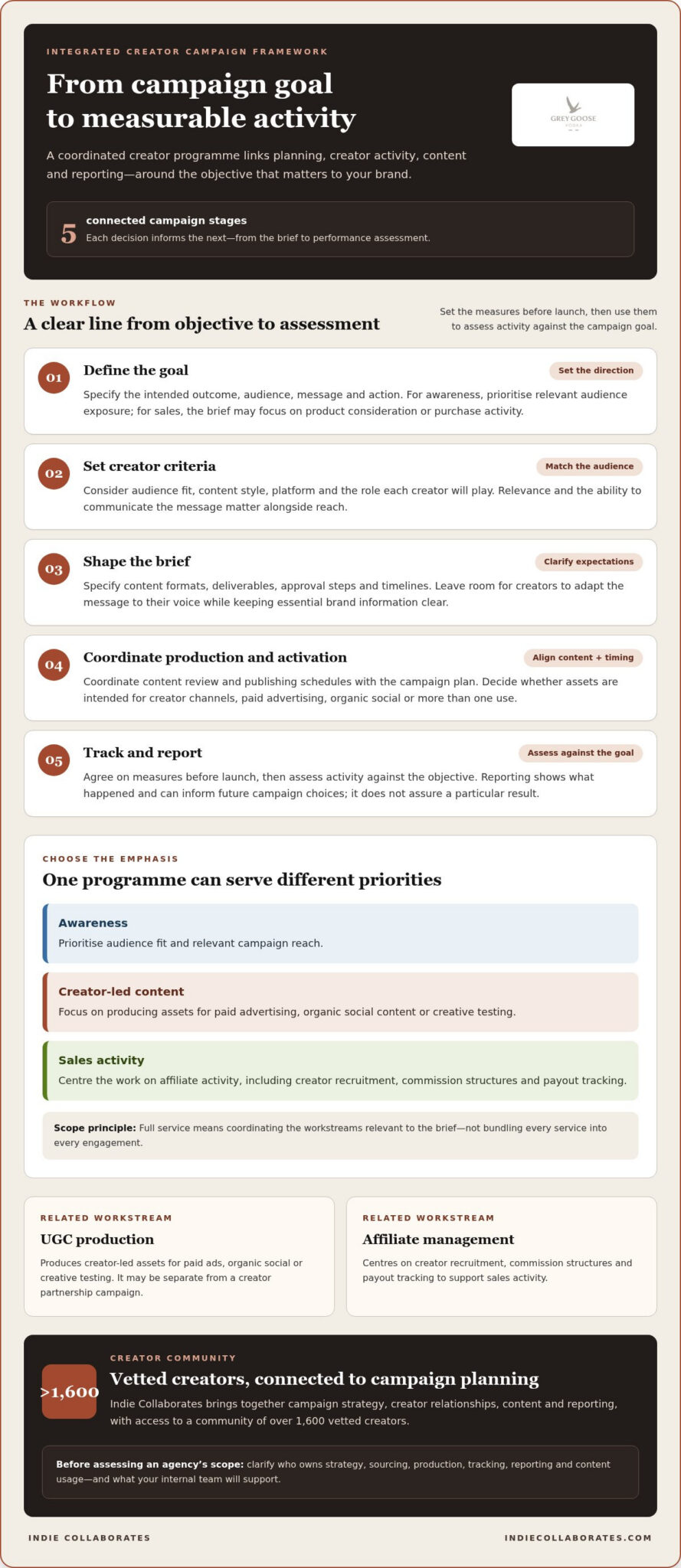
A Full service influencer agency Singapore programme should create a clear line from the business objective to creator activity and campaign assessment. Each stage informs the next. A brief built around a specific audience action gives creator selection, content decisions and reporting a shared point of reference, rather than leaving teams to coordinate separate tasks without a common measure.
- Define the goal. Set the intended outcome, audience, message and action. For awareness, prioritise relevant audience exposure. For sales, the brief may focus on product consideration or purchase activity.
- Set creator criteria. Consider audience fit, content style, platform and the role each creator will play. Audience relevance and the ability to communicate the message matter alongside reach.
- Shape the brief. Specify content formats, deliverables, approval steps and timelines. Give creators room to adapt the message to their voice while keeping essential brand information clear.
- Coordinate production and activation. Align content review and publishing schedules with the campaign plan. Decide whether assets are intended for creator channels, paid advertising, organic social or more than one use.
- Track and report. Agree on measures before launch, then assess activity against the objective. Reporting can show what happened and inform future campaign choices, without implying that any particular result is assured.
From campaign objective to creator brief
Start with the business need, not a preferred creator list. Identify who the campaign needs to reach, what message matters to that audience and what action the brand hopes to encourage. Translate those choices into creator criteria, content needs and clear deliverables. Audience research and creator feedback can reveal useful language, questions or content angles for different segments. Use those insights to shape a relevant brief without scripting every detail.
For example, a brand introducing a product to distinct audience groups might use creator perspectives to explore which benefits resonate with each group. Those insights can guide concepts and formats, while the final brief sets boundaries around key claims, timelines and required content.
From activation to performance reporting
Once content is in production, coordinate creator reviews, agreed deliverables and publishing dates, then track activity against the campaign’s chosen measures. UGC can supply assets for paid ads, organic social or creative testing. Affiliate activity can connect creator promotion with recruitment, commissions and payout tracking. These workstreams support different objectives, so include only those that fit the plan.
Reporting closes the loop by showing how campaign activity relates to the agreed objective and where there may be useful learnings. For a deeper look at measurement-led planning, explore this performance influencer marketing strategy. You can also read about performance-led influencer campaign management and how it connects strategy, creator partnerships and reporting.
How to assess agency scope, accountability, and campaign fit
A Full service influencer agency Singapore partner may describe broad capabilities, but a campaign depends on the responsibilities agreed for that engagement. Separate what an agency can do from what it will own: who leads each workstream, what your team supplies, and how progress and decisions are shared. This distinction helps prevent gaps between a proposal and day-to-day delivery.
Use this comparison framework to make the scope concrete:
A clear scope does not mean giving up control. The brand can retain approval over key messages and content while delegating creator coordination and campaign administration. Agree on the brief, approval points, decision-makers and reporting touchpoints before activation. For example, define who consolidates feedback and how revisions are handled. That way, creators receive clear direction rather than conflicting comments.
What should campaign accountability make clear?
Assign an owner for strategy, creator communication, content coordination, tracking and reporting, even when responsibilities are shared. Connect each campaign objective to an appropriate measurement approach: an awareness brief needs different indicators from a content production or sales-focused brief. Set expectations for updates and approvals early, so your team knows when input is needed and campaign work can keep moving.
The outsourced influencer campaign management checklist can help structure a scope review before work begins.
When should UGC or affiliate management be part of the scope?
Include UGC production when the priority is creator-led assets for paid or organic channels, or for creative testing. Include affiliate management when the programme needs creator recruitment, tiered commissions and payout tracking. These workstreams can complement influencer campaign activity, but each has distinct deliverables and operating needs. Match them to the brief rather than adding them by default.
For production-specific considerations, the scalable UGC production guide offers a focused reference. A well-defined scope keeps creative control, operational ownership and measurement aligned without making every campaign responsible for every channel.
Matching Influencer Agency Models to Your Brand Goals
Choose an agency model based on the outcome your brand needs, not the longest possible list of services. A Full service influencer agency Singapore programme can focus on campaign delivery, creator-led content or affiliate activity, with other workstreams added only when they support the same goal. Use this framework to identify the right emphasis:
- For awareness: Prioritise creator strategy, audience fit and coordinated partnerships. Choose creators whose audiences and content are relevant to the people you want to reach, then align campaign activity and reporting with the awareness objective.
- For creator-led content: Put UGC production at the centre if your team needs creator-made assets for paid advertising, organic social or creative testing. Define content formats and intended uses before production begins.
- For creator-led sales: Give affiliate management priority if the programme depends on recruiting creators, setting tiered commissions and tracking payouts. Set reporting expectations around the sales activity the programme is designed to monitor.
Then test that initial choice against four practical factors. Audience determines which creators and channels are relevant. Creative requirements shape the brief, content formats and production needs. Internal capacity affects how much coordination your team can manage. Reporting needs establish what information will help your team evaluate activity and make next-step decisions. A team with strong in-house production resources may need campaign coordination more than additional content creation. A team without those resources may place UGC production higher in scope.
When is managed influencer campaign delivery the priority?
Managed influencer campaigns are a fit when the core need is to connect creator strategy, partnerships, coordination and performance reporting around a defined objective. For an awareness initiative, selection may centre on audience relevance and creator content style. For a product consideration campaign, the brief may give creators room to explain product benefits in a way that suits their audience. In each case, agree on deliverables and measurement before launch, without treating reach, engagement or sales as guaranteed outcomes.
When should content production or affiliate activity lead?
Lead with UGC when asset creation is the main requirement, such as developing creator-led concepts for paid or organic use and testing different creative approaches. Lead with affiliate management when the priority is establishing creator participation in a sales programme, with recruitment, tiered commissions and payout tracking as key responsibilities. These can complement campaign management, but neither needs to be included automatically.
For example, a brand could commission UGC for creative testing while keeping creator partnerships focused on awareness. Another could centre its programme on affiliate activity and add campaign content only where it supports sales communication. The objective sets the sequence and scope. Integrated does not have to mean maximal.
Once you’ve identified the goal, audience, creative needs and internal capacity, explore a creator campaign built around your goals.
How Indie Collaborates can support a full-service creator programme
Indie Collaborates brings creator strategy, influencer campaign management, scalable UGC production, affiliate programmes and performance reporting into one creator economy offering. For brands exploring a Full service influencer agency Singapore partner, the value lies in connecting the workstreams that support the campaign objective, not automatically including every service. A programme can focus on creator partnerships, content production or creator-led sales, with its scope shaped around the brand’s priorities.
What Indie Collaborates brings to creator campaign delivery
Campaign management brings structure to creator partnerships for brand awareness, product seeding and performance-led activity. Creator strategy helps set direction, while access to the IC Inner Circle connects brands with a community of over 1,600 vetted creators. This offers a resource for campaign planning, though creator access alone does not determine campaign outcomes.
For brands that need creator-led assets, the UGC team produces content for paid ads, organic social and creative testing. Production can support a content-first brief or complement creator partnerships when the campaign needs both collaboration and reusable assets. Define the content’s purpose and intended use as part of the programme so production supports the wider plan.
Affiliate programmes serve a distinct role. Management covers creator recruitment, tiered commissions and payout tracking, giving brands a structure for creator-led sales activity. Campaign performance reporting provides a way to review activity against the programme’s objectives. Reporting supports evaluation and learning, rather than promising a particular return or result.
These capabilities can work together without becoming a maximal scope. A brand focused on awareness may prioritise campaign strategy, creator partnerships and reporting. A team building a library of assets may put UGC production first. If creator-led sales is the priority, affiliate management can take the lead, with other workstreams added where they contribute to that objective.
How brands can take the next step
A focused starting brief makes it easier to shape a relevant programme. Before discussing campaign delivery, outline:
- Campaign goals: the brand or business objective and the intended audience action.
- Audience priorities: who the campaign needs to reach and any relevant audience segments.
- Content needs: whether the priority is creator partnerships, UGC assets, affiliate activity or a selected combination.
- Internal requirements: your team’s available capacity, approval process and reporting needs.
These inputs connect strategy, creators, content and measurement to the actual brief, while clarifying which workstreams are relevant. You do not need every campaign detail decided in advance. A clear sense of your priorities gives the planning conversation a practical starting point. Learn about planning a creator campaign with Indie Collaborates.
Turn your campaign priorities into a clear next step
The strongest starting point is not a request to activate every creator channel. It is a clear decision about what your next campaign needs to move forward and what your team needs to learn from it. Choose the priority, identify who will guide approvals internally, and decide what evidence will help shape your next investment.
That gives your agency conversation a practical focus. Indie Collaborates can connect a vetted creator community with campaign strategy and reporting, then shape the programme around needs such as scalable UGC production or managed affiliate activity. A Full service influencer agency Singapore partner should make the scope purposeful, with each workstream tied to the brand’s objectives rather than included by default.
Bring your campaign priorities into the next conversation. Plan a performance-led creator campaign with Indie Collaborates and take the next step with a programme shaped around your goals.
Frequently Asked Questions
Is a full-service influencer agency different from a creator marketplace?
Yes. A creator marketplace primarily supports creator discovery or access, while a full-service agency can manage connected campaign work as well. A Full service influencer agency Singapore engagement, for example, may translate a product launch objective into creator criteria, coordinate agreed deliverables and report campaign activity. Compare responsibilities and hand-offs, not just the agency label or the size of its creator database, to see how planning connects to measurement.
Can an influencer agency manage UGC and affiliate campaigns as well?
Yes. An agency may manage both, but they serve different needs. UGC supports creator-led assets for uses such as testing ad concepts, while affiliate management supports creator recruitment, commissions and sales tracking. A brand might prioritise content production to develop creative options, then add affiliate activity if tracked creator sales become a priority. Set separate deliverables and evaluation measures for each workstream so their contributions stay clear.
How much does a full-service influencer agency cost in Singapore?
There is no single fee that fits every programme. Scope can vary with the campaign objective, creator requirements, production needs, duration and level of management involved. Before discussing a tailored scope, prepare your intended deliverables, audience and reporting needs. A campaign focused on creator-made assets may need a different combination of work from one centred on creator partnerships and affiliate activity. This gives the discussion a practical basis without assuming a standard rate.
What should a full-service influencer campaign include?
It should include the responsibilities needed to deliver the agreed objective, rather than a fixed list of services. A practical brief identifies the audience, creator role, required content, approval owner and how campaign activity will be assessed. If a launch includes both creator posts and reusable assets, specify which deliverables serve each purpose. Clear ownership for feedback and approvals helps keep brand input timely and avoids conflicting direction during production.
Can a full-service agency guarantee influencer campaign results?
No. An agency can plan the work, manage creator partnerships, track activity and report what happened, but it cannot control every factor shaping audience response. Creative, offer, timing and distribution all influence how people react. Treat agreed measurement and transparent reporting as tools for learning, not promises of reach or sales. A report, for example, can help a team identify which content generated useful audience actions and inform its next campaign decision.
Does full-service influencer campaign management include social media account management?
Not necessarily. Creator campaign delivery is distinct from ongoing management of a brand’s social accounts. A brand may own its channel calendar and publishing decisions while an agency coordinates creator partnerships and campaign reporting. Defining this boundary helps the team avoid gaps, such as assuming someone else will publish brand-owned posts or respond to comments. Indie Collaborates focuses on creator campaigns, UGC production and managed affiliate programmes rather than general social account management.
