
What if the creator with the biggest audience is the wrong partner for your campaign? Strategic influencer partnerships start with a better question: do the brand’s goals, the creator’s strengths and the audience’s interests genuinely align? When they don’t, even a polished campaign can feel transactional, leaving neither side with a relationship worth building on.
It’s understandable to look at follower counts first or tighten creative control when brand outcomes are on the line. But scale isn’t the same as audience fit, and clear requirements don’t have to come at the expense of creator trust. Strong partnerships make room for both: defined outcomes for the brand and enough creative autonomy for content to feel relevant to the people it reaches.
This guide sets out a practical framework for building collaborations around shared goals and mutual value. You’ll learn how to assess audience and creative alignment, choose a model that suits your objective, and establish a repeatable process for briefing, collaboration and performance review. Whether you’re planning an influencer campaign, developing UGC or building an affiliate programme, the aim is the same: create a working relationship that delivers value without treating creators as media placements.
Key Takeaways
- Strategic influencer partnerships connect a brand objective, creator value and audience relevance, creating a stronger foundation than a one-off placement.
- Set the business objective first, then define the creator’s role, the audience benefit and the metrics that match the goal.
- Compare campaign collaborations, UGC production and affiliate partnerships by the contribution and relationship structure each requires.
- Build trust into the brief by agreeing on deliverables, timing, review and usage expectations while leaving room for the creator’s interpretation.
- Match operating support to the work: campaign coordination, audience-specific UGC production and affiliate programme management serve distinct needs.
What makes strategic influencer partnerships different from one-off posts?
Strategic influencer partnerships are ongoing or deliberately structured collaborations that connect a brand objective, a creator’s strengths and value for the creator’s audience. A single sponsored post can have a clear purpose, but a partnership goes further: it defines how both sides will work together and what the content should make possible over time.
The difference isn’t simply more posts. A series of placements without a shared direction can still feel transactional. Strategy shapes who the brand works with, what role the creator plays and how each piece of content serves its audience. For example, a food brand introducing a new product might partner with a recipe creator who can show practical ways to use it. The creator brings a familiar format, the brand gains relevant visibility, and viewers get an idea they can use.
What does strategic mean in an influencer partnership?
Strategy starts with a specific objective, then connects it to a relevant creator role and a genuine audience benefit. The objective might be to explain a product, gather audience-specific content or encourage trial. Each goal calls for a different contribution. Increasing post volume without clarifying that contribution adds activity, but not necessarily value.
Good structure sets direction without scripting every choice. A brief can define key messages, timing and required details while leaving the creator room to use their voice, format and knowledge of their community. That balance matters: the brand gets coherence, while the creator can make the recommendation feel natural rather than mechanically delivered.
Why should brand, creator, and audience value align?
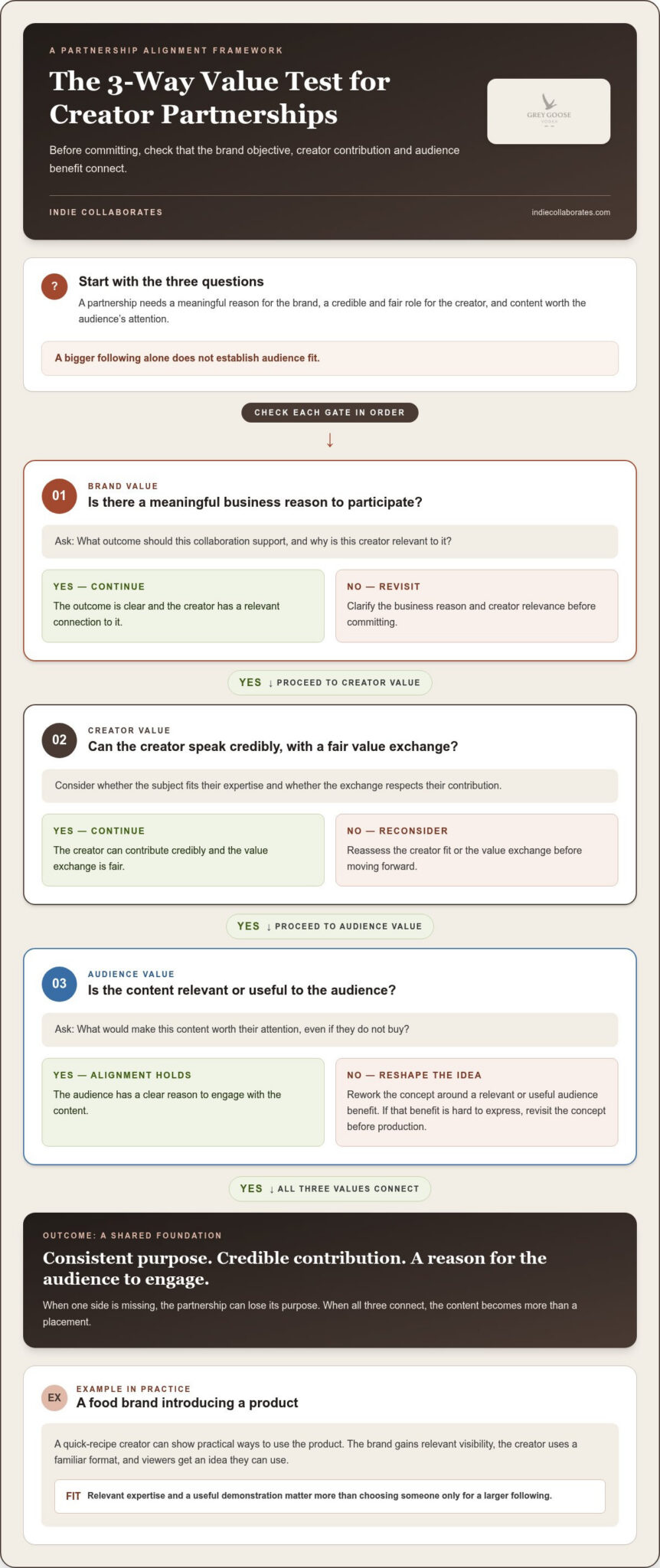
Think of alignment as a three-way value test. The brand needs a meaningful business reason to participate; the creator needs a credible fit and fair exchange; and the audience needs content that is relevant or useful. If one side is missing, the partnership can lose its purpose. A brand may achieve visibility without reaching people who care, while the audience may see a recommendation that doesn’t match the creator’s usual expertise.
Before committing, ask:
- Brand: What outcome should this collaboration support, and why is this creator relevant to it?
- Creator: Can they speak about the subject credibly, and does the value exchange respect their contribution?
- Audience: What would make the content worth their attention, even if they don’t buy?
For the food-brand example, a creator known for quick recipes may be a stronger fit than someone chosen only for a larger following. A practical demonstration can support the brand’s objective while giving viewers a useful idea. The creator’s credibility helps the recommendation make sense, but it doesn’t replace the need for a relevant product or clear value from the brand. This distinction is part of the broader discussion of Influencer marketing on Wikipedia, including how creator-led promotion differs from traditional advertising.
When all three answers connect, content becomes more than a placement. It has a consistent purpose, a credible creator contribution and a reason for the audience to engage. That shared foundation distinguishes a partnership designed for mutual value from a transaction measured only by what was published.
How to design a strategic influencer partnership around shared goals
A clear plan starts before creator outreach. Strategic influencer partnerships work best when the brand defines the outcome, understands what its audience needs and gives the creator a role that draws on their expertise. This sequence keeps those decisions connected instead of selecting a creator first and trying to fit a campaign around them later.
- Translate the business ambition into one primary objective. Replace a broad aim such as “build awareness” with a focused purpose, such as helping a defined audience understand how a product fits into a routine. Keep the objective specific enough to guide decisions, but not so prescriptive that it dictates the creator’s opinion.
- Identify the audience need or decision. Consider what people may need to learn, compare or feel confident about. Audience questions, customer feedback and product research can reveal useful themes. The partnership concept should address a real information gap, not simply repeat brand messaging.
- Define the creator’s contribution. Decide what expertise or format would make the subject clearer. A creator might demonstrate a process, explain a choice or share a considered perspective. Invite them to interpret the brief in a way that suits their established content and community.
- State the audience benefit. Write down what viewers or readers should take away, whether that’s a practical tip, a clearer understanding of the offer or a helpful comparison. If the benefit is difficult to express, revisit the concept before production.
- Choose measures that match the objective. Separate communication goals, audience outcomes and commercial objectives. Then select indicators suited to each: message recall or content views for communication, saves or substantive questions for audience response, and tracked visits or conversions for commercial activity. These are possible measures, not universal benchmarks.
Start with an objective the creator can meaningfully support
A strong objective connects the brand’s ambition to a decision the audience is actually making. For example, a homeware brand introducing a compact storage product could aim to help renters assess whether it suits a small living space. A creator who regularly shares practical organisation ideas could show how they evaluate storage options, while the brand supplies accurate product information. The creator’s personal opinion remains theirs to express.
Match the creator role to the partnership purpose
Assess audience relevance, subject credibility, content style and brand alignment together. Follower count may indicate potential reach, but it doesn’t show whether people are interested in the topic or whether the creator can explain it convincingly. A smaller, more focused audience may be a better match for a specialised objective. A considered creator content strategy can connect audience insight and creator strengths to the campaign concept.
Before outreach, capture the plan in a short working outline: objective, audience need, creator contribution, audience benefit and intended measures. This gives the brand and creator a shared starting point while leaving room to shape the execution together. Creator content strategy support can help turn audience and brand priorities into a coherent collaboration direction.
Which strategic influencer partnership model fits your objective?
The right structure depends on what the partnership needs to accomplish and what the creator is best placed to contribute. A planned campaign, creator-produced assets and an affiliate programme can all support growth, but they work differently. Choose the model after defining the objective, not simply because a particular platform or format is gaining attention.
Campaign-based collaboration
Purpose: Support a defined brand, product or communication objective. Creator contribution: Develop and publish agreed content for their audience. Relationship structure: A planned collaboration with a brief, deliverables, timing and campaign reporting.
UGC production
Purpose: Develop creator-led assets for uses such as paid advertising, organic social content or creative testing. Creator contribution: Produce content shaped by their perspective and audience insight. Relationship structure: Production-led, with agreed assets and usage expectations.
Affiliate partnership
Purpose: Support trackable referrals and sales. Creator contribution: Recommend or feature an offer in a way that fits their content. Relationship structure: An ongoing programme can include creator recruitment, tiered commissions and payout tracking.
These models can complement each other, but their roles should remain clear. A campaign may introduce a product through planned creator content, while UGC production develops assets for separate creative uses. An affiliate programme can support tracked referrals over time. Combining approaches makes sense when each has a distinct purpose and the creator understands how their contribution will be used.
When does a campaign-led creator partnership make sense?
A campaign-led partnership fits a defined objective that calls for planned creator content, such as explaining a new offer or bringing a brand message to a relevant audience. The creator’s role, content requirements and timing are agreed in advance, while the creative approach can still reflect their style. Creator strategy and campaign performance reporting connect the work to its intended outcomes, rather than treating publication as the only measure of success. A performance-focused influencer marketing framework can help teams structure that evaluation.
When are UGC or affiliate partnerships a better fit?
Choose UGC production when the priority is creator-led content assets shaped by creator insights and research for a specific audience. Choose an affiliate model when the priority is tracked referrals and a managed creator salesforce, supported by recruitment, tiered commissions and payout tracking. Each serves a different need; neither is a universal substitute for a campaign.
Strategic influencer partnerships are strongest when the model fits both the business objective and the creator’s contribution. Use a simple decision check: define what the work must achieve, identify what the creator can credibly bring, then choose the structure that supports both without blurring content production, campaign publishing and referral activity.
How to structure collaboration without compromising creator trust
A clear working agreement can protect brand requirements and creator autonomy at the same time. Strategic influencer partnerships need enough structure to keep deliverables, timing and review decisions aligned, but not so many controls that the creator’s voice disappears. Set expectations together before production begins, then use feedback to resolve genuine gaps rather than reshape every creative choice.
What belongs in a creator partnership brief?
A useful brief is a shared reference, not a script. State the partnership objective, intended audience, essential product or brand information, agreed deliverables, timeline and approval steps. Explain content usage expectations in accessible language, including where and how the work may be used. Separate non-negotiable requirements from optional prompts so the creator can see where accuracy matters and where interpretation is welcome.
Use this checklist to make the agreement practical:
- Deliverables: Specify the agreed content, format and submission requirements, without adding extra work informally later.
- Audience: Describe who the content is for and what information may help them.
- Timing: Set dates for drafts, feedback, revisions and publication, with a clear point of contact.
- Review: Identify who provides consolidated feedback and which elements need approval.
- Usage: Clarify how the content may be used and for what purpose, rather than relying on assumptions.
Keep essential requirements distinct from creative prompts. For instance, a brand can require accurate product details and agreed disclosures while inviting the creator to choose the opening, examples or format that best suit their audience. This gives the collaboration direction without making the content feel pre-written.
How should brands give feedback while preserving authenticity?
Feedback works best when it refers to an agreed objective, audience fit or factual accuracy, not a reviewer’s personal preference. If a draft misses a key detail, identify the specific issue and explain why it matters. If the creator proposes a different execution based on their audience knowledge, discuss whether it still meets the brief before requesting a change. Dialogue can improve the work without treating the creator’s expertise as a risk.
Reduce mixed signals by assigning one person to gather comments and return them in a single, prioritised response. Separate necessary corrections from optional suggestions, and make revision expectations clear at the outset. If a request changes the agreed deliverables or intended use, discuss it with the creator before proceeding. Clear responsibilities help prevent last-minute surprises and repeated rounds of subjective edits.
For brands seeking coordination across creator relationships, campaign requirements and reporting, explore Indie Collaborates campaign support as part of a structured collaboration process.
How to scale strategic influencer partnerships with the right operating support
As creator activity expands, sourcing, coordination and measurement can put pressure on internal teams. Specialist support can connect these workstreams, especially when a brand is managing multiple creators, timelines or partnership models. The aim isn’t to add process for its own sake. It’s to give teams a consistent way to manage creator relationships while keeping the work connected to its purpose.
Strategic influencer partnerships may need different kinds of support at different stages. A campaign needs aligned strategy, creator coordination and performance reporting. UGC production needs creator insights and research to shape audience-specific assets. An affiliate programme needs a structured way to recruit creators, manage tiered commissions and track payouts. Treating these as distinct needs helps teams choose support that matches the work.
What can specialist creator partnership support coordinate?
Managed campaign support can bring planning, creator relationships and reporting into a connected workflow. This gives the internal team a clearer view of who is contributing, what has been agreed and how campaign activity relates to its intended outcomes. Indie Collaborates’ IC Inner Circle is a paid community of more than 1,600 vetted creators.
Different partnership needs call for different operating capabilities:
- Campaign management: Coordinate creator collaboration, campaign requirements and performance reporting around a defined campaign objective.
- UGC production: Develop creator-led assets for use in paid advertising, organic social content or creative testing. Creator insights and research can help shape content for a specific audience.
- Affiliate operations: Support creator recruitment, tiered commissions and payout tracking for a programme focused on referrals and creator-led sales.
These capabilities can work alongside one another, but they shouldn’t be collapsed into a single measure of success. Campaign reporting helps assess campaign activity, UGC workflows support asset development, and affiliate tracking follows programme referrals and payouts. Keeping each workstream distinct makes responsibilities and performance discussions easier to manage.
How can a brand take the next step?
Begin with a short internal brief: identify the objective, the audience, the creator role you have in mind and the capacity your team can commit to sourcing, coordination and reporting. Note where support would make the greatest difference. This gives planning a practical starting point without requiring every campaign detail to be settled in advance.
Indie Collaborates supports managed influencer campaigns, scalable UGC production, affiliate programmes, creator content strategy and campaign performance reporting. Each pathway addresses a different operational need, from coordinating a campaign to developing audience-specific content or managing affiliate activity.
To shape a creator programme around your goals and team capacity, explore Indie Collaborates’ creator partnership support and identify the pathway that fits your next objective.
Turn your next collaboration into a learning opportunity
The strongest next move isn’t necessarily a larger creator roster or more content. It may be a focused pilot that helps your team learn how a partnership works in practice: how decisions are made, how feedback flows and what the audience responds to. Agree on one question the collaboration should help answer, then gather the creator’s perspective as well as your team’s. Those insights can guide the next decision, whether that’s refining the creative approach, extending the relationship or exploring a different model. Strategic influencer partnerships develop with purpose when learning is part of the work, not an afterthought.
Before you begin, decide what you want to learn and who will use that learning. A clear next step gives the collaboration direction while leaving room to adapt as the relationship develops. Progress doesn’t require a perfect plan. It starts with a considered objective and a willingness to build together.
Ready to put a shared-growth approach into practice? Explore creator partnership solutions with Indie Collaborates and take your next step with confidence.
Frequently Asked Questions
Can strategic influencer partnerships work for a small brand?
Yes. A small brand can start with a focused collaboration that fits its capacity. Choose one product and a creator whose audience has a clear reason to care, then agree on a manageable scope and a specific learning goal. After publication, review audience questions and the creator’s feedback before deciding whether to continue. A smaller pilot can help a team learn without committing to a large programme upfront.
How do brands identify whether a creator is the right fit for a partnership?
Review the creator’s recent work, the conversations their content encourages and how naturally the subject fits their usual expertise. Look for evidence that their audience engages with the topic, not just a high follower count. For example, a brand selling specialist equipment could assess whether the creator explains related tools clearly and responds thoughtfully to practical questions. Consider whether the collaboration would feel credible to their existing community.
Can a brand work with the same creator across multiple social platforms?
Yes, if the creator has an active, relevant audience on each platform and the collaboration is planned for those distinct contexts. Agree separately on the format, intended audience, timing and usage for each deliverable. A short demonstration might suit one channel, while a deeper explanation fits another. Avoid assuming that one asset should simply be reposted everywhere. Confirm the creator’s role and expectations for each platform before expanding the scope.
What should a brand do if a creator partnership needs to change direction?
Raise the change early and explain what has shifted, such as a product update, a revised launch date or new audience feedback. Discuss the effect on the creator’s planned work, timing and agreed deliverables before changing the brief. If the original concept no longer makes sense, pause publication while both sides agree on a revised approach. Keep a written record of the new decisions so the creator and brand team work from the same plan.
Do strategic influencer partnerships work for B2B companies?
Yes. Strategic influencer partnerships can help B2B companies make complex subjects easier to understand through practitioners, specialists or creators whose audiences follow the relevant field. A software company, for example, might collaborate with an industry educator to demonstrate a workflow or discuss common implementation considerations. The content should offer professional value rather than force a consumer-style endorsement. Define the intended audience, such as users, technical evaluators or business decision-makers, before choosing a creator.
How can brands build trust with creators before a campaign begins?
Build trust through a thoughtful first conversation, clear expectations and follow-through. Explain why you approached that creator specifically, share relevant context about the offer and invite questions before asking them to develop content. Discuss compensation, timing and decision-making openly, then ensure the people approving the work understand the agreed approach. Respectful communication before production signals that the creator is a collaborator with expertise, not simply a channel for distributing brand messages.
