
Customer-style content can make a product feel more tangible than a polished brand claim alone. UGC content for social proof includes reviews, photos and videos that show how people experience a product. Paid UGC is content a brand commissions from creators for its own channels. The key distinction: paid UGC focuses on producing content, while influencer marketing typically involves a creator sharing content with their audience.
That difference matters when you’re deciding how to build credibility. Sponsored creator content and organic customer posts can both support trust, but they serve distinct roles. Be clear about who created the content and whether the brand commissioned it.
This article explains what UGC is, how paid UGC compares with influencer marketing, and how creator-led content can support feedback, traffic, conversions and social proof. It also covers how to present real product experiences, not just another promotional asset.
Key Takeaways
- Identify the different forms organic UGC can take, from customer reviews to photos, videos and social posts, and choose the ones that best show real product experiences.
- Distinguish paid UGC from influencer marketing by focusing on whether the goal is to produce reusable content or reach a creator’s audience.
- Match each UGC asset to a clear outcome, then assess its contribution using relevant measures rather than vanity metrics alone.
- Use customer content where it can answer a buyer’s concern, while preserving its meaning and securing permission before sharing it.
1. What is user-generated content (UGC)?
User-generated content is material created by customers or audiences about their experiences with a brand. Organic examples include reviews, ratings, photos, videos, testimonials and social posts. UGC content for social proof gives prospective buyers customer perspectives alongside brand messaging, helping them picture how a product or service is used.
Different formats answer different questions. A review may explain whether a product was easy to set up, while a photo shows its size or colour. Videos can demonstrate a feature in use, and social posts show how people talk about products in everyday settings. Choose examples that relate to the buyer’s decision.
Reviews and testimonials can seem fabricated when every comment uses identical wording or makes broad, unsupported claims. Preserve each customer’s specific language and context rather than over-polishing it. For UGC content for social proof, credible details are more useful than generic praise that could describe almost any product.
In Singapore, obtain clear permission before using customer content in marketing. When customer content includes personal data, consider privacy obligations before collecting, using or disclosing it. The Singapore Code of Advertising Practice references Section 22 for Testimonials and Endorsements and Section 24 for Social Media. Avoid screenshots exposing personal details.
Manage submissions with a permission log, shared asset library and platform tools for locating posts. Tool costs depend on functions such as storage, permissions tracking and reporting. Record the creator, approved format and placements, especially if content may appear in paid advertising. This keeps customer content organised and its intended use clear.
Place reviews beside relevant product details on product pages, and pair social posts with the claim they illustrate. Transavia Airlines’ #VeryBadPic campaign generated over 1,600 Instagram posts in March 2018 by inviting people to share deliberately poor holiday photos. A clear, product-relevant prompt can help brands encourage customer participation and generate UGC content for social proof.
2. Paid UGC and how it differs from influencer marketing
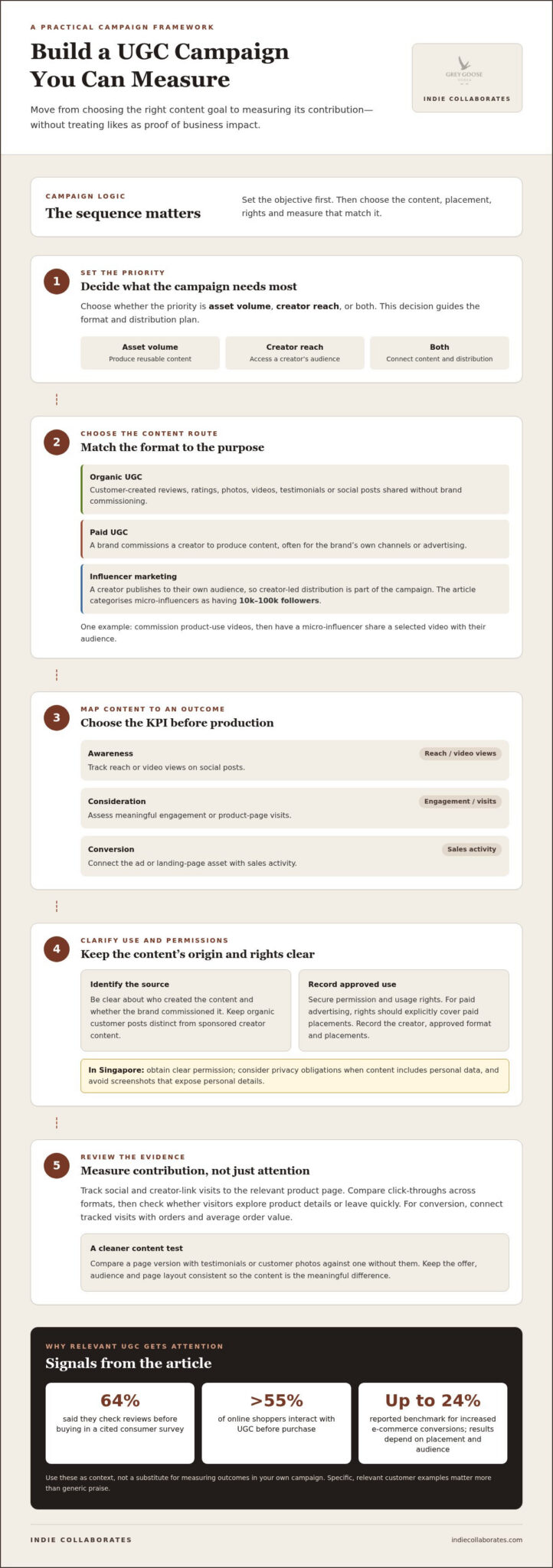
Organic UGC is customer-created content shared without a brand commissioning it. Paid UGC is content a brand commissions from a creator, often for the brand’s own channels or advertising. Influencer marketing usually pays a creator to publish to their audience, making distribution part of the campaign. In short, paid UGC prioritises content production; influencer marketing prioritises creator-led reach.
The distinction is about purpose, not simply how polished a video looks. A creator can make an authentic product demonstration for a brand’s paid ads without posting it personally. A sponsored influencer post, by contrast, uses the creator’s profile and audience. Keep organic customer posts separate from sponsored creator content, and secure usage rights that explicitly cover paid placements before using UGC in advertising.
Combining formats can connect the two goals. For example, commission a creator to produce several product-use videos, then work with a micro-influencer to share a selected video with their audience. Micro-influencers are categorised as having 10k-100k followers. A branded hashtag can help organise audience contributions, while creator-made assets provide planned volume and consistent messaging.
Map each UGC touchpoint to a campaign KPI before production. For awareness, track reach or video views on social posts; for consideration, assess meaningful engagement or product-page visits. For conversion, connect an ad or landing-page asset with sales activity. This keeps reporting tied to the intended outcome instead of treating likes as proof of business impact.
Start by deciding whether the priority is asset volume, creator reach or both. Then define the audience, placement, rights and measurement approach in the brief. A creator content strategy can help align content formats with campaign objectives, while influencer marketing can add creator-led distribution where audience access matters.
3. UGC benefits for credibility, feedback, traffic and conversions
Customer evidence can strengthen credibility by showing how a product performs beyond brand messaging. In a cited consumer survey, 64% said they check reviews before buying. More than 55% of online shoppers interact with UGC before purchase. Those signals can help address doubts, but specific, relevant examples matter more than a high volume of generic praise.
UGC can also provide actionable feedback. Group reviews and comments by recurring themes, such as sizing, delivery or ease of use. If customer photos repeatedly show a product used in an unexpected way, that pattern may guide product information or future creative. Treat praise and criticism as useful insight, not simply as promotional content.
To assess traffic, track visits from social posts and creator links to the relevant product page. Compare click-throughs across formats, such as a customer video and a product image. Then check whether visitors explore product details or leave quickly. This helps distinguish content that attracts attention from content that brings qualified visitors.
Conversion evidence needs a closer test. One reported benchmark says UGC can increase e-commerce conversions by up to 24%, but results depend on the placement and audience. Test a page version with testimonials or customer photos against one without them. Keep the offer, audience and page layout consistent so the content is the meaningful difference.
Brands can measure UGC’s impact on trust and conversions by comparing customer sentiment, engagement, click-throughs and completed purchases across test versions. For revenue, connect tracked visits with orders and average order value; don’t treat views or likes alone as sales evidence. In Singapore, reviewing these measures by product category can show whether a particular image, testimonial or video helps shoppers make a decision.
4. UGC as authentic product experience and social proof
UGC is customer-created material that shows real experiences with a product or service. It creates social proof when prospective buyers see other people describing, using or recommending something, rather than relying only on brand claims. In Singapore, 76% of shoppers read online reviews and ratings before purchasing on social media.
UGC’s strength lies in useful detail. A customer video can show how a kitchen appliance fits on a counter; a photo can show a garment’s colour in natural light. These examples help audiences picture ownership, while a review may explain a benefit or limitation that polished advertising leaves out.
Place customer content near the decision it supports. On product pages, position a relevant review beside the feature it discusses, such as fit or ease of use. On social platforms such as Instagram, show a customer post alongside the product or experience it features. Keep the connection clear without changing the creator’s meaning.
Authenticity depends on context, not just an unfiltered image. Preserve specific language in testimonials, avoid presenting general praise as proof of a particular product claim, and identify the source where appropriate. For example, a review about delivery speed should not imply product durability. Request permission before publishing customer photos or videos.
Build a repeatable approach: match each asset to a customer question, choose its placement, then assess whether it helps answer that question. A product-page image may help shoppers assess appearance; a social post may show how a product works in daily life. This gives customer content a defined role instead of treating every post as interchangeable.
For a more structured approach to creator-led product storytelling, develop a creator content strategy that connects authentic experiences with relevant customer questions.
Indie Collaborates: Influencer Marketing Campaigns
Indie Collaborates helps brands build structured creator-led campaigns through Influencer Marketing Campaigns and Scalable UGC Production. Use its creator content strategy to align formats, audiences and campaign goals, or to develop creator-produced assets for paid and organic channels.
For brands balancing content production with creator reach, the two approaches can work together: UGC builds a library of creative assets, while influencer campaigns connect content with creators’ audiences. Campaign Performance Reporting helps assess results against the outcomes you set, such as engagement, traffic or conversions.
Planning a creator-led campaign? Contact Indie Collaborates or visit indiecollaborates.com to discuss your goals.
Put your next creator campaign into motion
Start by choosing one customer question your marketing needs to answer. Build a focused creative brief around that decision: define the audience, the moment of hesitation, the content format and where the asset will appear. This gives creators clear direction while leaving room for natural, individual experiences.
A considered approach to UGC content for social proof treats each asset as part of the wider customer journey, not as a standalone post. Decide what you want the content to help people understand, then use campaign reporting to learn which messages merit further testing. That learning can shape stronger creative choices over time.
If you’re ready to plan creator content around a specific business goal, start a conversation with Indie Collaborates. Bring your audience, objective and initial idea; the next step is a more purposeful creator campaign.
Frequently Asked Questions
What is user-generated content (UGC)?
User-generated content is material created by customers or other users about a brand, product or service. For example, a customer might post a photo showing how a bag fits daily essentials, or describe the setup in a comment. Brands can use these real-world perspectives to help prospective buyers understand an experience beyond product descriptions and campaign messaging.
Do I need permission for a customer photo?
Yes. Ask the customer for clear permission before using their photo in marketing. In Singapore, consent matters when customer content includes personal data, such as an identifiable face or name. Specify where the photo may appear, such as a product page or paid advertisement, and keep a record of the approval and agreed use.
How is UGC different from influencer marketing?
UGC describes the content and its creation; influencer marketing also involves a creator publishing to their audience. For example, a creator could make a product demonstration for a brand’s advertising without posting it on their profile. If the campaign also asks the creator to publish the demonstration, audience reach becomes part of the activity.
Want Help Turning Social Proof Into a Scalable Growth Engine?
Indie Collaborates supports brands with Scalable UGC Production for creator-led assets, or Influencer Marketing Campaigns when creator distribution is part of the objective. Affiliate Programmes offer another way to build creator-led sales activity. Start by identifying the outcome you want, such as more usable creative or measurable campaign reach, then discuss an approach that fits that goal.
What is organic UGC?
Organic UGC is content users create and share without a brand commissioning that specific asset. A customer might post an Instagram story after trying a new café, for instance. If the business later wants to use that story in an advertisement, it should obtain permission for the intended use rather than assume a public post grants marketing rights.
What is paid UGC?
Paid UGC is content a brand commissions from a creator, usually for the brand’s channels or advertising. A brief might request a first-use demonstration, an answer to a common customer question and a clear product view. Before production, define placements and usage rights, especially for paid advertising, so the creator and brand share the same expectations.
