
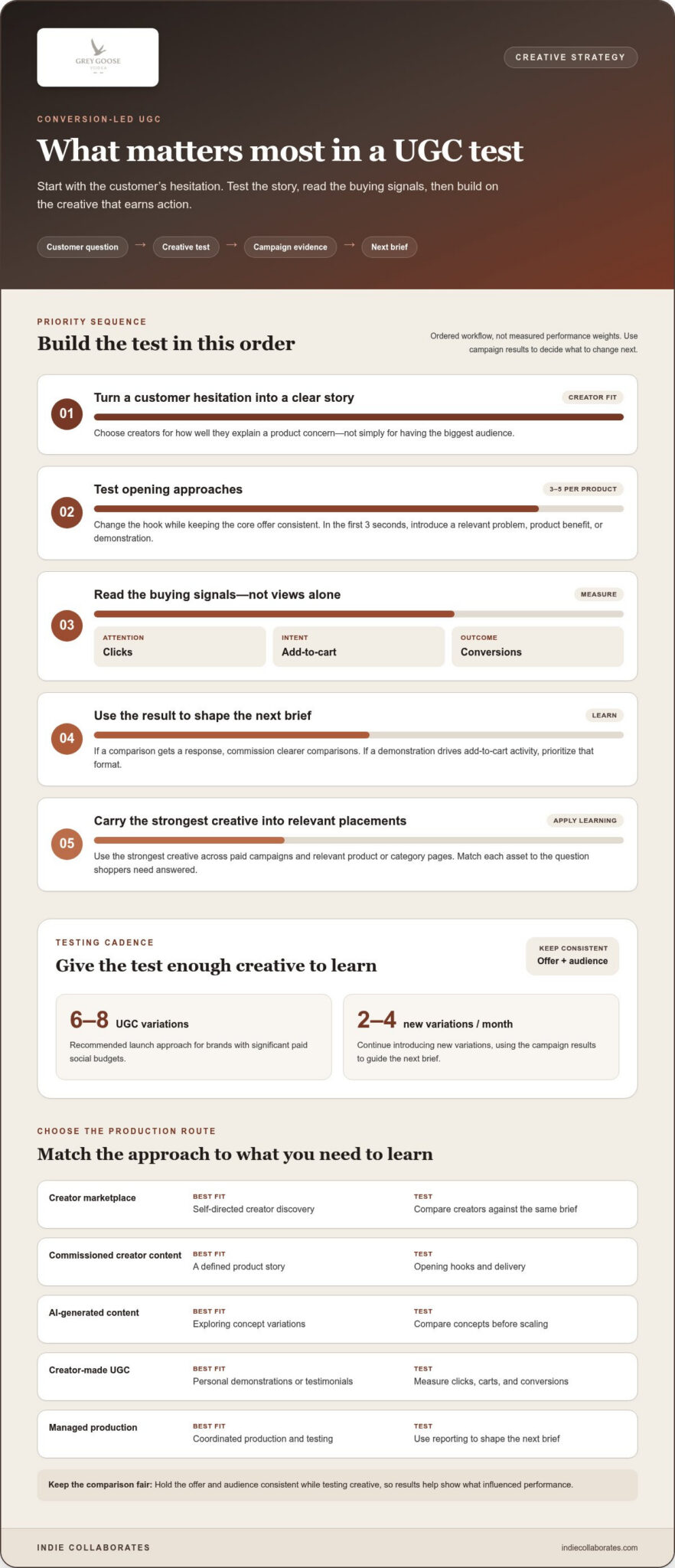
The creator with the biggest audience isn’t automatically the right choice for conversion-led UGC. For UGC production for conversion optimization, prioritize creators who can turn a customer hesitation into a clear product story, then assess each concept through clicks, add-to-cart activity and conversions. Test 3-5 opening approaches per product, and use the strongest creative across paid campaigns and relevant product or category pages.
Finding reliable creators is only part of the decision. Content also needs to fit the buying journey: a hook can earn attention, while a clear demonstration or testimonial can help shoppers decide. If you’re weighing creator-led content against a hybrid approach, choose the mix based on what you need to learn and where customers need reassurance.
This guide explains how to assess creators, use campaign data to shape creative, and allocate content between creator-led and hybrid production. You’ll also learn how to test UGC formats and place useful content across product and category pages, giving each asset a clear role in moving shoppers towards a purchase.
Key Takeaways
- Assess creators by how well they translate customer questions and hesitations into clear product stories, then use click, add-to-cart and conversion data to guide your next creative test.
- Choose a creator-led or hybrid approach based on the campaign’s purpose: building trust, generating testable creative, or supporting both goals.
- Match customer photos, videos and testimonials to the questions shoppers have on product and category pages, and secure permission before using their content.
- Compare video, carousel and single-image formats against the action you want shoppers to take, then adapt the strongest creative for its placement.
Using campaign data to inform creative strategy
Plan conversion-focused UGC by matching each creator brief to a customer hesitation, then compare clicks, add-to-cart activity and conversions. In Singapore, the best platform or agency route depends on whether you need self-directed creator discovery, commissioned assets or managed production and testing.
Hooks and Creative Variants
Test 3-5 opening approaches per product, changing the hook while keeping the core offer consistent. The first 3 seconds should introduce a relevant problem, product benefit or demonstration; campaign data then shows which angle earns attention and encourages action. Compare click, add-to-cart and conversion rates, not views alone. For example, if a demonstration attracts clicks but few carts, test a clearer benefit or a different customer concern.
Creator marketplaces let brands discover and commission creators directly, while creator-made UGC brings a person’s delivery and product experience into the content. AI-generated content can help explore concept variations; human creators can provide personal demonstrations and testimonials. Choose based on the message, audience and evidence your campaign needs.
Managed Production and Creative Testing
Managed production coordinates creator briefs, content creation and performance reporting; it differs from a marketplace, where the brand handles more of the process. Set one conversion goal, brief creators around specific objections, and test multiple hooks for each creative. For brands with significant paid social budgets, the recommended launch approach is at least 6-8 UGC variations, followed by 2-4 new variations per month.
Use campaign results to shape the next brief. If shoppers respond to a comparison, commission more clear comparisons; if a product demonstration drives add-to-cart activity, prioritise that format. Keep the offer and audience consistent while testing creative, so results help show what influenced performance.
| Option | Best fit | Testing approach |
|---|---|---|
| Creator marketplace | Self-directed creator discovery | Compare creators against the same brief |
| Commissioned creator content | A defined product story | Test opening hooks and delivery |
| AI-generated content | Exploring concept variations | Compare concepts before scaling |
| Creator-made UGC | Personal demonstrations or testimony | Measure clicks, carts and conversions |
| Managed production | Coordinated production and testing | Use reporting to shape the next brief |
Choose the approach that gives you the right balance of creator fit, production control and measurable learning.
Hybrid UGC strategies and content allocation
A hybrid approach pairs creator-made stories with AI-generated content or polished brand assets. Give each format a distinct role: creator content can demonstrate product use, while generated variations can help explore different messages. Tie the mix to campaign goals rather than treating every asset as interchangeable.
One suggested allocation is 70% AI UGC for volume and testing, with 30% traditional UGC for trust and authenticity. Treat this as a starting framework, not a universal formula. For a product that needs personal demonstration, give creator-made content more weight; for a campaign exploring multiple messages, use more generated variations and compare their performance.
UGC and branded content can play complementary roles. Traditional UGC posts on Instagram earn 28% more engagement than branded posts, while UGC is up to 5 times more likely to lead to conversion than brand-produced content. These measures describe different outcomes. Use engagement to assess attention, then evaluate conversion data to understand buying impact.
Agree on content rights before moving stories from social marketing to product pages. Obtain permission to use customer content in campaigns or on-site, and define the intended channels and uses. If you plan to edit or repurpose a creator’s content, explain the proposed changes and get their agreement. This keeps usage aligned with the creator’s expectations.
- Awareness: Use creator stories to introduce the product and invite discovery.
- Consideration: Pair a creator demonstration with a polished brand explanation of product details.
- Purchase: Place permitted testimonials or customer videos near product information, including at the bottom of a product page.
- Testing: Compare formats against the same audience and campaign objective before reallocating production effort.
Choose the balance by identifying the customer’s decision stage, the evidence they need and where the content will appear. A category page may benefit from varied customer perspectives; a product page can use focused demonstrations or testimonials to address specific doubts.
Distributing UGC across product and category pages
Place UGC where it answers the shopper’s next question. On a category page, customer photos can show product range, scale or different use cases. On a product page, a close-up demonstration can clarify how one item works. Match each asset to the decision that page supports instead of repeating the same video everywhere.
Product pages can feature customer videos in a gallery, concise testimonials in a reassurance block, or a dedicated section near product details. A customer video uploaded directly to a product gallery adds no third-party script. The bottom of the page can suit longer stories, giving shoppers room to explore social proof after reviewing specifications.
Category pages need a different balance. Choose formats that help shoppers compare relevant items, such as customer photos showing products in real-life settings. Keep each asset tied to the correct product, and avoid placing a specific testimonial beside unrelated items. This adds useful context without crowding the page.
- Product gallery: Use a permitted customer video or photo to show product details and real-world use.
- Product-page reassurance block: Place a concise testimonial near a decision point, such as product details or a call to action.
- Category page: Feature varied customer perspectives that help shoppers understand product differences.
- Homepage: Use a reassurance block to introduce customer experiences before shoppers choose a category.
Measure placements separately. Compare product-page and category-page performance using the same evaluation period and conversion definition. A/B test whether a gallery, reassurance block, or bottom-of-page placement changes shopper behaviour. Revenue attributed to a placement doesn’t establish incremental lift by itself; a controlled comparison helps show whether the content contributed additional value. Visitors who interact with UGC are associated with a 104% conversion lift, making placement and interaction worth evaluating together.
Get permission before featuring customer content on product pages or in campaigns, and agree on any creator edits or repurposing. Track each asset alongside its approved use and page placement. This helps preserve authenticity as content moves across formats.
Which UGC formats perform best for conversion optimization?
No single format works for every product or buying stage. Match the format to the information shoppers need: video can demonstrate use, a carousel can show several details, and a single image can communicate one clear benefit. Test each with the same audience and conversion goal to identify what moves shoppers beyond engagement.
For Facebook UGC ads, use 30-60-second storytelling to develop a product experience. A creator can introduce a need, show the product in use, then explain its value. For TikTok ads, use vertical 9:16 video. Adapt the opening and pacing to the platform, then compare results rather than assuming one cut works everywhere.
Let the product’s proof requirement guide the format. A skincare product may benefit from a creator demonstration, while customer photos showing a home accessory in its real-life setting may explain it more clearly. For e-commerce, choose natural customer photos and videos that show the product in use. This context can make social proof more relevant than a polished image alone.
- Video: Use for demonstrations, stories, or explaining how a product solves a specific need.
- Carousel: Show several angles, steps, or product details in one ad sequence.
- Single image: Highlight one visual benefit or customer perspective with minimal distraction.
- Customer photo or video: Present the product in a familiar setting to help shoppers picture its use.
For a fair comparison, keep the audience, offer and campaign objective consistent while changing the format. Track clicks and conversions as well as engagement. If video earns attention but a carousel generates more purchases, use each format for the role its results support. Review performance by placement too: an asset that works in an ad may need adjustment for a product page.
Build your next test around the product story and the format that communicates it clearly. Develop a creator content strategy that aligns creative choices with campaign goals.
Indie Collaborates: Influencer Marketing Campaigns
Indie Collaborates can turn a conversion-focused creative plan into creator campaigns and usable content. Its Influencer Marketing Campaigns support brands seeking end-to-end creator campaign execution, while Scalable UGC Production suits teams that need a structured supply of assets for creative testing. Campaign Performance Reporting helps connect campaign results with decisions about future content.
Turn to Indie Collaborates when your team has defined its audience, conversion goal and content needs, but wants support coordinating creator activity or producing UGC. If you’re ready to discuss how creator campaigns or UGC production could support your marketing plans, contact Indie Collaborates.
Build your next creative cycle with purpose
Make your next campaign a learning cycle, not a one-off content request. Give your team a shared brief linking the customer question, creator perspective, intended placement and business outcome. This helps marketing and commerce teams work towards the same creative objective while leaving room for creators to express ideas in their own voice. For UGC production for conversion optimization, a consistent brief can make each new test more useful than the last.
Indie Collaborates offers Influencer Marketing Campaigns, Scalable UGC Production and Affiliate Programmes. These services can support different parts of a creator-led growth plan, from campaign execution to asset production and affiliate activity. Choose the starting point that fits your current priority, then plan the next step around what your team needs to learn.
Contact Indie Collaborates to discuss a creator programme that fits your goals. Start with a clear objective, and move forward with confidence.
Frequently Asked Questions
How do I find reliable UGC creators for my brand?
Find reliable UGC creators by assessing fit, communication and execution, not follower count alone. Review sample work for clear product explanations, natural delivery and audience relevance. Give shortlisted creators a brief defining the customer, key message, format and intended use, then assess how well they interpret it. A dependable creator communicates clearly, follows agreed milestones and supplies content in the required formats.
What makes UGC ads perform better than traditional brand ads?
UGC ads present a product through a person’s experience, while traditional brand ads often rely on brand-led messaging and polished visuals. A creator showing how a product solves a specific problem can help shoppers picture how it works. That difference doesn’t guarantee stronger results. Compare both approaches with the same audience, offer, placement and conversion goal to see what works for your campaign.
Which social media platforms deliver the best results for UGC ads?
No platform is best for every brand; choose based on audience behaviour, content fit, and campaign objective. TikTok UGC ads commonly use vertical 9:16 video, while Facebook storytelling ads can use 30-60-second narratives. On Instagram, test how creator content fits the placement and call to action. Compare platform results using the same conversion measure, rather than choosing by views or engagement alone.
What is UGC production for conversion optimization?
UGC production for conversion optimization means planning and creating user-generated-style content to encourage a defined customer action, such as adding a product to cart or completing a purchase. Start with a customer need, translate it into a creator brief, then evaluate the content against conversion data. The aim is business impact, not simply high view counts or social engagement.
How does user-generated content affect conversion rates and purchase decisions?
User-generated content can help shoppers assess a product through real-life examples and customer perspectives. 79% of consumers say UGC directly influences their buying decisions, and two-thirds of shoppers are likely to make a purchase based on UGC. For a practical evaluation, compare product-page interactions and completed purchases before and after adding relevant customer content, while keeping other page changes in view.
How should UGC be tested and optimized in A/B tests?
Test one meaningful creative change at a time, such as the opening hook, creator delivery or format. Keep the audience, offer and placement consistent, and set the primary success measure before launch. Track actions further down the buying journey, not just video views. For example, if a new opening increases clicks but not purchases, test whether the rest of the content answers product questions clearly.
