
What if the best UGC concept for TikTok is the wrong fit for Instagram or YouTube Shorts? A creator’s video can feel authentic and still miss its mark when the format, hook or message doesn’t suit the channel. Effective UGC production for social media marketing starts with channel roles, then turns strong ideas into useful, reusable creative.
Making that happen takes more than asking creators for content. You need to turn audience insights into clear briefs, give creators enough direction to meet brand standards without flattening their voice, and plan assets for more than one use. The goal is creative that feels relevant to its audience and fits its paid or organic placement.
This guide explains how to match concepts to channel needs, brief creators clearly and plan assets for reuse. It also outlines a production workflow for building a content library that supports testing and ongoing campaigns. With creator perspective and brand strategy working together, UGC can become a repeatable creative system rather than a collection of disconnected videos.
Key Takeaways
- Set a clear role for each social channel before deciding what creators should make.
- Turn audience research into a focused brief that guides the message while leaving room for the creator’s perspective.
- Choose video, still images, testimonials or demonstrations based on the communication task and where the content will appear.
- Use a practical planning sequence to connect your objective, audience, channel and format in each production cycle.
- UGC production for social media marketing can build a reusable content library for paid ads, organic social and creative testing.
Why UGC production for social media marketing starts with channel roles
UGC production for social media marketing is the planned creation of creator-led assets for specific brand-selected social uses. Define the channel’s role before filming: it helps determine who the content is for, what the opening needs to communicate and what response the asset should invite. Without that direction, even a polished video may not suit its placement.
User-generated content can also refer to material customers create and share independently. The broader idea is outlined in this user-generated content overview, but commissioned creator assets and unsolicited customer posts aren’t interchangeable. A brand can plan, brief and review commissioned work for marketing use. Customer posts originate independently, so the brand doesn’t control their original format or message.
What does UGC production mean for a brand?
In a production programme, a brand works with creators to make content for an agreed purpose and selected social placements. Assets may support paid ads, organic social or creative testing. Each use has a different job: an ad might introduce a message to a new audience, an organic post might contribute to regular brand content, and a test might compare creative approaches.
Creator-led content isn’t automatically authentic, and it doesn’t guarantee stronger results. Its value comes from combining a clear brand objective with a creator’s perspective, then ensuring the finished asset suits its intended use. A customer’s personal post can offer a genuine view of their experience, but it doesn’t become a commissioned deliverable simply because a brand later shares it.
Why do social channel roles matter before production?
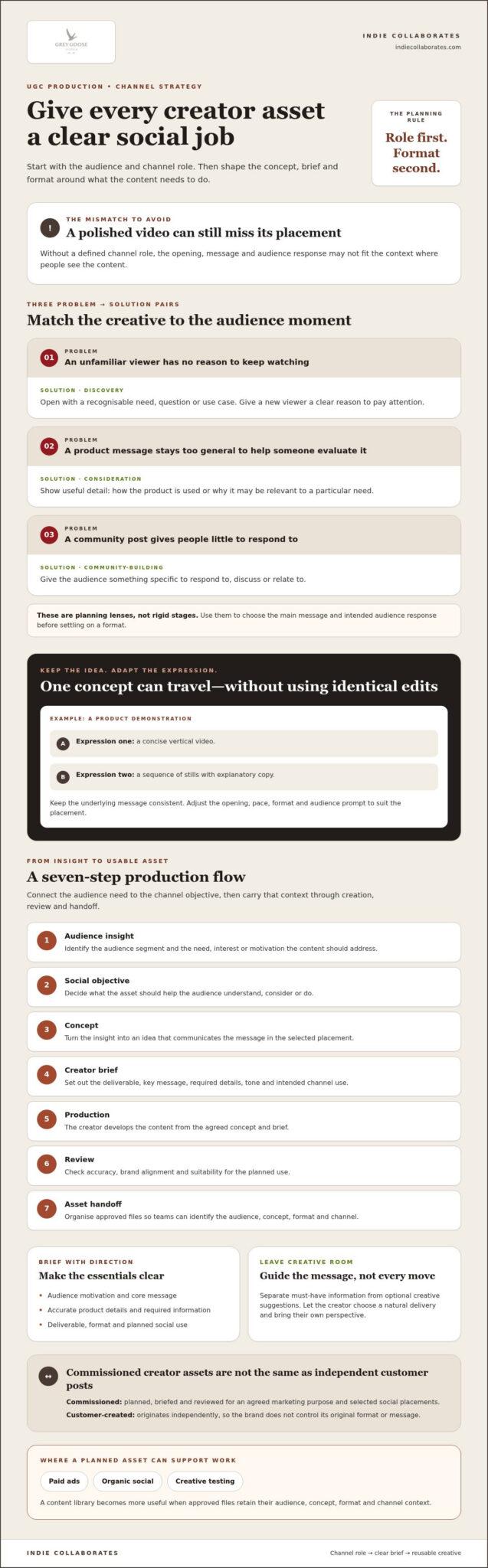
People encounter content in different contexts. Someone discovering a brand may need a quick reason to pay attention. Someone considering a product may need an explanation or demonstration. An existing community may respond to a prompt that invites conversation. These are planning lenses, not rigid stages. They help marketers choose the main message and intended audience response before settling on a format.
Start with the role, then brief the asset:
- Discovery: Lead with a recognisable need, question or use case that gives an unfamiliar viewer a reason to keep watching.
- Consideration: Focus on useful detail, such as how a product is used or why it may be relevant to a particular need.
- Community-building: Give the audience something specific to respond to, discuss or relate to.
One core idea can travel across channels, but it may need a different expression. A product demonstration could become a concise vertical video for one placement and a sequence of stills with explanatory copy for another. Keep the underlying message consistent while adjusting the opening, pace, format and audience prompt. That lets creators make work suited to each platform instead of forcing identical edits everywhere.
Before production, record the channel, its role, the intended audience and the response the content should encourage. This gives the creator a clearer brief and the brand a practical standard for reviewing the finished asset.
How UGC moves from audience insight to social-ready content
A useful production process connects audience needs with what a social asset must do. Research informs the message, the channel objective gives it direction, and the brief turns both into a practical creative starting point. Creators develop the content, the brand reviews it against agreed criteria, and approved files are organised for use.
Move from audience insight to channel-ready content by defining the audience need, setting a social objective, shaping a concept, briefing the creator, producing and reviewing the asset, then handing it off with clear usage context.
- Audience insight: Identify a relevant audience segment and the need, interest or motivation the content should address.
- Social objective: Decide what the asset should help the audience understand, consider or do.
- Concept: Turn the insight into an idea that communicates the message in the selected placement.
- Creator brief: Set out the deliverable, key message, required details, tone and intended channel use.
- Production: The creator develops the content from the concept and brief.
- Review: Check accuracy, brand alignment and suitability for the planned use.
- Asset handoff: Organise approved files so teams can identify their audience, concept, format and channel.
Turn audience research into a useful creator brief
Research should clarify who the content is for and what matters to them, not prescribe every line, gesture or shot. For example, if an audience segment wants to simplify a routine, the brief can focus on that motivation and the product detail that addresses it. The creator can then find a natural way to tell the story.
Make the brief a shared reference. Separate must-have information, such as an accurate product detail or core message, from optional creative suggestions. Include the required format and planned social use, while leaving room for the creator’s delivery and point of view.
Coordinate production, review and asset handoff
With the agreed concept and brief, the creator can build the asset around the audience need and intended placement. Review it against the brief, not personal preference alone: is the information accurate, does it reflect the brand, and is it suitable for its planned use? Clear criteria make feedback more focused and help preserve the creator’s voice.
After approval, use a consistent naming or filing structure that captures audience segment, concept, format and channel. This makes assets easier to find for paid ads, organic social or creative testing, and helps teams select the right version. A structured approach to UGC production can connect creator insight, campaign execution and reporting in a repeatable workflow.
Which UGC formats fit different social media marketing needs?
Choose a format for the job the content needs to do, not simply because it’s popular. Short video can make a sequence or explanation easier to follow; a still image can focus attention on one product detail. Testimonials and demonstrations also serve different purposes. For UGC production for social media marketing, ask whether the format helps the audience understand the message in the context where they’ll see it.
| Format | Useful for | Planning consideration |
|---|---|---|
| Short-form video | Showing a sequence, creator explanation or moment of use. | Decide what viewers should see or understand first, then shape the opening and pacing around that message. |
| Still images | Highlighting a product detail, visual idea or concise message. | Keep the central detail clear and consider how the image will appear alongside its caption or surrounding content. |
| Testimonials | Sharing a creator’s perspective or experience in their own words. | Keep the point relevant to the audience and ensure the content accurately reflects the experience being described. |
| Demonstrations | Explaining how something works or showing a process step by step. | Choose a format that gives the viewer enough context to follow the action, whether that calls for video or a sequence of images. |
When should a brand choose short-form video or still imagery?
Video is a natural choice when meaning depends on movement or sequence, such as a creator explaining a routine, showing how a product is used or walking through a process. Still imagery suits a message that can be understood through one focused visual, such as a product detail paired with a concise caption. Neither format is universally better. Let the message and viewing context determine the choice.
The same concept may need a different story in each format. A video might show the steps in a routine, while a still image draws attention to one useful detail. Adapt the idea to the format instead of compressing a video script into a caption or adding motion without a clear purpose.
How do organic and paid social uses affect asset planning?
Before production, identify whether the asset is intended for an organic post or paid placement, and consider the audience’s context. Organic content may contribute to an ongoing conversation with people who encounter the brand’s posts. Paid creative may need to introduce the message to people who haven’t chosen to follow the brand. Plan each asset for its intended placement.
Build variants around meaningful differences, such as a distinct audience need, message or explanation. Changing only a caption or crop may not create a useful alternative if the communication itself stays the same. Keep paid-social planning focused on the asset’s role and format; campaign setup and testing are separate considerations.
Let the content’s purpose lead. A trend can inspire a creative approach, but it shouldn’t determine the format before the audience need and placement are clear.
How to plan UGC production for social media marketing
A production cycle is easier to manage when every concept has a defined audience, purpose and destination. Start with the social objective, then decide which audience you want to reach and what message could help move that objective forward. Choose the channel, format and creator approach after those decisions. This keeps UGC production for social media marketing connected to a clear use instead of generating assets without a plan.
Build a channel-and-content planning map
Before commissioning content, record the essentials for each concept in one planning document. This gives strategy, production and review teams a shared view of what each asset should accomplish, without locking every creator into the same execution.
- Priority audience: Name the segment and the need, interest or motivation the content should address.
- Message: State the key idea the audience should take away, along with any essential supporting detail.
- Social role: Define whether the concept supports discovery, consideration, community interaction or another agreed objective.
- Format and placement: Select the content format and intended social placement based on how the message will be encountered.
- Success measure: Connect the asset to an agreed campaign or content objective, so evaluation has a clear reference point.
Then decide whether an idea can be adapted or needs a distinct treatment. A demonstration might work as a video and as a still-image sequence if each format makes the same information easy to follow. But if one placement needs to introduce a benefit and another needs to answer a specific question, treat them as separate concepts rather than superficial edits of one asset.
Keep the plan proportionate to the objective. There’s no universal number of assets or posting frequency for every campaign; let the audience, channel mix and creative question determine the scope of each production cycle.
Create a review and learning loop
Review each asset against its purpose: is the message clear, is the content aligned with the brand, and does it fit the planned audience and placement? Focus feedback on the brief and agreed criteria. Specific direction helps creators understand what needs attention without turning review into a rewrite of their personal delivery.
After the content is used, compare outcomes with the objective set at the start. Note patterns by audience, concept and format, then apply relevant observations to future briefs. Interpret each result in context rather than assuming every audience or channel will respond the same way. This loop turns each production cycle into useful learning.
For a deeper look at building a repeatable approach, explore a guide to scalable UGC production services. A structured production workflow can help connect creator-led assets to campaign needs through UGC production support.
How Indie Collaborates supports UGC production for social media marketing
A channel-first framework gives brands a clearer way to plan creator content. The next step is coordinating the people, decisions and assets that bring it to life. Indie Collaborates produces UGC for paid ads, organic social and creative testing, connecting brand objectives with creator perspectives through a structured process.
What does managed UGC production involve?
Managed production brings strategy, creator selection, execution and analytics reporting into one campaign process. Audience insights and research help identify needs and messages relevant to different segments. Those insights inform the creative direction, while creators contribute their own perspective. The aim is a thoughtful collaboration that supports brand equity and gives each asset a defined purpose.
For brands, the process connects:
- Strategy to the campaign objective and audience insight.
- Creator selection to the audience and content concept.
- Execution to the brief, intended format and channel use.
- Analytics reporting to the outcomes the campaign set out to assess.
This structure supports a scalable content library for paid, owned and earned channels, rather than a set of disconnected requests. Assets can be planned for different uses while staying grounded in the brand’s strategy. The approach makes creator-led production more organised and measurable without assuming every piece of content will produce the same response.
How can brands take the next step?
Start with the essentials: define the audience, the social objectives and the intended uses for the content. A clear campaign brief gives the work a practical foundation, aligning brand priorities with the creator collaboration and the assets the team needs.
As planning develops, consider how creator insights can shape concepts for distinct audience segments, and how approved assets may support more than one channel. The ultimate guide to scalable UGC production offers broader context for brands considering a structured approach to creator-led content.
Indie Collaborates brings strategy, creator selection, execution and reporting together to support UGC production for social media marketing. Explore UGC production with Indie Collaborates to shape a production approach around your campaign objectives and creator collaboration.
Make your next creator brief a starting point
Your next step doesn’t need to be a large production plan. Choose one audience and one social objective, then identify the creative question you want the content to help answer. That focus gives your team a practical starting point for UGC production for social media marketing, while leaving room to learn and refine future work.
Think of each production cycle as a foundation for the next. A useful asset library isn’t simply a collection of files; it reflects clear choices about audiences, messages and intended uses. With a considered approach, creator collaboration can become a more connected part of your wider marketing activity.
Indie Collaborates supports the planning and production of creator-led content around campaign needs. Explore UGC production with Indie Collaborates to develop a more intentional creative workflow.
Frequently Asked Questions
Is UGC production the same as influencer marketing?
No. UGC production commissions creator-led assets for a brand’s marketing use, while influencer marketing commonly centres on a creator publishing sponsored content to their own audience. A campaign can include both: a creator might make a video for a brand’s channels and publish a separate sponsored post. Make the priority clear in the brief, whether that’s content creation, creator reach or a combination.
Can a brand use creator-produced UGC in both paid and organic social?
Yes. Creator-produced assets can be planned for paid ads, organic social or both. State the intended placements before production so the concept and format suit how the content will appear. Agree on the relevant usage permissions with creators as well. A video commissioned for an organic post shouldn’t automatically be treated as approved for paid promotion; clear usage terms help prevent that mismatch.
How much UGC should a brand produce for social media marketing?
There’s no universal amount. Base the initial scope on the audiences, messages and placements your campaign needs to address. For UGC production for social media marketing, a focused set of concepts can help your team learn which ideas warrant further development. For example, compare content addressing different audience questions, then use the campaign objective and results to shape the next cycle instead of following a fixed quota.
What should a UGC creator brief include?
A useful brief covers the target audience, communication objective, key message, intended format and planned placements. Add practical deliverable details and explain how review will work, so creators know what to prepare and how feedback will be handled. Separate essential information, such as accurate product details, from optional storytelling suggestions. That distinction gives creators clarity without prescribing every word or action.
How can brands keep UGC authentic and on-brand?
Give creators accurate information, a clear purpose and the brand boundaries that matter, then allow them to express the idea in their own way. For instance, specify a product claim that must be accurate, but avoid scripting every line of a personal explanation. During review, focus on factual accuracy and brand alignment. Suggest changes where they’re needed, not simply to make every creator sound alike.
What should brands measure after publishing UGC?
Choose measures that reflect the content’s intended role. For a post designed to introduce a brand, examine relevant attention and reach indicators. For a campaign intended to prompt action, use measures tied to that outcome. Where possible, compare patterns across concepts, audiences and placements. Record what the results suggest for future briefs, but don’t treat one campaign’s outcome as proof that a format will always work best.
Do brands need customer-created posts to produce UGC?
No. Brands can commission creator-led assets without relying on customers’ existing posts. The content types have different origins: a commissioned video is made for an agreed marketing purpose, while a customer post is independently created. A brand can brief a creator to explain a product feature even if no customer has posted about it. Plan each asset around its intended message and use.
