
What if ad-ready creator content were built as a repeatable system, not a one-off video? User generated content creation for ads can give brands a natural way to communicate, but an engaging clip alone won’t persuade someone to act. The campaign objective, creator brief and reason to respond all need to work together.
It’s understandable to want creator content that feels genuine without losing brand consistency. The challenge is giving creators enough direction to make the message clear while leaving room for their own voice. It also helps to distinguish UGC production, where a brand commissions content for its channels, from influencer marketing, where a brand partners with a creator to reach their audience.
This guide explains how to turn a campaign objective into a clear brief, support production and review each asset for authenticity, brand fit and message clarity. You’ll also learn how to interpret creative results and apply those learnings to future work, without assuming a particular format will guarantee performance. The goal is a practical process that connects creator insight with purposeful content across paid, owned and earned channels.
Key Takeaways
- Build User generated content creation for ads around a defined campaign objective, audience need, message, creative concept and deliverable.
- Choose creator-made or AI-generated content based on the authenticity cues, message control and production needs your campaign calls for.
- Use a focused review process to assess accuracy, brand fit, message clarity and whether the opening gives viewers a reason to keep watching.
- Turn creative results into learning for future tests, without assuming one asset or format will guarantee performance.
- Connect strategy, creator selection, production and reporting in a managed UGC system for ads, organic social and creative testing.
What Is User-Generated Content Creation for Ads?
User generated content creation for ads is the planned production of creator-led photos or videos for a brand to use in paid advertising. The style may feel conversational and platform-native, but the asset is created to serve a campaign objective, not simply to document someone’s spontaneous experience. For a broad overview of the term, see User-generated content (UGC) definition and types. In advertising, it helps to distinguish the content’s style and source from the way it is used.
“UGC” can describe organic posts that customers create and share, as well as creator-made assets commissioned by a brand. These are not interchangeable. A customer post begins with the customer; an ad asset is produced to meet a defined brief and intended use. A conventional brand-produced advertisement, by contrast, is created directly by the brand or its production team. Creator-led work brings a person’s voice and perspective into a planned piece of advertising.
Quotable definition: UGC for ads is creator-produced content a brand commissions for its own advertising; influencer marketing pays for a creator’s reach to their audience.
How Ad-Focused UGC Differs from Organic Creator Content
An ad asset starts with a campaign objective and audience. The brief guides what the creator demonstrates, explains or brings to life, while the brand determines where the asset will run as an ad. Organic creator content, on the other hand, is published to the creator’s own audience. A creator’s natural delivery can make an ad feel relatable, but it does not automatically mean the person is a customer or is sharing a personal testimonial.
Where UGC Fits in a Brand’s Advertising Mix
Creator-led assets can demonstrate how a product is used, frame a familiar audience problem or explain a benefit in everyday language. For example, a creator might show how a kitchen storage item fits into a weekly routine, while a brand-produced asset focuses on specifications or a broader campaign idea. Each format has a role, and creator content can complement existing creative rather than replace it.
This flexibility makes the format useful across paid ads, organic social and creative testing, provided the intended use is clear from the outset. A production plan can also help teams develop a library of distinct assets instead of relying on one execution. For a wider look at planning and building that process, explore this scalable UGC production guide.
How to Turn an Advertising Goal into a Strong UGC Brief
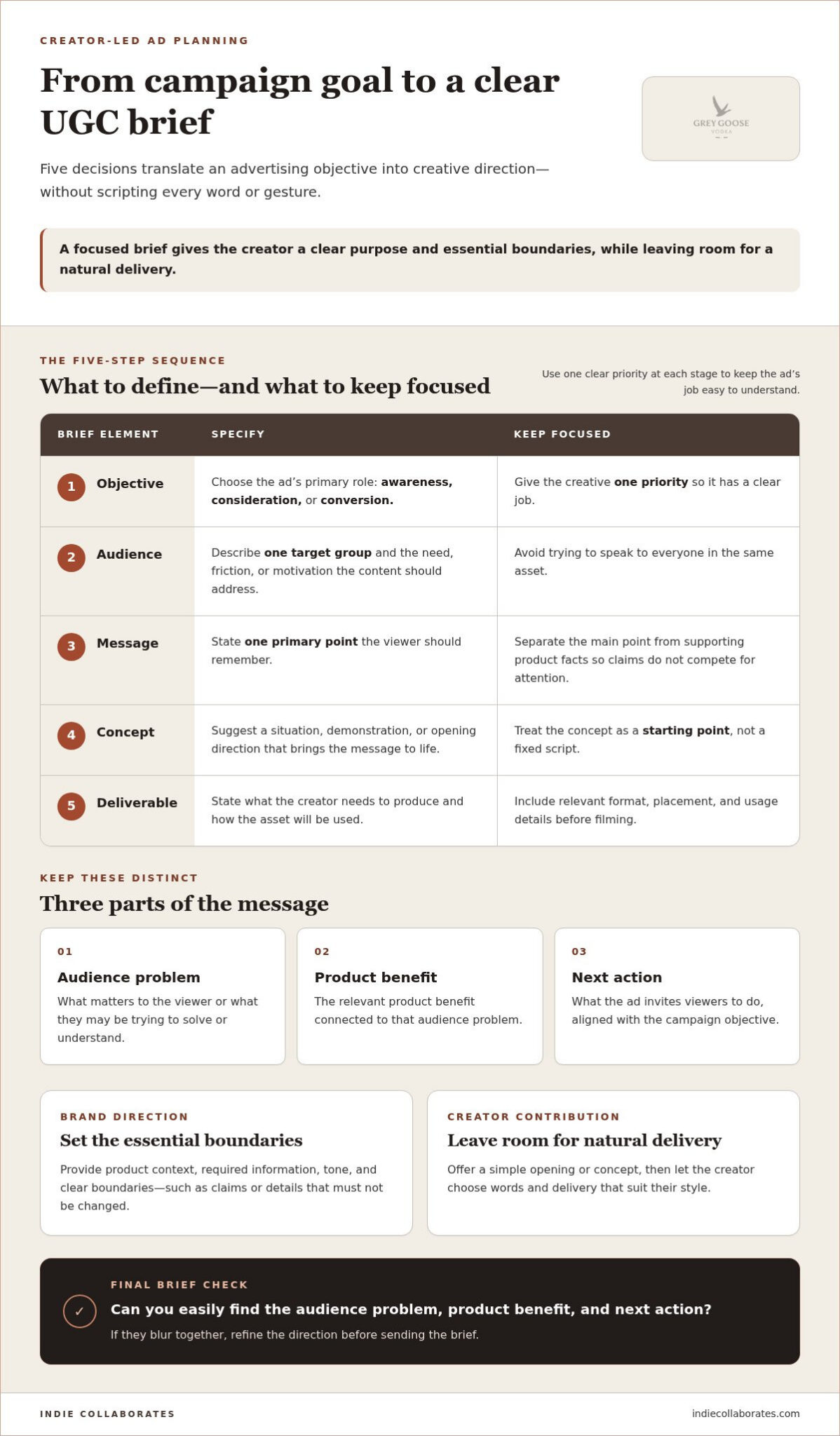
A useful UGC brief translates a marketing objective into clear creative direction without dictating every word or gesture. For User generated content creation for ads, align the campaign goal, audience need and creator’s approach before production begins. Keep the audience problem, product benefit and desired next action distinct: they explain what matters to the viewer, what the product offers and what the ad invites them to do.
A focused brief gives the creator a clear purpose and essential boundaries, while leaving room for a natural delivery.
Use this five-step sequence to shape the brief:
- Define the objective. Decide the ad’s primary role, such as building awareness, supporting consideration or prompting a conversion. One priority gives the creative a clear job.
- Choose the audience. Describe one target group and the need, friction or motivation the content should address. Avoid trying to speak to everyone in the same asset.
- Set the message. State one primary point the viewer should remember. Keep it separate from supporting product facts so several claims do not compete for attention.
- Shape the concept. Suggest a situation, demonstration or opening direction that can bring the message to life. Treat the concept as a starting point, not a fixed script.
- Specify the deliverable. State what the creator needs to produce and how it will be used. Include relevant format, placement and usage details so expectations are clear before filming.
Set the Audience, Message, and Ad Objective
Make the audience description practical: identify who the ad is for and what they may be trying to solve or understand. Then connect that problem to one product benefit, rather than listing unrelated advantages. For example, a brief for a meal-planning app might address the challenge of deciding what to cook, explain how the app helps organise ideas, and invite viewers to explore it. Match the message to the campaign objective instead of trying to serve every stage at once.
Give Creators Structure Without Over-Scripting
Include product context, required information, tone and clear boundaries, such as claims or details that must not be changed. Offer a simple opening or concept, then let the creator choose words and delivery that suit their style. Creator insight can help identify a natural way to show the product or explain its relevance, while the brief keeps the execution aligned with the brand.
Before sending the brief, check that the audience problem, product benefit and next action are each easy to find. If they blur together, refine the direction. Teams building a consistent brief-to-production process can explore creator content strategy with Indie Collaborates as part of a structured approach to creator-led production.
Creator-Made or AI-Generated UGC Ads: How to Choose
Creator-made content and AI-generated UGC-style content can both be designed for advertising, but they offer different creative inputs. One features a real creator’s delivery; the other uses generated elements to create a UGC-inspired look. Neither route is automatically right for every campaign. For User generated content creation for ads, choose based on the message, audience expectations, production requirements and how much human perspective the concept needs.
Use this comparison to frame the decision:
| Consideration | Creator-led production | AI-generated UGC-style content |
|---|---|---|
| Authenticity cues | A real person’s voice, gestures and perspective can bring human nuance. | Can imitate familiar creator-style conventions, but does not represent a verified customer experience. |
| Message control | A clear brief guides the message while the creator shapes the delivery. | May offer direct control over generated elements, but still needs close review for accuracy and tone. |
| Production needs | Requires creator selection, coordination and production planning. | Uses a generation workflow; the output still needs assessment and approval. |
| Brand suitability | Useful when a human demonstration or lived perspective supports the concept. | May suit concepts where generated presentation fits the brand and audience expectations. |
Brand safety depends on the asset itself, not just the production route. Check claims against approved product information, confirm the tone fits the brand, and assess whether the people and situations shown are appropriate for the audience. Pay particular attention to portrayals that could be mistaken for a real customer’s experience.
When Creator-Led Production Is the Better Fit
Choose creator-led production when the ad needs a human demonstration, a personal point of view or a natural explanation of how a product fits into a routine. Creator selection and audience insight can help shape a relevant concept without assuming every viewer has the same needs. A concise brief can set factual and brand boundaries while leaving the creator room to deliver the idea in their own voice.
When AI-Generated UGC-Style Content May Fit
AI-generated content may suit a campaign when its synthetic presentation aligns with the concept and brand. Treat it as a distinct production method, not as customer-created content or proof of lived experience. Examine the portrayal, product details and overall tone carefully, including whether a viewer could mistake a generated person or account for a real customer. Production speed alone is not enough to determine suitability.
Before choosing, write down what the asset must communicate and what could undermine trust. Then compare each route against that standard: Does the format support the message? Are product details represented accurately? Does the tone fit? Is the portrayal appropriate? This keeps the decision grounded in campaign needs rather than assumptions that creator-made or AI-generated content will perform better.
How to Produce, Review, and Learn from UGC Ad Creatives
A strong production process connects the approved brief to an asset that is ready for review and its intended use. For User generated content creation for ads, make each step visible so the team can spot gaps before they lead to revisions: align on the brief, select a suitable creator, confirm production expectations, review the asset and record what the campaign teaches you.
- Align on the brief. Confirm the objective, intended audience, key message, concept and deliverable before production begins.
- Select the creator. Consider whether their communication style and perspective suit the audience and concept, not just whether they can appear on camera.
- Coordinate production. Share the necessary product context, factual boundaries and practical requirements, while giving the creator room to deliver naturally.
- Review and approve. Check the finished asset against the brief and agree on any revisions before it is used.
- Record the learning. Connect campaign reporting to the creative choices made, then identify what may be useful to test next.
Set expectations for paid-media use and potential adaptations before deployment. The team should understand where the content may appear and what changes are planned, so approval covers the intended use rather than only the first version.
Review the Asset Before It Goes Live
Review more than polish. The asset should be accurate, easy to follow and appropriate for the intended audience. Check every factual product detail against approved brand information, then assess whether the creator’s delivery feels clear and credible. Finally, watch the opening without relying on context from the brief: does it give viewers a reason to keep watching, and is the message understandable?
- Accuracy: Are product details and claims consistent with approved information?
- Message clarity: Can viewers understand the main point and intended next step?
- Brand fit: Does the tone and presentation suit the brand and audience?
- Usage: Are paid placement and planned adaptations covered by the agreed permissions?
Use Campaign Results to Shape the Next Creative
Once the asset runs, review campaign reporting alongside its intended audience, message and placement. Results are evidence to interpret, not proof that one creative choice caused a change. Other campaign factors may influence what the numbers show, so avoid treating a single outcome as a universal rule.
Capture a practical learning: perhaps a product demonstration held attention, a particular message was clearer, or a different opening deserves testing. Keep the next test focused so the team can make a useful comparison. A scalable UGC production strategy can connect creative production with ongoing testing and learning.
For a managed process that links creator-led production with campaign reporting, explore UGC production with Indie Collaborates.
How Indie Collaborates Supports User-Generated Content Creation for Ads
User generated content creation for ads works best when strategy, creator selection, production and learning connect. Indie Collaborates manages creator-led campaigns, bringing those elements together from brief through reporting. This approach builds content around a campaign purpose and creator insight, with brand fit and responsible communication in view.
UGC production can support more than paid placements. Indie Collaborates produces creator-led assets for paid ads, organic social and creative testing, giving teams content to draw on for different needs. A consistent strategic foundation helps each asset serve its intended role without assuming one creative will suit every audience or placement.
From Campaign Brief to Creator-Led Content
Clear briefs and considered creator matchmaking give production a shared direction. The brief aligns the brand and creator on the campaign message and boundaries; creator insight informs how that idea can be expressed naturally. This balance matters. Too little direction can leave content disconnected from the campaign, while overly prescriptive instructions can restrict the creator’s voice.
Creator feedback reflects the value of concise briefs, respect for creative control and organised collaboration. These practices help creators understand what the brand needs while leaving room for their perspective. Long-term creator partnerships can also sustain continuity across campaign activity, building familiarity between collaborators rather than treating each project as an isolated exchange.
As the content library grows, teams can organise creative assets around their intended uses, such as paid advertising, organic social or message testing. This gives brands a clearer view of what content is available and how it fits into wider creative plans. Brand safety and performance focus remain important throughout production, without promising a particular campaign outcome.
A Managed Partner for Performance-Led Creative
Indie Collaborates connects creator content strategy and creator selection with campaign execution and analytics reporting. Managing these elements together keeps the work aligned from planning through review, rather than separating production from the campaign context it serves. Reporting helps teams understand how their creative performed and identify questions to explore in future work, without making unsupported assumptions about what caused a result.
Client feedback has highlighted clear, detailed analytics reporting and creative ideas. That feedback points to the value of combining structured campaign management with useful creative thinking. The process helps brands produce creator-led content for paid ads, build assets for other channels and use campaign learning to inform future creative decisions.
If your team wants to connect creator strategy with managed production, explore Indie Collaborates’ UGC production support.
Make Your Next Creative Test More Intentional
Treat User generated content creation for ads as an ongoing creative practice, not a single production request. Start with one campaign need, decide what you want the audience to understand, then use the asset and campaign learning to shape your next creative decision. Progress comes from a clear process and thoughtful iteration, not from assuming any one format will guarantee a result.
Strong collaboration supports that process. Creator feedback has highlighted concise briefs and respect for creative control, while client feedback has recognised fresh creative ideas and detailed analytics reporting. Together, these perspectives point to a useful balance: give creators clear direction, preserve their ability to deliver naturally, and use reporting to inform what you test next. End-to-end campaign management connects strategy, creator selection, execution and reporting, helping teams keep the work aligned from planning to review.
Ready to build a more structured approach to creator-led ad content? Explore Indie Collaborates’ UGC production support and take the next step toward a creative process your team can learn from and develop over time.
Frequently Asked Questions
What does UGC mean in advertising?
In advertising, UGC refers to content presented in a creator or customer style to communicate a product or brand message. It may be made by a hired creator, so the format alone does not prove the person has used or bought the product. For example, a creator can demonstrate a feature without claiming personal customer experience. Ad-focused UGC is planned for a campaign and distributed through paid media.
How do you make a UGC ad feel authentic?
Give the creator a clear audience need and one message, then leave room for their natural way of expressing it. In User generated content creation for ads, authenticity comes from a credible fit between the creator, concept and intended audience, not from forcing casual language into a script. For example, let the creator explain a product in their own words, then review the claims and brand fit before use. No style guarantees performance.
Can a brand use customer-submitted content in paid ads?
Potentially, but finding a customer post online does not automatically give a brand permission to use it in an advertisement. Get permission from the creator and agree on intended channels, edits and usage period before the content runs. For instance, permission to repost a video organically may not cover paid placement or a cut-down version. Check the content for accurate claims and brand suitability, and follow relevant platform rules and applicable guidance.
Is UGC advertising suitable for B2B brands?
Yes, UGC-style advertising can suit B2B campaigns when the format helps explain a business need, product experience or practical use case. A software company, for example, might use a creator-led walkthrough to show how a team completes a task. Brief for the decision-maker, the message and the evidence the creative can accurately present. A testimonial is not essential: demonstrations, explainers and informed points of view can serve different campaign objectives.
Can UGC ads work without showing a creator’s face?
Yes. A UGC ad can focus on hands using a product, a voiceover, a screen demonstration or another visual approach that makes sense for the message. A face-free format may be useful when the product action matters more than the presenter, such as showing how an item is assembled. Keep the benefit easy to understand and the claims accurate. Choose the execution to suit the audience and placement, not because every ad needs a talking head.
How should a brand adapt one UGC asset for different ad placements?
Treat each placement as its own viewing context rather than automatically cropping one master file. Review framing, text size, pacing and whether the main message remains clear in each format. For example, a version designed for a vertical feed may need a different opening or text position than a wider placement. Agree on planned edits before production or use, keep the core message consistent, and interpret results carefully because placement and creative changes can interact.
What should a UGC ad review checklist include?
Check the asset against its brief, product information and intended use before approving it. Confirm that the opening makes sense without extra context, the main message is easy to follow, and the creator’s delivery suits the audience. Review visual details such as legible on-screen text, then confirm planned edits and advertising usage are agreed. After launch, compare the asset with available campaign reporting and note observations as hypotheses to test, not proof of cause.
Ready to build a structured approach to creator-led ad content? Explore UGC production with Indie Collaborates.
