
Pretty lifestyle videos don’t convert cold traffic; direct-response creative engineering does. If your customer acquisition costs keep climbing while ad fatigue drains your budget, you already know the frustration of paying for assets that look charming but fail to generate revenue. Partnering with a dedicated performance UGC content agency bridges that divide, turning unpredictable creator experiments into a disciplined, high-velocity testing engine.
Managing creator outreach, shifting briefs, and complex licensing rights internally creates an exhausting operational bottleneck. You shouldn’t have to choose between protecting your brand reputation and hitting ambitious return on ad spend targets. Discover how to evaluate, select, and scale with a strategic partner that treats creative production as a predictable science rather than aesthetic luck. This 2026 buying guide breaks down the operational vetting criteria, compliance safeguards, and structured testing systems across TikTok, Instagram Reels, and YouTube Shorts needed to build a dependable conversion pipeline.
Key Takeaways
- Understand why a specialized performance UGC content agency focuses on direct-response engineering rather than aesthetic vanity metrics.
- Discover the creator vetting standards and strategic brief frameworks that safeguard brand integrity while maximizing conversions.
- Learn how modular creative testing matrices systematically isolate winning hooks, bodies, and calls to action across paid channels.
- Clarify commercial partnership terms, paid advertising licensing parameters, and perpetual usage rights to prevent unexpected budget leaks.
- Follow a structured thirty-day integration roadmap that aligns external creative strategy directly with your internal growth team.
What Defines a Performance UGC Content Agency in 2026?
While User-generated content (UGC) originated as unprompted customer advocacy, modern paid media dynamics have fundamentally changed its purpose. A dedicated performance UGC content agency treats creative production as an agile direct-response discipline rather than an aesthetic exercise. Traditional branding agencies often prioritize abstract storytelling and polished visual vanity. In contrast, performance creative partners build assets specifically to lower customer acquisition costs, lift return on ad spend, and maintain conversion efficiency.
Modern ad auction algorithms rapidly exhaust creative concepts. Running the same two or three lifestyle videos inevitably sparks audience fatigue, causing acquisition costs to climb within weeks. Maintaining profitable account scale requires continuous, high-volume asset production that systematically targets specific buyer motivations.
Direct Response Principles Applied to Creator Content
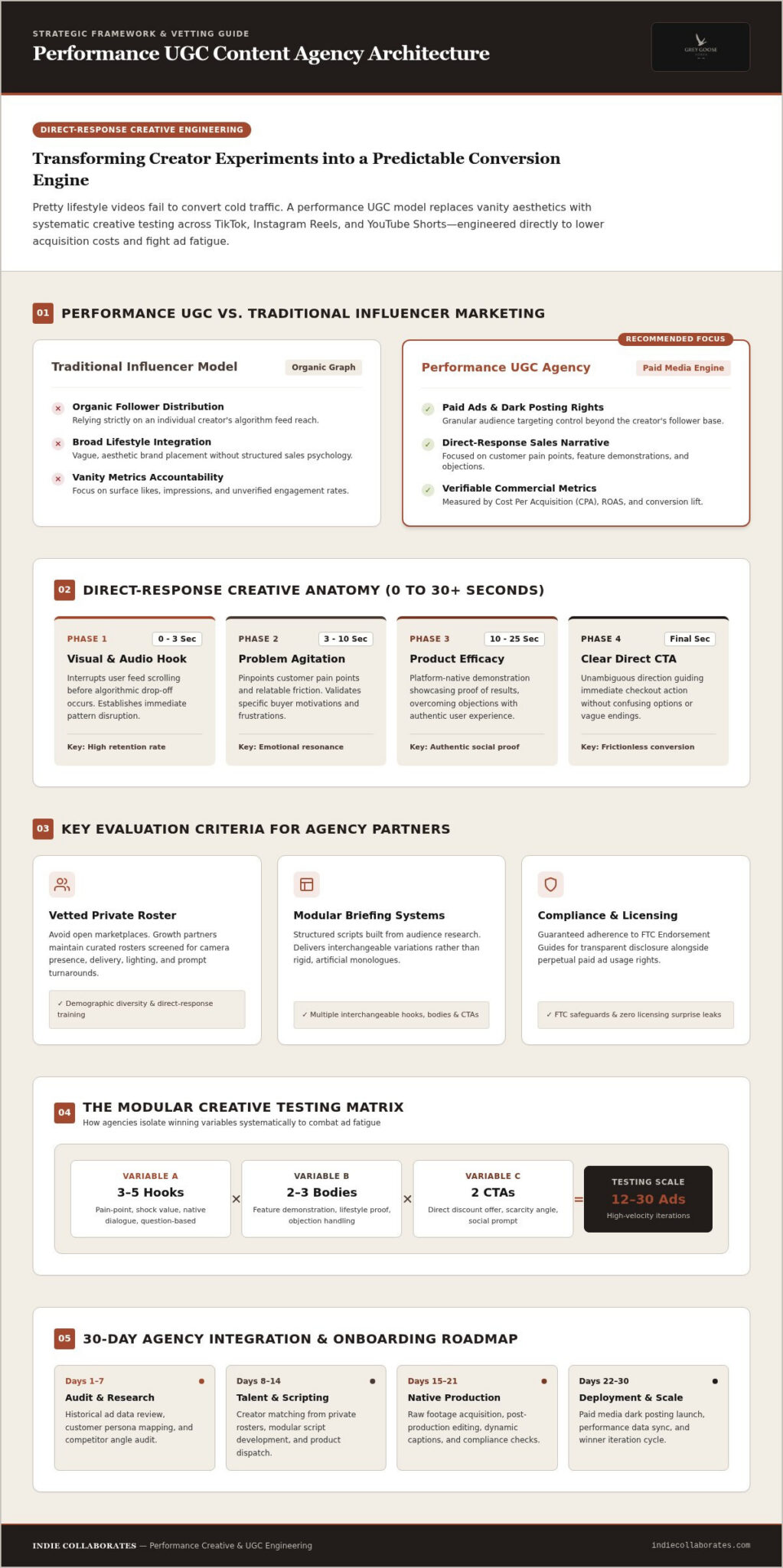
Converting cold social traffic requires precise creative engineering. Every top-performing video integrates a visual hook within the first three seconds, interrupting user scrolling before algorithmic drop-off occurs. The narrative arc quickly transitions into clear problem agitation, demonstrates product efficacy via authentic social proof, and wraps with an unambiguous call to action. This process balances raw, platform-native authenticity with proven direct-response sales psychology to drive immediate checkout behavior.
Performance UGC vs. Traditional Influencer Marketing
Brands frequently confuse performance UGC with conventional influencer marketing, yet their strategic roles diverge across several critical operational fronts:
- Distribution mechanics: Traditional influencer campaigns depend entirely on an individual creator’s organic follower graph. Performance UGC prioritizes paid media distribution and dark posting, giving brands granular control over audience targeting.
- Narrative focus: Influencer placements center around broad lifestyle integration. Performance assets focus squarely on customer pain points, feature demonstrations, and objection handling.
- Accountability metrics: Influencer marketing regularly leans on vanity likes and reach. A performance UGC content agency measures success through verifiable commercial outcomes, including cost per acquisition and incremental conversion lift.
Securing full paid advertising rights unlocks the true value of creator content. It frees your media spend from the limitations of organic algorithms and allows high-performing assets to scale predictably across paid channels.
Key Criteria for Evaluating a Performance UGC Partner
Selecting an effective performance UGC content agency requires looking past slick pitch decks and evaluating operational infrastructure. High-converting creative isn’t born from serendipity. It demands rigorous talent selection, structured scripting methodologies, and tight feedback loops between paid media buyers and production strategists. Use the evaluation framework below to separate true growth partners from standard creative boutiques.
Creator Vetting and Community Architecture
Open talent marketplaces often yield unvetted creators who struggle with basic lighting, poor audio, or unnatural delivery. Prioritize partners with dedicated talent managers who curate and maintain private rosters of tested talent. A robust vetting system evaluates camera presence, authentic articulation, demographic diversity, and reliable turnaround times. Sourcing through an established community ensures that creators understand direct-response fundamentals before receiving their initial product shipment.
Creative Strategy and Direct-Response Briefing Systems
Winning UGC balances structural precision with personal authenticity. The agency’s creative briefing framework should deliver modular scripts built on competitive research and audience pain points without scripting word-for-word monologues that sound artificial. These frameworks must protect brand integrity, align with the FTC’s Endorsement Guides on transparent disclosure, and maintain native platform styling.
- Modular brief architecture: Structured scripts featuring multiple interchangeable hooks, body demonstrations, and distinct calls to action.
- Platform-native editing: In-house post-production utilizing native platform typography, dynamic captions, trending sound design, and pacing optimized for mobile retention.
- Angle diversification: Systematically testing unboxing, founder stories, problem-solution comparisons, and direct product demonstrations.
Data Integration Between Creative and Media Buying Teams
Production should never operate in an isolated silo. An elite performance UGC content agency establishes real-time reporting loops with your growth team. Post-campaign analytics must attribute retention, click-through rates, and customer acquisition costs directly back to specific script variations and creators. Applying a structured Creator Content Strategy ensures that winning hooks inform future concept batches while losing angles are promptly retired. If you want to streamline this operational engine without building an internal studio from scratch, partnering with a specialized team at Indie Collaborates delivers vetted creator networks and performance reporting under one roof.
The Creative Testing Architecture That Drives Return on Ad Spend
Scaling paid social efficiently isn’t about hoping a video goes viral. It’s about deploying a repeatable testing framework that isolates variables, reveals actionable patterns, and systematically reduces ad spend waste. A proficient performance UGC content agency treats creative strategy like scientific modeling. By pairing consumer psychology with rigorous production matrices, you turn creative production into a predictable engine for revenue growth.
Executing this strategy follows four sequential stages:
- Stage 1: Customer persona research: Mine review feeds, support tickets, and community comments to uncover friction points, unspoken hesitations, and real purchase drivers.
- Stage 2: Modular creative matrices: Pair individual core bodies with diverse hook styles and distinct calls to action to test varied psychological angles.
- Stage 3: Controlled budget testing: Deploy fresh variations into low-spend testing environments to surface statistically significant click-through and thumbstop rates before scaling.
- Stage 4: Channel scaling and iteration: Shift validated winners into primary scaling campaigns while creating iterative variations to prolong creative longevity.
Modular Asset Production and Variable Isolation
Testing an entire video against another introduces too many variables to draw clear conclusions. Did an ad fail because of the creator’s delivery, the visual hook, or the final offer? Modular asset production eliminates this guesswork. By requiring creators to film three to five distinct hooks alongside multiple calls to action for a single core body, editors assemble a robust test matrix from a single shoot.
Direct-response teams test question hooks, contrarian statements, visual demonstrations, and unboxing reveals against the exact same product pitch. Understanding this workflow is vital, and reviewing The Guide to Scalable UGC Production Services offers clear frameworks for structuring these variable libraries at scale.
Combating Ad Fatigue Across Meta, TikTok, and YouTube
Creative fatigue degrades return on ad spend faster than ever. When frequency climbs and first-time impression ratios dip, algorithms penalize saturated assets with higher delivery costs. A skilled performance UGC content agency anticipates this decay by cycling fresh iterations before efficiency drops.
Extending asset lifespan doesn’t always require brand-new shoots. Growth teams rapidly refresh fatigue-stricken winners by remixing background tracks, swapping text overlays, shifting caption styling, and updating dynamic cuts. Every iteration must stay strictly aligned with the FTC’s Guides Concerning the Use of Endorsements and Testimonials, ensuring disclosures stay visible across edited hooks and new narrative cuts.
Contracting, Licensing Rights, and Commercial Partnership Models
Commercial structures make or break agency partnerships. A high-performing creative pipeline quickly falls apart if intellectual property ambiguities, unexpected licensing surcharges, or hidden usage clauses surface after production wraps. Navigating commercial models requires transparent alignment across asset deliverables, paid media permissions, and raw asset access. Whether negotiating monthly volume retainers or hybrid performance arrangements, clarity around deliverables protects your ad budget.
Navigating Licensing, Usage Rights, and Raw Footage Access
Never assume an agency contract grants full paid distribution rights automatically. Creative assets frequently get caught in legal disputes when brands expand vertical videos into direct-response landing pages or push high-performing reels across secondary channels. Clear contracting establishes baseline operational security:
- Defined paid ad windows: Audit whether licensing covers 30, 90, or 365 days of paid distribution across paid social platforms to prevent steep renewal fees.
- Perpetual organic rights: Retain the permanent right to host assets organically on owned social feeds and e-commerce product pages.
- Full raw footage delivery: Demand unedited B-roll, alternate hook takes, and isolated audio stems so your internal team can remix fresh iterations without paying for a new shoot.
Creator Whitelisting and Partnership Ads Infrastructure
Running dark ads directly through a creator’s verified social profile unlocks profound performance advantages. Whitelisting via Meta Partnership Ads and TikTok Spark Ads blends third-party social endorsement with your brand’s native tracking and conversion bidding infrastructure. Consumers perceive these placements as genuine peer recommendations rather than polished corporate sales pitches, often leading to lower cost-per-click metrics.
Executing this strategy requires robust permission governance. Your agency partner must secure creator platform authorization directly within Meta Business Manager and TikTok Ads Manager, eliminating messy password sharing and ensuring automated ad code expiration. For a deeper breakdown of structural accountability and performance setups, study the framework outlined in Performance Based Influencer Marketing.
A dependable performance UGC content agency handles these legal workflows, talent usage rights, and whitelisting integrations as a standard operational protocol. If you need a scalable creative engine backed by established creator legal agreements, partner with Indie Collaborates to secure high-converting, fully licensed assets designed to drive predictable paid social returns.
Selecting Your Agency Partner: Onboarding and Strategic Integration
Successful agency partnerships hinge on operational discipline during the initial thirty days. Without a structured launch sequence, creator campaigns quickly stall in feedback loops, misaligned briefs, or delayed shipments. Integrating a performance UGC content agency into your growth ecosystem requires aligning creative strategists directly with your internal media buyers, ensuring production directly serves your customer acquisition roadmap.
The 30-Day Onboarding and Product Seeding Workflow
A rigorous launch sequence eliminates guesswork, transforming strategic objectives into active test assets within four weeks:
- Week 1 (Strategic discovery): Align on customer pain points, study historical account winners, and construct modular testing hypotheses.
- Week 2 (Talent curation): Match concepts with vetted creators from a managed network rather than cold marketplace talent pools.
- Week 3 (Product seeding and capture): Complete product fulfillment, monitor creator delivery milestones, and track incoming footage.
- Week 4 (Post-production and review): Execute compliance audits, edit multiple hook permutations, and deliver final files ready for ad manager integration.
Expanding Beyond Ads: Creator Affiliates and Sustainable Growth
Paid ad testing naturally identifies your most compelling brand advocates. Rather than treating top creators as one-off freelance vendors, forward-thinking brands migrate their highest-converting talent into tiered ambassador models. This transition unlocks sustained organic reach, continuous asset creation, and aligned commercial incentives.
Structuring this migration requires clear tracking and attribution frameworks. Exploring the mechanics documented in the Managed Creator Affiliate Salesforce buying guide reveals how linking creator content directly to conversions establishes long-term revenue channels that complement paid acquisition.
Building this multi-channel engine demands an agile partner. At Indie Collaborates, we eliminate operational bottlenecks by combining creative research, scalable UGC production, and comprehensive campaign performance reporting. Backed by our IC Inner Circle network of over 1,600 vetted creators, our team gives your growth marketing pipeline the predictable, conversion-focused creative needed to scale paid social profitably.
Transform Your Creative Testing Pipeline for Sustainable Growth
Thriving on paid social in 2026 demands moving beyond aesthetic guesswork. Sustainable scale comes from treating creative production as an empirical discipline. When you implement modular creative testing frameworks tailored to Meta and TikTok algorithms, secure clear licensing rights, and tether script variations directly to conversion data, customer acquisition costs drop and creative fatigue disappears.
Selecting the right performance UGC content agency provides the structural foundation needed to turn scattered creator tests into a predictable revenue driver. Backed by our proprietary IC Inner Circle community of over 1,600 vetted creators, Indie Collaborates delivers end-to-end management from direct-response briefing to campaign performance reporting. Don’t let operational bottlenecks or creative burnout stall your acquisition momentum. Scale your paid social return with high-converting performance UGC from Indie Collaborates and transform your paid social channels into high-velocity conversion engines.
Frequently Asked Questions
What is the difference between a standard creative agency and a performance UGC content agency?
A performance UGC content agency engineers direct-response creative assets specifically to lower acquisition costs and lift conversions, whereas standard creative agencies prioritize brand awareness and high-gloss aesthetics. Rather than optimizing for superficial vanity metrics, a performance partner designs modular video variations based on customer psychological triggers, direct-response copy, and iterative testing frameworks built to satisfy paid social algorithms.
How many creative assets should a performance UGC agency deliver each month?
Monthly deliverable volumes depend on your monthly ad spend and testing velocity, but a standard cadence typically ranges from 8 to 20 unique concepts. When applying modular production principles, these core assets yield dozens of testing variations through interchangeable visual hooks, varied text overlays, and alternative calls to action. This volume ensures media buyers have sufficient creative inventory to rotate before audience ad fatigue degrades campaign efficiency.
Can our internal marketing team handle paid media buying while the agency handles UGC production?
Yes, modular asset creation integrates seamlessly with in-house growth teams. In this collaborative model, your internal media buyers manage campaign bidding, audience targeting, and budget scaling inside your ad accounts. Meanwhile, the performance UGC content agency operates as an agile creative engine, delivering structured testing batches and reviewing weekly performance reporting data to guide future scripting iterations.
What is creator whitelisting, and why is it essential for performance UGC campaigns?
Creator whitelisting allows brands to run dark paid advertisements directly through a creator’s personal handle rather than the brand’s official profile. This approach gives paid campaigns the authenticity of a personal peer recommendation while preserving full backend conversion tracking and algorithmic optimization. Ads deployed via TikTok Spark Ads or Meta Partnership Ads typically generate higher click-through rates and thumbstop rates compared to standard brand-handle placements.
How do performance UGC agencies vet creators for authentic brand alignment?
Leading agencies vet creators through proprietary, managed networks like the IC Inner Circle rather than unvetted public freelancer platforms. Talent evaluators assess on-camera charisma, native platform fluency, audio-visual technical quality, and reliability with delivery milestones. Creators must demonstrate an ability to deliver direct-response talking points naturally, ensuring that product demonstrations feel like genuine user recommendations rather than rigid commercial scripts.
Who owns the raw footage and intellectual property rights for the produced UGC assets?
Asset ownership terms depend on your partnership agreement, but robust contracts grant full commercial usage rights and access to raw footage. Brands should secure perpetual rights to publish finished assets on owned organic channels, alongside defined licensing windows for paid advertising. Receiving unedited B-roll, alternate hooks, and isolated voice tracks ensures your internal growth team can edit fresh variations without paying new production fees.
How quickly can a brand expect to launch its first round of performance UGC creative tests?
Most brands launch their initial testing batch within three to four weeks from onboarding. The first week focuses on persona research and strategic brief development. Week two covers creator selection from vetted talent networks and product fulfillment. Weeks three and four encompass product arrival, content filming, compliance checks, native editing, and final asset delivery, allowing media buyers to deploy live ads before month’s end.
