
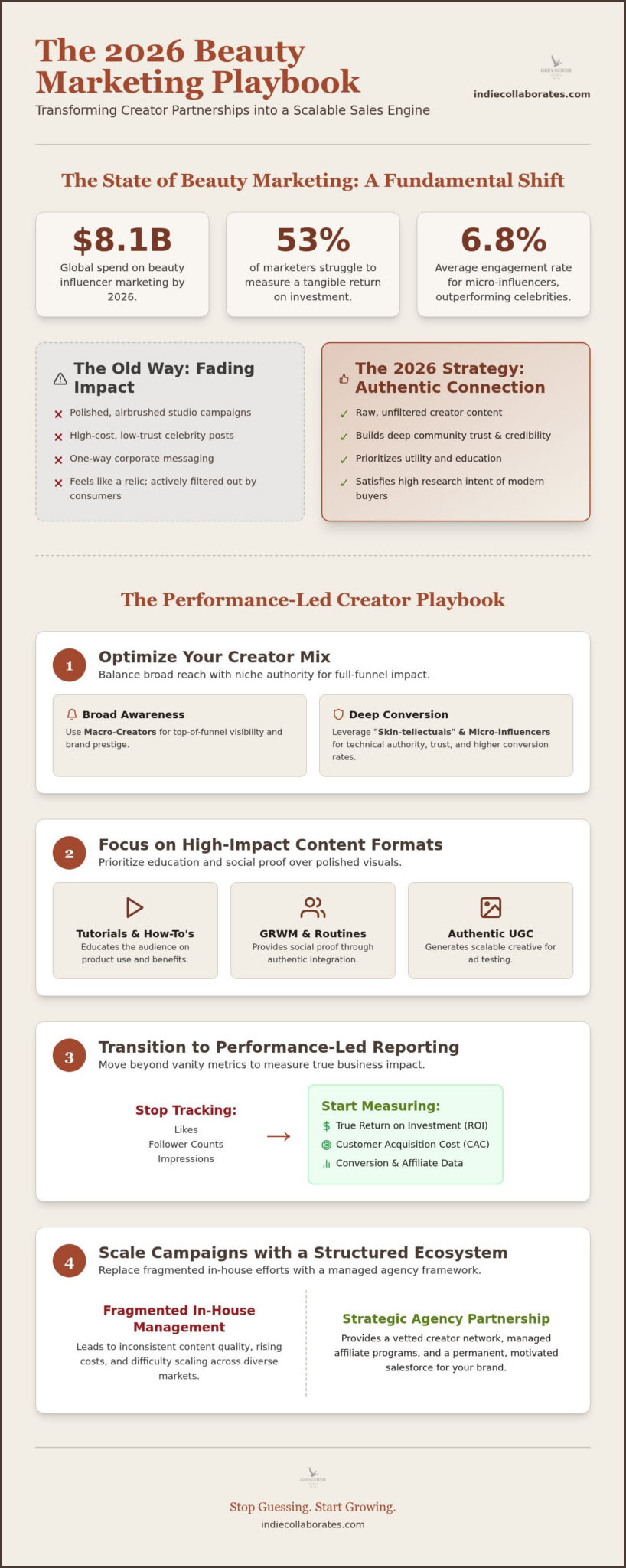
Why are brands still paying six-figure premiums for celebrity posts when micro-influencers currently command a 6.8% engagement rate? In 2026, the global spend on influencer marketing for beauty brands has reached $8.1 billion, yet 53% of marketers still struggle to measure a tangible return on that investment. You’ve likely felt the sting of inconsistent content quality and the rising costs of traditional endorsements. It’s a common challenge; you want the prestige of high-end creators but need the accountability of a performance-driven channel. This playbook bridges that gap.
We’ll show you how to master a performance-led strategy that transforms creator partnerships from a vanity project into a scalable sales engine. You’ll learn to move beyond likes to build deep community trust and consistent ROI. We will explore the mechanics of vetting creators through the IC Inner Circle, the power of scalable UGC for creative ad testing, and how managed affiliate programs create a permanent, motivated salesforce for your brand. It is time to stop guessing and start growing through precision-engineered creator ecosystems.
Key Takeaways
- Understand the fundamental shift from polished corporate advertisements to raw, authentic creator content that satisfies the high-research intent of the 2026 beauty consumer.
- Optimize your creator mix by balancing broad reach with the technical authority of “Skin-tellectuals” to build deep expertise into your influencer marketing for beauty brands.
- Identify high-impact content formats like Tutorials and GRWM videos that prioritize education and social proof over traditional high-production studio visuals.
- Transition from vanity metrics to performance-led reporting by utilizing affiliate tracking and conversion data to measure true ROI and Customer Acquisition Cost.
- Learn how to scale complex campaigns across diverse markets by leveraging a structured agency ecosystem instead of relying on fragmented in-house management.
The Evolution of Beauty Marketing: Why Creators Outperform Traditional Ads in 2026
By 2026, the beauty industry has undergone a radical transformation. Consumers no longer scroll past ads; they actively filter them out. Modern buyers exhibit high research intent, often checking three or more independent sources before a single purchase. Traditional “glamour shots” and airbrushed studio campaigns feel like relics of a distant past. Instead, The Evolution of Beauty Marketing has shifted toward raw, unfiltered content that prioritizes utility over polish. This shift is why influencer marketing for beauty brands has moved from a peripheral tactic to the core of every successful performance strategy.
The Psychology of Trust in Beauty and Personal Care
Consumers today view beauty creators as peers and mentors rather than paid mouthpieces. This shift is driven by the rise of “de-influencing,” where creators gain massive credibility by telling their audience what not to buy. When a creator admits a viral foundation didn’t work for their skin type, their eventual recommendation carries ten times the weight of a standard commercial. This radical honesty builds a foundation of long-term brand equity that corporate PR simply cannot replicate. Creator Trust is the primary currency of 2026 beauty marketing.
From Celebrity Endorsements to Vetted Creator Networks
The era of the untouchable mega-celebrity is fading. While a Hollywood star might offer broad reach, they often lack the technical expertise consumers demand in a crowded market. Brands are now prioritizing “Skin-tellectuals” and subject matter experts who can explain the science behind an active ingredient. Success in 2026 isn’t about how many followers a creator has, but how authentic their connection is to their niche. Vetting for this authenticity is a complex, data-heavy process. Many brands are moving away from manual outreach and toward a vetted creator network to ensure brand safety and performance. This structured approach allows for:
- Higher conversion rates through niche-specific targeting.
- Protection against bot-inflated engagement metrics.
- Consistent content quality that aligns with brand values without sacrificing the creator’s voice.
By replacing traditional PR and media relations with strategic creator seeding, beauty brands build a resilient community that drives measurable sales growth. This systematic transition ensures that influencer marketing for beauty brands remains a high-performance engine rather than a speculative expense. It’s about moving from a one-off shoutout to a permanent, trusted presence in the consumer’s daily routine.
Selecting Your Beauty Creator Mix: From Micro-Influencers to Subject Matter Experts
Building a performance-led ecosystem requires more than just high follower counts. It demands a tiered approach. You need a mix of macro-creators for broad awareness and niche specialists for conversion. This balanced selection is the new standard for influencer marketing for beauty brands. By diversifying your partner portfolio, you mitigate risk and ensure your message reaches different stages of the buyer journey simultaneously.
The Power of the Micro-Influencer in Beauty
Micro-influencers often outperform their larger counterparts in specific categories like clinical skincare or curly haircare. Their followers treat them as reliable peers rather than distant celebrities. Investing in a micro influencer strategy allows brands to penetrate high-intent communities where trust is already established. These creators currently drive a 6.8% engagement rate, which is nearly five times the average of mega-influencers. They are essential for categories requiring deep education, such as SPF application or complex serum layering.
Diversity, Equity, and Inclusion must be a core component of your selection process. It is not a quota; it’s about reflecting the actual diversity of your consumer base. Whether you are targeting clean beauty enthusiasts or the K-beauty crowd, your creator mix should feel representative and inclusive. This authenticity is what drives long-term community loyalty in a skeptical market.
Vetting for Performance and Brand Alignment
Vetting is where most campaigns fail. You must look past the surface metrics. High-performing creators demonstrate consistent engagement quality and audience alignment. Red flags like sudden follower spikes or mismatched interests can drain your budget quickly. Scaling influencer marketing for beauty brands requires a balance of technical expertise and creative flair. As social platforms evolve into high-impact content formats, the technical ability of a creator to produce quality video becomes as important as their follower count.
To mitigate these risks, many brands rely on curated communities like the IC Inner Circle. This ensures every creator has been pre-vetted for authenticity and historical performance. If you’re looking to professionalize your approach, partnering with a specialized agency can help you identify the right mix for your specific goals. This structured vetting process ensures your brand remains safe while maximizing every dollar of your media spend.
High-Impact Content Formats for Beauty Brands: Tutorials, GRWM, and Authentic UGC
Visual storytelling in 2026 has moved beyond the static image. Beauty consumers now demand to see how a product moves, blends, and reacts to different skin textures in real time. Tutorials and “Get Ready With Me” (GRWM) segments remain the gold standard for education because they provide the practical proof required to convert high-intent researchers. Effective influencer marketing for beauty brands relies on content that feels native to the platform. This means embracing a “Skin-First” aesthetic where raw, unedited textures and visible pores are valued over heavy filters. Authenticity isn’t just a buzzword; it’s a performance requirement.
Scalable UGC Production for Paid Ads
User-Generated Content (UGC) is no longer just for organic feeds. It has become the primary fuel for high-performing paid social accounts. Unlike traditional studio ads that often trigger “ad blindness,” UGC feels like a recommendation from a friend. To maintain a competitive edge, brands are moving toward scalable UGC production services to ensure a constant stream of fresh assets for creative testing. This volume allows you to identify which “hooks” stop the scroll and which “payoffs” drive the click. Your creator insights should drive your creative research, as those on the front lines of community interaction often spot emerging trends before they hit the mainstream.
Leveraging Short-Form Video for Discovery
Discovery happens in seconds. TikTok and Instagram Reels algorithms prioritize high-retention video, making the first three seconds of your content critical. While trending sounds can offer a temporary boost in reach, original educational audio often leads to higher conversion rates. Consumers in Southeast Asia are particularly responsive to creators who can bridge the gap between organic discovery and the checkout page through clear, actionable advice. Successful strategies focus on:
- Direct-to-camera addresses: Building an immediate personal connection.
- Side-by-side comparisons: Demonstrating immediate product efficacy.
- Ingredient deep-dives: Satisfying the “Skin-tellectual” desire for technical transparency.
By treating creator content as a laboratory for what resonates, you can optimize your influencer marketing for beauty brands to be both culturally relevant and commercially effective. It’s about creating a content engine that doesn’t just look good but actually works to lower your customer acquisition costs.
Performance-Led Strategy: Measuring Success Beyond Vanity Metrics
Vanity metrics like likes and shares are no longer sufficient to justify marketing spend in 2026. While engagement indicates interest, it doesn’t always translate to revenue. Modern influencer marketing for beauty brands requires a shift toward hard data, focusing on Cost Per Acquisition (CAC) and overall Customer Lifetime Value. This transition allows brands to treat creator partnerships as a measurable performance channel rather than a speculative brand-building exercise. By analyzing the entire funnel, you can identify exactly which creators drive awareness and which ones trigger the final purchase decision. For a comprehensive framework on building this kind of accountability into your campaigns, explore our guide to performance based influencer marketing and the 2026 strategic framework for ROI.
Building a Managed Creator Affiliate Salesforce
One of the most effective ways to drive measurable sales is through a managed creator affiliate salesforce. This model moves away from flat-fee payments and toward performance-based incentives. Tiered commission structures allow you to reward high-performing creators, encouraging them to remain long-term advocates for your brand. This systematic approach removes the administrative burden of tracking individual codes and manual payouts. It transforms your creator network into a permanent, motivated sales team that grows alongside your business.
Key KPIs for Beauty Influencer Campaigns
Success is measured by the precision of your attribution. While direct sales are the ultimate goal, you must also consider Earned Media Value (EMV) to understand the total impact of your campaign. Performance-Led Influencer Marketing in 2026 is the systematic alignment of creator content with measurable business outcomes through transparent data and real-time optimization. Tracking Return on Ad Spend (ROAS) across different creator tiers helps you allocate budget to the most efficient performers. If your current reporting feels opaque, it’s time to professionalize your tracking methods.
Attribution in the beauty sector is notoriously complex. A consumer might see a GRWM video on TikTok, research reviews on a blog, and eventually purchase via an Instagram ad. Using performance data to iterate on your creator selection ensures you aren’t wasting budget on “noise.” You can double down on the creators who successfully bridge these touchpoints. To start building a data-backed strategy that prioritizes your bottom line, consult with our performance team today. This structured approach ensures every dollar spent on influencer marketing for beauty brands contributes to sustainable, long-term growth.
Scaling Beauty Campaigns with a Strategic Creator Economy Agency
Managing a single creator is a tactical project. Managing five hundred is a complex ecosystem. As beauty brands expand across diverse regional markets, the logistical friction of in-house management often becomes a significant barrier to growth. This complexity is why leading organizations are shifting toward specialized creator economy agencies. These partners act as strategic architects, designing a robust framework that supports high-volume output while maintaining the precision required for measurable performance. It’s the difference between a one-off campaign and a sustainable, scalable content engine. For brands evaluating whether to bring this function in-house or delegate it entirely, our outsourced influencer campaign management checklist for 2026 provides a definitive framework for making that decision with confidence.
End-to-End Creator Management
A specialized agency removes the administrative burden of recruitment, contracting, and compliance monitoring. It ensures that every piece of content meets strict brand safety standards without stifling the creator’s unique voice. Balancing brand consistency with creative freedom is a delicate process, but it’s essential for maintaining the “raw authenticity” that 2026 consumers demand. For organizations requiring a comprehensive solution, the Indie Collaborates Enterprise arm provides full-service management. This includes everything from initial strategy to final performance reporting, allowing your internal team to focus on high-level product innovation rather than chasing content approvals.
Accessing the Right Talent at Scale
Finding specialized beauty talent requires more than just a social media search bar. Utilizing a creative marketing jobs board allows brands to tap into a pre-vetted pool of creators who understand specific sub-niches like medical-grade skincare or halal beauty. This is particularly vital when executing cross-border strategies across Southeast Asia. You need local cultural relevance without losing central brand consistency. A performance-led agency ensures that your influencer marketing for beauty brands isn’t just broad; it’s deep and resonant. It provides the connectivity needed to align diverse stakeholders for mutual success.
The shift from vanity metrics to performance-led strategies is a competitive necessity in 2026. You need more than just posts; you need a data-backed system that drives sales. If you’re ready to professionalize your approach and master influencer marketing for beauty brands, it’s time to build a structured creator ecosystem. Contact Indie Collaborates today to launch your next high-performance campaign and turn your community into a measurable sales force.
The Future of Beauty: Building Your Performance-Led Creator Ecosystem
The shift toward performance-led influencer marketing for beauty brands isn’t a temporary trend; it is the new operational standard for 2026. Success now depends on your ability to bridge the gap between creative authenticity and measurable ROI. You’ve seen how raw UGC and technical expertise outperform traditional glamour shots. You also know that scaling these efforts requires a structured approach to vetting and attribution. By moving away from vanity metrics and toward managed affiliate models, you turn community trust into a permanent sales engine.
Indie Collaborates provides the strategic architecture needed to navigate this landscape. With a vetted community of over 1,600 creators and specialized arms for performance-led UGC and Affiliate management, we offer full-service end-to-end campaign management. It’s time to stop treating creator partnerships as a speculative expense and start treating them as a scalable growth channel. Ready to scale your beauty brand with performance-led creator campaigns? Contact Indie Collaborates today. We look forward to building this future with you.
Frequently Asked Questions
How much should a beauty brand spend on influencer marketing in 2026?
Most beauty brands currently allocate an average of 34% of their total digital marketing budgets to creator partnerships. Some industry leaders dedicate as much as 62% of their media budget to these collaborations. With the global spend in this sector reaching an estimated $8.1 billion in 2026, your allocation should reflect your growth targets. We recommend starting with a performance-led pilot to determine your specific customer acquisition costs before scaling your investment.
Is micro-influencer marketing more effective for beauty than using macro-influencers?
Micro-influencers are often more effective for driving deep engagement and conversions within niche communities. In the beauty space, creators with 10,000 to 100,000 followers maintain an average engagement rate of 6.8%, significantly higher than the 1.4% seen with mega-influencers. While macro-influencers provide massive reach for top-of-funnel awareness, micro-influencers act as trusted peers. A balanced mix ensures you achieve both broad visibility and high-intent sales growth through authentic, relatable content.
How do you measure the ROI of a beauty influencer campaign?
Measuring ROI requires moving beyond likes to track specific conversions and Customer Acquisition Costs (CAC). You should utilize unique affiliate links, promo codes, and pixel tracking to attribute sales directly to specific creators. On average, influencer marketing returns $5.78 for every $1 spent. By implementing a managed affiliate program, you can monitor real-time performance data and refine your strategy based on tangible revenue rather than speculative vanity metrics or high-level engagement.
What is the difference between UGC and influencer marketing for beauty brands?
Influencer marketing for beauty brands typically involves a creator posting to their own established audience to drive awareness. In contrast, User-Generated Content (UGC) is content created by specialists for use on the brand’s own channels or in paid advertisements. While influencer posts leverage the creator’s social capital, UGC provides authentic assets that often outperform high-production studio ads in creative testing. Both are essential pillars of a modern, performance-led content strategy in 2026.
Can influencer marketing help with beauty product launches?
Creator partnerships are critical for successful product launches because they provide immediate social proof and educational content. During a launch, influencers can demonstrate product efficacy through tutorials and Get Ready With Me videos, which 86% of consumers now use to inform purchasing decisions. By coordinating a tiered rollout across micro and macro-influencers, you generate a surge of authentic reviews that build long-term community trust and drive the initial sales momentum needed for success.
How do beauty brands find vetted creators in Southeast Asia?
Finding reliable talent in Southeast Asia requires a structured vetting process to ensure audience authenticity and brand safety. Many brands utilize specialized agencies that maintain curated communities, such as the IC Inner Circle, which features over 1,600 vetted creators. This approach protects you from bot-inflated engagement and ensures your partners align with local cultural nuances. A performance-led agency acts as a strategic architect, connecting you with the right creators to deliver measurable results.
What are the most effective social media platforms for beauty influencer marketing?
Short-form video platforms like TikTok, Instagram Reels, and YouTube Shorts are currently the most effective for beauty discovery. These formats have driven a 27% increase in click-through rates compared to previous benchmarks. TikTok’s algorithm is particularly powerful for viral discovery, while Instagram remains a stronghold for aesthetic brand building and community engagement. The key to successful influencer marketing for beauty brands is to optimize your content format for each platform’s specific algorithm to maximize reach.
How do you handle creator payouts and affiliate tracking at scale?
Handling payouts and tracking for hundreds of creators requires a centralized management system or a specialized partner. Managed affiliate programs allow you to automate performance-based payouts and monitor individual creator contributions in real-time. This systematic approach reduces administrative friction and ensures transparency for both the brand and the creator. By leveraging an agency’s infrastructure, you can scale your affiliate salesforce across multiple markets without the logistical headache of manual tracking or inconsistent reporting.
