
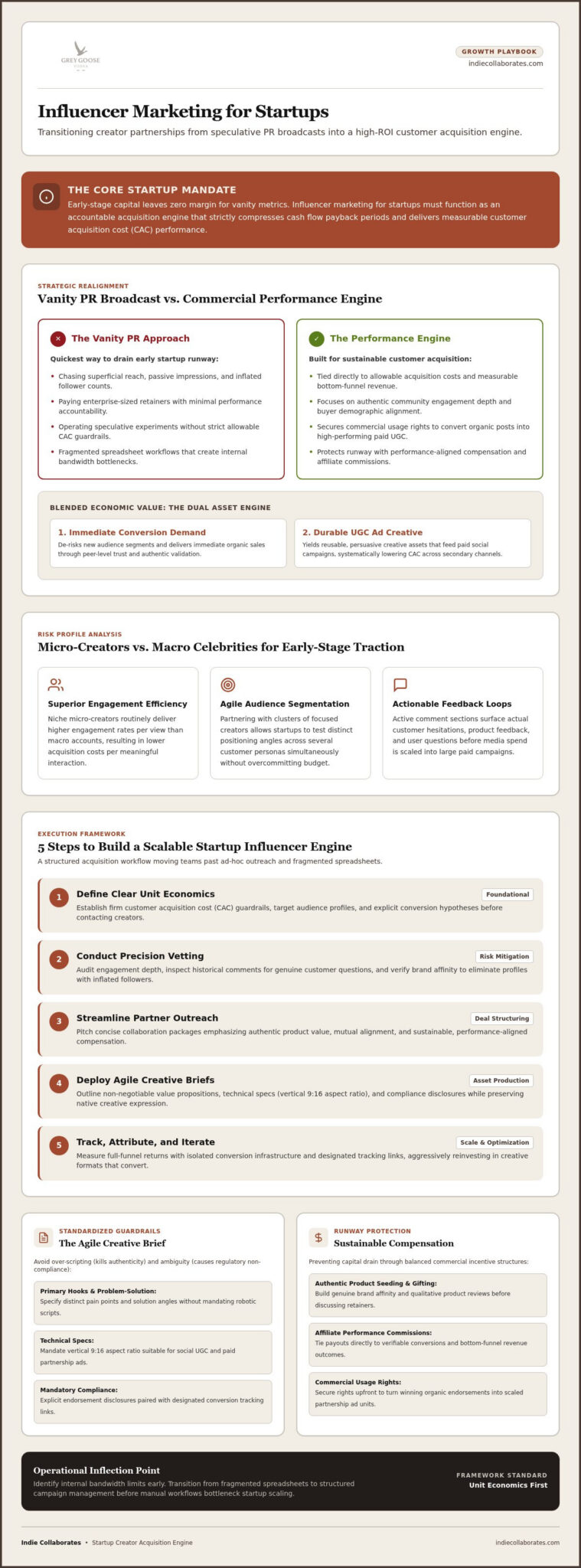
Treating creator collaborations like a PR broadcast is one of the quickest ways to drain early capital. When executed strategically, influencer marketing for startups isn’t about chasing vanity reach or paying enterprise-sized retainers; it functions as a precision asset engine built for sustainable customer acquisition.
If you’ve watched precious runway vanish into likes and comments that failed to generate actual conversions, you aren’t alone. Sourcing the right partners, negotiating complex usage rights, and tracking CAC across fragmented social channels often overwhelms lean teams. You need dependable commercial outcomes, not speculative marketing experiments that burn cash without accountability.
In this growth playbook, you’ll discover how early-stage and scaling startups build cost-effective, high-ROI creator programs without draining their runway. We’ll explore sustainable commission and affiliate models, full-funnel attribution frameworks, and proven workflows to transform raw creator assets into high-converting UGC for your paid growth channels.
Key Takeaways
- Shift from vanity reach to commercial performance: Successful influencer marketing for startups treats creators as an acquisition engine tied directly to customer acquisition cost and measurable revenue.
- Build a disciplined sourcing workflow that filters prospective creators by true community engagement and audience demographic alignment rather than inflated follower numbers.
- Maximize asset efficiency by securing commercial usage rights, turning organic creator endorsements into high-performing UGC for paid social campaigns and partnership ads.
- Protect early runway through performance-aligned compensation models that blend authentic product seeding with sustainable affiliate commissions.
- Identify internal bandwidth limits early, transitioning from fragmented spreadsheet workflows to structured campaign management before operational bottlenecks stall growth.
Why Influencer Marketing for Startups Requires a Performance Mindset
Early-stage capital leaves zero margin for vanity metrics. While the foundations of influencer marketing were historically built on broad brand awareness and top-of-funnel reach, modern venture environments demand verifiable commercial returns. For early-stage operators, influencer marketing for startups cannot function as speculative PR; it must operate as an accountable acquisition engine that systematically compresses payback periods.
Every creator collaboration should yield dual value: immediate conversion demand and high-performing, authentic creative assets. When you treat partnerships as experimental testing loops, you simultaneously de-risk new audience segments and feed your multi-channel acquisition funnels with persuasive social proof.
The Unit Economics of Startup Creator Partnerships
Predictable growth begins with unit economics, not follower counts. Before initiating outreach or discussing compensation, anchor your targets to strict allowable acquisition costs. Evaluate every collaboration through cash flow payback timelines rather than passive impressions. A viable partnership generates blended economic value: it delivers immediate organic conversions while providing durable creative assets that reduce paid customer acquisition costs across secondary channels.
Micro-Creators Versus Macro Celebrities for Early Stage Traction
Macro celebrities demand substantial upfront commitments with minimal performance accountability. For lean growth teams, betting on focused clusters of micro-creators offers a far superior risk profile. Creators with dedicated followings foster authentic peer conversations where product endorsements carry genuine trust, unlocking several strategic advantages:
- Superior engagement efficiency: Niche creators routinely deliver higher engagement rates per view than macro accounts, resulting in lower costs per meaningful interaction.
- Agile audience segmentation: Partnering with multiple focused creators allows you to test distinct positioning angles across several buyer personas simultaneously.
- Actionable feedback loops: Active comment sections uncover real purchase hesitations, product feedback, and user questions before you scale paid media spend.
5 Steps to Build a Scalable Startup Influencer Engine
Scaling a predictable acquisition program requires moving past ad-hoc outreach. For early-stage operators, executing influencer marketing for startups successfully depends on an agile five-stage framework:
- Define clear unit economics: Establish firm CAC guardrails, target audience profiles, and explicit conversion hypotheses before contacting creators.
- Conduct precision vetting: Audit engagement depth, audience credibility, and brand affinity to eliminate inflated profiles.
- Streamline partner outreach: Pitch concise collaboration packages emphasizing product value, mutual alignment, and equitable compensation models.
- Deploy agile creative briefs: Outline non-negotiable value propositions while giving creators structural freedom to speak natively to their communities.
- Track, attribute, and iterate: Measure bottom-funnel performance using isolated conversion infrastructure, doubling down on creative formats that convert.
Vetting Creators for Audience Authenticity and Brand Fit
Auditing potential partners protects limited startup cash. Rather than relying on headline reach, inspect historical comment sections to ensure followers ask substantive questions about featured solutions. High-converting partnerships hinge on creator credibility. A landmark Harvard Business Review study on influencer marketing ROI demonstrates that creative alignment and follower engagement heavily dictate campaign effectiveness, making rigorous vetting essential before deploying capital.
Structuring Agile Briefs That Protect Brand Identity
Over-scripted briefs destroy creator authenticity; ambiguous briefs risk regulatory non-compliance. Build standardized guidelines that specify primary hooks, problem-solution angles, and clear technical requirements such as vertical 9:16 aspect ratios. Ensure every brief explicitly mandates compliant endorsement disclosures alongside designated tracking links. Lean teams needing hands-on execution often rely on specialized influencer marketing campaigns to establish these strategic guardrails efficiently.
Tracking Performance with Direct Attribution Infrastructure
Attribute every dollar directly to its traffic source. Assign distinct UTM parameters and personalized discount codes to each creator to monitor click velocity, conversion volume, and user drop-off points within your sales funnel. For advanced tracking models, explore our guide to performance based influencer marketing to refine your post-click attribution mechanics.
UGC and Whitelisting: Maximizing Creator ROI Across Paid Ads
Organic reach fades within hours. Paid media amplification, by contrast, transforms brief creative moments into enduring acquisition engines. Modern influencer marketing for startups thrives at the intersection of authentic storytelling and algorithmic distribution. Relying solely on organic reach leaves pipeline growth to chance; feeding proven creator assets into paid testing loops creates systematic predictability.
Comparing organic posts with paid amplification highlights stark efficiency differences. A single organic post reaches a fractional slice of an audience once. Repurposing that endorsement into user-generated content (UGC) for paid channels allows you to test dozens of opening hooks, isolate winning messages, and slash blended customer acquisition costs across your entire growth funnel.
Securing Content Usage Rights in Startup Contracts
Intellectual property laws grant creators default ownership over their work. Paying for an organic post does not grant permission to run that footage as an ad. Ensure your contracts explicitly secure commercial licensing rights across Meta, TikTok, and YouTube for specific durations, typically 30 to 90 days. Always negotiate delivery of raw, unedited video files. Having access to modular clips allows your team to assemble new hooks, cut alternate endings, and iterate rapidly without paying for fresh shoots. For deeper operational frameworks, review the guide to scalable UGC production services.
Executing Spark Ads and Partnership Ad Whitelisting
Running ads from corporate accounts often triggers instant user resistance. Whitelisting solves this by serving paid campaigns directly through authentic creator handles using Meta Partnership Ads and TikTok Spark Ads. This third-party endorsement bypasses banner fatigue, preserving native social proof while leveraging advanced ad targeting. Platform benchmarks show TikTok Spark Ads generate a 25% higher click-through rate and a 24% higher conversion rate than standard in-feed ads. Beyond initial clicks, growth teams can retarget engaged viewers with direct-response conversion offers, compounding campaign efficiency.
Cost-Effective Compensation Models: Seeding, Gifting, and Affiliates
Preserving runway dictates how early ventures compensate creators. Heavy upfront retainers create severe financial strain long before you validate creative or channel fit. When structuring influencer marketing for startups, performance-aligned incentives balance fiscal restraint with creative motivation. Aligning payouts with actual conversions ensures both founder and creator share the direct financial upside of growth.
Hybrid compensation models provide an effective middle ground. Offering a modest baseline creation fee paired with performance incentives, such as rev-share percentages or tiered bonus payouts, keeps cash outlays manageable while giving creators compelling commercial upside.
Setting Up High-Converting Creator Affiliate Programs
Commission structures should reward sustained sales velocity. Build multi-tiered revenue shares where creators unlock higher commission percentages as their referral volume scales over time. Pair this structure with attribution software that accurately tracks multi-week cookie windows and recurring customer subscriptions. Transparent reporting builds mutual trust and keeps creators engaged. To design sustainable commission tiers that protect gross margins, consult our guide to building a managed creator affiliate salesforce.
Executing Product Seeding Without Expectation of Reciprocity
Product seeding works best when detached from rigid contractual demands. Sending your product without mandatory posting requirements removes transactional friction. Industry data confirms that gifted product collaborations generate an average engagement rate of 2.19%, outperforming transactional flat-fee posts (1.94%) because the creator’s recommendation stems from genuine discovery rather than a script.
Identify passionate micro-creators whose content directly addresses the problems your product solves. Craft thoughtful, premium unboxing experiences that naturally inspire spontaneous sharing on social channels. When a creator shares unsolicited organic praise, follow up swiftly. Acknowledge their content and transition that authentic enthusiasm into a long-term commercial partnership. If you want to turn creators into an active sales engine, connect with our team to launch performance-led affiliate programmes that scale acquisition without draining your budget.
Scaling Up: In-House Management Versus Specialist Creator Agencies
Early traction often convinces founders to manage creator relationships internally. While coordinating a handful of gifted collaborations across spreadsheets feels manageable at first, operational friction compounds quickly as volume expands. Scaling influencer marketing for startups requires deciding whether to construct an expensive in-house apparatus or tap into established infrastructure that protects team focus.
Hybrid operating models offer a practical balance. By outsourcing administrative bottlenecks while retaining direct authority over positioning and unit economics, early-stage operators preserve their time for core commercial milestones.
Calculating the True Operational Overhead of In-House Sourcing
Internal workflows carry substantial hidden costs. Teams easily sink dozens of weekly hours into manual outreach, contractual negotiations, shipping logistics, and licensing compliance. Monthly subscriptions for creator discovery software, fraud detection tools, and attribution platforms add thousands in fixed software overhead before a single asset goes live. When key marketing hires spend their days chasing creator drafts rather than optimizing funnels, growth stalls. Evaluating an outsourced influencer campaign management framework helps assess whether internal bandwidth is truly best spent on day-to-day administrative execution.
How Indie Collaborates Accelerates Startup Creator Campaigns
Specialist execution converts operational drag into acquisition momentum. Indie Collaborates acts as a strategic growth engine, connecting lean ventures with performance-focused creator infrastructure without enterprise-level overhead.
Rather than spending months testing cold outreach, startups gain immediate access to the IC Inner Circle of over 1,600 pre-vetted creators primed for performance activations. The team builds and executes integrated campaigns combining strategic product seeding, scalable UGC production, and managed affiliate programmes. Every deliverable is tied to full-funnel attribution and rigorous campaign performance reporting, ensuring your creator pipeline operates as an accountable driver of sustainable customer acquisition.
Turn Creator Collaborations into Your Strongest Growth Engine
Scaling customer acquisition doesn’t require enterprise budgets or speculative ad spend. By replacing vanity metrics with strict unit economics, transforming authentic creator endorsements into reusable UGC assets, and structuring performance-aligned affiliate models, influencer marketing for startups evolves from an unpredictable expense into a dependable revenue driver.
You don’t have to carry the operational drag of manual sourcing, negotiating, and tracking alone. Indie Collaborates connects lean teams directly to our IC Inner Circle of over 1,600 vetted creators, delivering end-to-end campaign execution that spans strategic product seeding, scalable UGC production, and managed affiliate programmes. Backed by full-funnel campaign performance reporting tied directly to conversion metrics, you maintain total visibility over every dollar deployed.
Ready to protect your runway while building sustainable traction? Partner with Indie Collaborates to turn high-impact creator partnerships into your most predictable acquisition advantage.
Frequently Asked Questions
How much should an early-stage startup spend on its first influencer marketing campaign?
Startups should size initial budgets around customer acquisition cost targets rather than arbitrary packages. When launching influencer marketing for startups, allocate roughly 50% to 60% of available capital to creator deliverables and 20% to 30% to amplification and licensing rights. Reserving the remainder for shipping logistics and tracking infrastructure gives you enough room to test multiple creators without depleting cash reserves.
Can B2B and SaaS startups successfully utilize influencer marketing to acquire customers?
B2B and SaaS startups achieve substantial customer acquisition by partnering with niche industry practitioners and respected subject matter experts. Instead of consumer lifestyle endorsements, software creators produce tactical workflow tutorials, interface walkthroughs, and teardowns. This practical content demystifies technical capabilities, overcomes buyer friction, and drives qualified inbound leads directly into demo pipelines with high conversion intent.
What is the difference between product seeding and paid influencer marketing partnerships?
Product seeding involves gifting physical inventory or software access without contractual posting obligations, whereas paid partnerships legally require specific deliverables, usage rights, and publication dates. Seeding builds organic goodwill and authentic brand advocacy at a low initial cost. Paid collaborations give you direct creative control, scheduled publication timelines, commercial ad licensing, and strict compliance oversight across multi-channel campaigns.
How do startups protect their brand reputation when collaborating with external creators?
Protecting brand reputation requires thorough creator vetting, transparent brief guardrails, and binding compliance clauses in every collaboration agreement. Screen historical content archives to verify tone and check comment sections for artificial engagement. Outline clear messaging guidelines, mandatory FTC disclosure requirements, and competitor exclusivity terms. Always review draft video files before public distribution to ensure positioning accuracy.
What key metrics should startups track to evaluate creator campaign performance?
Prioritize bottom-funnel commercial metrics over superficial impression counts or vanity follower reach. In performance-led influencer marketing for startups, focus on customer acquisition cost, return on ad spend, click-through velocity, and net conversion volume through unique tracking links. When amplifying assets through paid media, evaluate hook retention, average watch duration, and post-purchase customer lifetime value.
Why is user-generated content often more effective for startups than branded creative assets?
User-generated content converts better because it blends natively into social feeds and sidesteps consumer skepticism toward traditional brand advertising. Authentic smartphone footage featuring relatable problem-solving resonates faster than polished studio productions. When deployed across paid growth channels, UGC lowers creative fatigue, drives higher click-through rates, and provides the immediate peer social proof early ventures need.
