
What if the creator with the biggest audience is the least reliable path to growth? Results driven influencer campaigns start with a better question: can the partnership produce measurable business outcomes, not just attention? Likes and views can signal reach, but they don’t show whether a campaign generated sales, produced useful ad content, or built customer trust.
If creator performance feels unpredictable, ROI is hard to prove, and tracking content, commissions, and payouts takes too much effort, you’re not alone. The answer isn’t simply to recruit more creators. It’s to build a managed system that connects the right partners to clear goals, usable content, and consistent measurement.
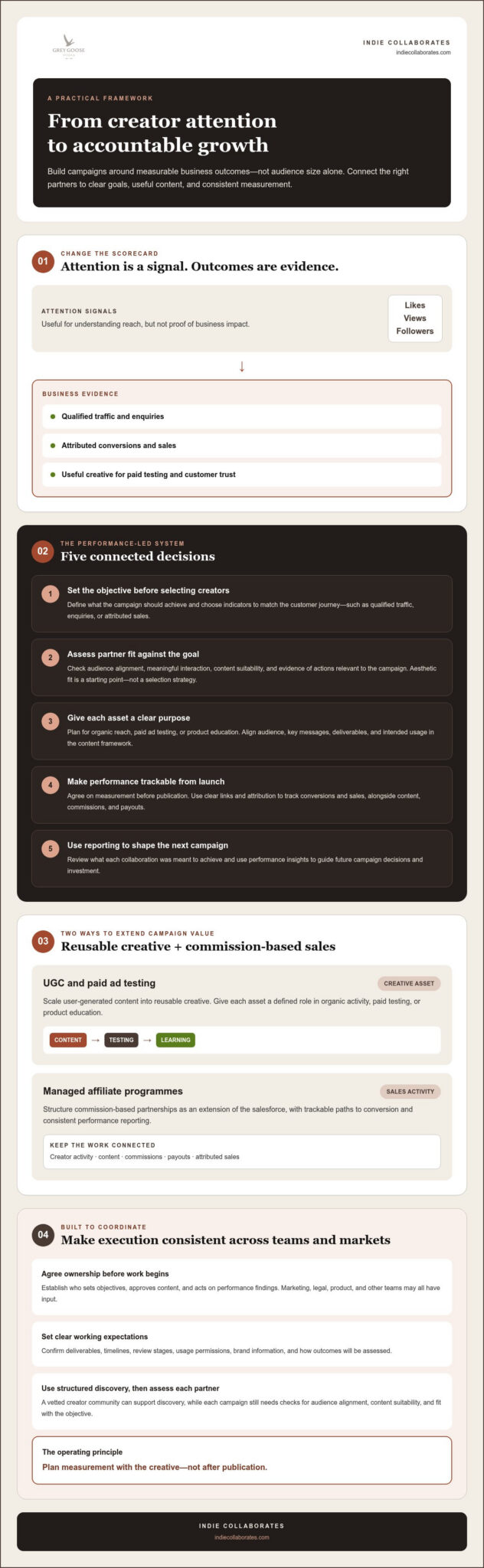
This article lays out a practical framework for moving from vanity metrics to accountable creator marketing. You’ll learn how to set objectives, assess potential partners, measure results, scale UGC for paid ad testing, and structure affiliate programmes that can work as an extension of your salesforce. You’ll also see how a consistent approach can help teams coordinate creators, content, and reporting across multiple markets.
Key Takeaways
- Build Results driven influencer campaigns around business outcomes, with goals and measurement methods defined before selecting creators.
- Align creator partnerships and content strategy with organic reach and paid ad testing so each asset has a clear purpose.
- Use scalable UGC and managed affiliate programmes to develop reusable creative and commission-based sales activity.
- Track conversions and sales with clear links and attribution, then use performance reporting to guide future campaign decisions.
- For campaigns across multiple markets, consider how specialized creator expertise and the IC Jobs Board can support execution and talent needs.
Why Results driven influencer campaigns are the 2026 standard
Follower counts and likes can indicate attention, but they don’t prove that a campaign influenced a purchase, generated qualified leads, or produced creative worth testing in paid media. Audiences move between platforms, and the same creator can perform differently depending on the format, offer, and campaign objective. Results driven influencer campaigns connect creator activity to business outcomes by planning measurement alongside the creative, not adding it after publication.
This changes the role of the creator. Instead of a one-off promotional post, a partnership can contribute at different stages: introducing a brand, answering audience questions, producing useful content, and supporting a trackable path to conversion. This broader approach builds on the varied applications of influencer marketing, while giving teams a clearer way to assess what each collaboration is meant to achieve.
The Evolution from Awareness to Conversion
Brands are asking for performance based influencer marketing because they need to connect investment to evidence. That doesn’t mean abandoning brand building for direct response. Awareness can create the conditions for later action. Conversion goals simply make the relationship between creator content and business performance easier to examine. Set objectives that reflect the customer journey, then choose indicators such as qualified traffic, enquiries, or attributed sales to match.
For enterprise teams, this makes creator partnerships more accountable to wider goals, from market entry to customer acquisition. A managed creator salesforce can also provide continuity: partners can learn the product, content can be adapted for different stages, and performance insights can inform the next campaign.
Data-Driven Decision Making in Creator Selection
A strong aesthetic fit is a useful starting point, not a selection strategy. Check whether a creator’s audience aligns with your intended market, whether their content earns meaningful interaction, and whether past work shows evidence of actions relevant to your goal. Agree on how success will be tracked before launch. A polished post without audience alignment or a measurable next step may attract attention without advancing the campaign.
A vetted creator community can provide a more structured starting point for discovery, but each potential partner still needs to be assessed against the campaign. Indie Collaborates brings a structured approach to creator selection, aligning partnerships with campaign objectives rather than relying on software alone.
“Performance creator” and “lifestyle influencer” aren’t mutually exclusive labels. Look for creators who can make persuasive, audience-relevant content and work toward a defined outcome. A lifestyle-led voice may build trust; a performance-oriented partnership adds clear objectives, trackable links, and learning that shapes future investment.
Architecting a Performance-Led Influencer Strategy
At enterprise scale, a creator strategy needs clear ownership as well as a compelling campaign idea. Marketing, legal, product, and other teams may all have input, so establish who sets objectives, approves content, and acts on performance findings before work begins. A shared campaign plan helps prevent duplicated effort and gives creators a consistent experience, even when several teams or business units are involved.
Plan creator content around where it will be used. An organic post, a paid ad asset, and a product education video may share a core message, but each needs a format and brief suited to its purpose. Define audiences, key messages, deliverables, and intended usage in one content framework. Guidance on goal-driven content strategies can help teams connect creative planning to campaign objectives.
Vetting and Onboarding Professional Creators
Make creator selection more consistent by documenting evaluation criteria and approval steps. A vetted creator community offers a structured starting point for discovery, while each campaign still needs checks for audience alignment, content suitability, and working expectations. During onboarding, confirm deliverables, timelines, review stages, usage permissions, and how outcomes will be assessed.
Clarity protects both sides. Explain required brand information and any non-negotiable boundaries, but let creators shape the delivery in their own voice. This gives internal reviewers a practical basis for feedback without turning every asset into a rigid script.
Strategic Campaign Management for Scale
A repeatable outsourced influencer campaign management workflow can coordinate planning, creator communication, approvals, launch, and reporting as campaign volume grows. For work across multiple markets, build in the review steps and audience considerations relevant to each campaign. Don’t assume one template will suit every product or audience.
Protect creative freedom while keeping performance requirements clear. Agree on what creators can adapt, which claims need verification, and how revisions will be handled. After launch, document decisions and lessons so teams can improve the next brief rather than start from scratch. Brands considering additional campaign support can review Indie Collaborates’ creator campaign services alongside their internal capabilities.
UGC and Affiliate Models: Driving Tangible Business Outcomes
Creator partnerships can deliver more than a published post. Scalable UGC production turns creators into a flexible content studio, while affiliate programmes connect partner activity to tracked sales. Used together, these models give brands two complementary assets: creative to test in paid channels and a network of partners motivated to drive measurable action.
The Power of Scalable UGC Production
Scalable UGC production helps brands develop a range of creator-led assets for paid campaigns instead of relying on a single polished concept. Start with real audience questions, product use cases, and common objections. Creators can translate those insights into distinct hooks, demonstrations, and testimonials that feel natural to their style.
Then test deliberately. For example, compare a problem-and-solution opening with a product demonstration, keeping the audience and offer consistent where possible. Review each asset against the campaign’s chosen indicators, such as click-throughs or conversions, and use the learning to guide the next creative brief. This can help teams identify content worth further investment and assess its effect on customer acquisition cost (CAC). It doesn’t guarantee lower CAC; results depend on the offer, audience, media execution, and measurement.
For Meta and TikTok campaigns, organize creative by concept and version so teams can see which messages and formats merit further testing. Build usage permissions and intended placements into the content plan from the start. Results driven influencer campaigns treat UGC as performance creative, not simply a collection of customer-style reviews.
Building a Managed Creator Affiliate Salesforce
A managed creator affiliate salesforce combines trusted recommendations with a clear route to purchase. Recruitment should prioritize audience relevance and genuine product fit. Retention depends on reliable communication, useful campaign information, and commissions that reward contribution. Tiered commission structures can recognize stronger performance while giving partners a clear incentive to grow their impact.
Keep the operating model measurable. Assign each affiliate a trackable link or code, explain how sales are attributed, and review results consistently. Before launch, clarify commission rules, payout processes, and how returns or cancellations affect attribution. This creates a more transparent relationship for creators and a more useful performance picture for the brand.
Product seeding and affiliate sales serve different purposes. Seeding provides a product in the hope that a creator may choose to feature it; it doesn’t establish a sales incentive or guarantee coverage. An affiliate programme defines the commercial relationship, tracking method, and commission for attributed sales. A brand may use both, but should distinguish awareness activity from accountable sales partnerships. Together, scalable UGC and managed affiliates can support a connected growth system: creative for testing and partners rewarded for outcomes.
The Metrics of Success: Accurate ROI and Performance Tracking
For Results driven influencer campaigns, measurement should answer a practical question: what did the campaign contribute to the business, and what should happen next? Set reporting priorities before launch, then distinguish outcome metrics such as sales and qualified leads from diagnostic signals such as views and engagement. Diagnostic signals can help explain how content performed, but they aren’t substitutes for commercial results.
Framework for Influencer Marketing ROI
ROI in influencer marketing is the ratio of net profit generated by a campaign to campaign spend. To make the result meaningful, define which revenue and costs are included before calculating it. Cost per acquisition (CPA) is campaign spend divided by the number of customers acquired through the campaign. Include relevant creator, content production, and paid distribution costs rather than counting only creator fees.
Use a consistent attribution approach to connect activity to outcomes. Unique links, campaign parameters, and codes can help identify creator-driven visits and conversions, but no single method captures every influence on a customer’s decision. Someone may see content, return later through another channel, and purchase without using a creator’s link. Document attribution assumptions and compare tracked results with overall sales trends.
For a longer-term view, examine customer lifetime value (LTV) over a defined observation period, separating observed results from forecasts. Compare micro-influencers and enterprise-level creators by campaign role, audience fit, acquisition cost, and conversion quality. Reach alone doesn’t determine value. The useful comparison is whether each creator contributes efficiently to the outcome the campaign was designed to achieve.
Streamlining Payouts and Tracking
Affiliate performance reporting should make the path from attributed action to payout easy to audit. Maintain a record of eligible conversions, adjustments, commission terms, payout status, and reporting periods. Clear statements help creators understand how results translate into rewards, while giving the brand a reliable basis for reconciling campaign data.
Use regular reviews to identify creators who contribute qualified traffic, conversions, or repeat customers. Before increasing investment, check whether the result reflects audience fit, content, the offer, or another factor that can inform future activity. Tiered rewards can recognize agreed milestones, provided the criteria and calculation method are transparent from the outset.
Use consistent metric definitions and a shared reporting format so teams can compare creator performance across campaign waves without losing important context. Indie Collaborates supports brands with campaign performance reporting and managed affiliate programmes. Clear reporting helps turn results into better decisions, not just a final campaign score.
Scaling with a Performance-Led Creator Economy Partner
As creator activity expands, the challenge shifts from running individual campaigns to coordinating the capabilities behind them. A specialized creator economy partner can connect influencer marketing campaigns, scalable UGC production, affiliate programmes, and campaign performance reporting. Traditional PR and media firms may serve different communications objectives; for measurable creator campaigns, look for expertise that directly supports creator selection, content, and performance measurement.
A partner can help align campaign objectives with creator fit in each target market. A vetted community of over 1,600 creators gives teams a structured starting point for discovery, though vetting should complement clear briefs, audience checks, and campaign-specific review, not replace them.
Selecting the Right Performance Partner
Assess a potential performance influencer marketing partner by how clearly it connects its work to your goals. Ask how it evaluates creators, structures campaign workflows, reports outcomes, and adapts activity for different audiences. A vetted community can help narrow the field, but your team should still confirm audience relevance, content quality, and suitability for each brief.
Integration matters as much as expertise. Agree on responsibilities, approval steps, reporting cadence, and who makes decisions when campaign results call for a change. Your internal team brings brand knowledge and business priorities; the partner contributes creator campaign experience and operational coordination. Shared definitions of success keep both sides aligned.
Leveraging the IC Jobs Board for Specialized Hires
External support isn’t the only way to build capability. Brands that need in-house expertise can use a specialist channel to reach talent familiar with creator marketing. The IC Jobs Board connects employers with creative and marketing roles, complementing campaign support with a route to building internal knowledge.
For roles focused on creator-led content, explore guidance on hiring content creators and define the skills the role actually requires. For example, a content strategist may need to translate campaign objectives into briefs, while an affiliate specialist may focus on partner communications and performance analysis. Clear role outcomes help internal hires work effectively with external campaign partners.
Future-proofing isn’t about choosing an agency instead of building a team. It’s about deciding which capabilities should be internal, which benefit from specialist support, and how both can adapt as creator formats and performance needs change. That operating model gives brands room to scale without losing strategic control.
Build a Creator Strategy That Moves Growth Forward
Results driven influencer campaigns work best when creator partnerships are built for measurable outcomes, not attention alone. The framework is clear: connect campaign goals to creator selection, use UGC and affiliate programmes for complementary growth, and track performance with reporting that helps guide the next decision.
Execution matters just as much as strategy. Indie Collaborates brings together a vetted community of over 1,600 creators, specialized arms for UGC, Affiliate, and Enterprise management, and performance-led campaign support. This combination can help brands connect creator activity to business priorities through influencer campaigns, content production, affiliate management, and reporting.
Ready to put a performance-led approach into practice? Explore performance-led creator campaigns with Indie Collaborates and see how the team can support your next campaign.
Frequently Asked Questions
What are results-driven influencer campaigns?
Results-driven influencer campaigns are creator partnerships planned around measurable business objectives, such as sales, qualified leads, or conversions. They connect creator selection, content, tracking, and reporting to those goals rather than treating reach or likes as proof of success. For example, a brand might pair creator content with tracked links and a clear offer, then use conversion data to decide which messages or partnerships to develop further.
How do you measure the ROI of a performance-led influencer campaign?
Measure influencer campaign ROI by comparing the campaign’s net profit with its spend, using a consistent calculation and agreed attribution rules. Track relevant costs, attributed revenue, conversions, and, where possible, customer lifetime value. Unique links or codes can help identify creator-driven activity, but they may not capture every purchase influenced by a campaign. Review the attribution method alongside wider sales data, and use cost per acquisition to compare the cost of acquiring customers.
What is the difference between an influencer and a creator in 2026?
An influencer is generally valued for their ability to affect an audience’s opinions or decisions, while a creator is commonly described by their skill in producing content. The roles often overlap: one person may make videos, build a community, and influence what that community considers or buys. For campaign planning, focus less on labels and more on whether the person’s audience, content capabilities, and partnership approach fit your objective.
How can UGC production be scaled for a growing brand?
Scale UGC by turning production into a repeatable process rather than commissioning disconnected assets. Define target audiences and content needs, brief multiple creators with clear deliverables, and plan how the resulting assets may be used across paid ads, organic channels, or creative tests. Track each concept and version so performance insights can shape future briefs. Confirm usage permissions and review requirements before production to keep scaling organized and aligned with the brand.
Why is a vetted creator community important for performance marketing?
A vetted creator community gives brands a more structured starting point for finding potential partners whose content and audience may suit a campaign. Vetting can help reduce discovery friction, but it doesn’t guarantee campaign results or remove the need for brand-specific checks. Review audience relevance, content quality, past work, and suitability for the brief. Indie Collaborates’ IC Inner Circle includes over 1,600 vetted creators.
How do managed affiliate programs work for creators?
Managed creator affiliate programmes organize partner recruitment, tracked referrals, commission terms, performance monitoring, and payout tracking. Each creator can receive a link or code to help attribute eligible actions, with commission rules explained before promotion begins. Some programmes use tiered commissions to reward agreed performance milestones. Clear reporting, consistent communication, and transparent payout records help creators understand how their activity is measured and how commissions are calculated.
Can influencer marketing drive direct sales for B2B or enterprise brands?
Yes, influencer marketing can support direct sales for B2B and enterprise brands when partnerships reach relevant decision-makers and have a trackable next step. A campaign might use a specialist creator to explain a complex solution, then direct interested viewers to a demo request or other lead form. Because enterprise purchases can involve longer consideration and multiple stakeholders, measure qualified leads and pipeline contribution as well as immediate conversions.
What should brands consider when running creator campaigns across multiple markets?
Campaigns across multiple markets require market-aware planning rather than assuming one audience, creator brief, or content approach will work identically everywhere. Assess creator and audience fit for each target market, then keep campaign objectives and reporting definitions clear enough to compare results. Indie Collaborates supports performance-led creator campaigns by connecting campaign strategy with creator content and affiliate programme management.
