
Winning UGC isn’t a lottery; it’s a modular system of vetted creator insights and iterative hook isolation that transforms raw content into predictable ROI. If you’re watching your CPA climb while your creative team burns out on a content treadmill, you aren’t alone. Most brands struggle with the high cost of creative fatigue and the frustration of wasting media spend on untested video concepts. Implementing a structured approach to ugc for creative testing is no longer a luxury for 2026; it’s the only way to maintain a competitive edge in an algorithmic landscape.
We’ll show you how to master a systematic, data-driven approach that identifies winning ad assets before you waste your media spend. This framework moves beyond the chaos of unverified concepts toward a predictable method for lowering CPAs and building a library of high-performing creative assets. We’ll walk through the exact steps to shorten your learning cycles and professionalise your production pipeline for maximum impact. By the end of this guide, you’ll have the tools to turn specialised creator content into a reliable engine for growth.
Key Takeaways
- Shift your focus from high production value to creative diversity to better align with 2026 algorithmic trends and audience expectations.
- Implement a modular framework for ugc for creative testing to isolate and validate hooks, bodies, and calls to action independently.
- Execute a disciplined three-phase roadmap that transitions your assets from initial hypothesis testing to profitable, long-term scaling.
- Track mission-critical metrics like Hook Rate and Hold Rate to objectively measure creative resonance before increasing your media spend.
- Scale your creative pipeline by leveraging specialised production services and a vetted community of creators to maintain a consistent testing cadence.
Why Creative Testing is the Foundation of UGC Success in 2026
The digital auction environment has matured beyond simple aesthetics. Brands that once prioritised high-gloss production now find themselves outpaced by competitors who treat User-generated content (UGC) as a rigorous laboratory for data. Vanity metrics like likes or shares have been replaced by a focus on performance-led content that drives actual conversion. Using ugc for creative testing isn’t just about finding a visually appealing video. It’s about identifying which specific psychological triggers resonate with your audience before you commit a single dollar of significant media spend. This systematic approach bridges the gap between raw creativity and performance based influencer marketing, ensuring that every creator collaboration is an investment in measurable growth rather than a shot in the dark.
The Death of the Single Hero Ad
Relying on a single hero video is a high-risk strategy that often leads to rapid creative fatigue. Modern social algorithms reward diversity and volume because they need to match the right message to the right user at the right moment. When you bet your entire budget on one untested concept, you invite rising CPAs and wasted spend. Creative testing mitigates this risk by treating every piece of content as a learning opportunity. It allows paid social teams to pivot quickly. You can replace exhausted assets with fresh, validated iterations before performance dips. This proactive cycle keeps your campaigns healthy and your acquisition costs stable.
UGC as a Variable, Not a Format
We must stop viewing UGC as a static video file and start seeing it as a library of modular variables. There is a fundamental difference between organic social posts and ugc for creative testing. While organic content focuses on community building, testing-focused UGC isolates specific components like hooks, bodies, and CTAs to see what truly stops the scroll. Creator-led content works because it feels native to the platform, yet it requires a structured framework to ensure it performs as a reliable ad. By capturing multiple intros and angles in a single shoot, brands can test dozens of permutations. This identifies the precise combination that converts a viewer into a customer without needing to restart the production process from scratch.
The Modular UGC Framework: Designing Content for Systematic Testing
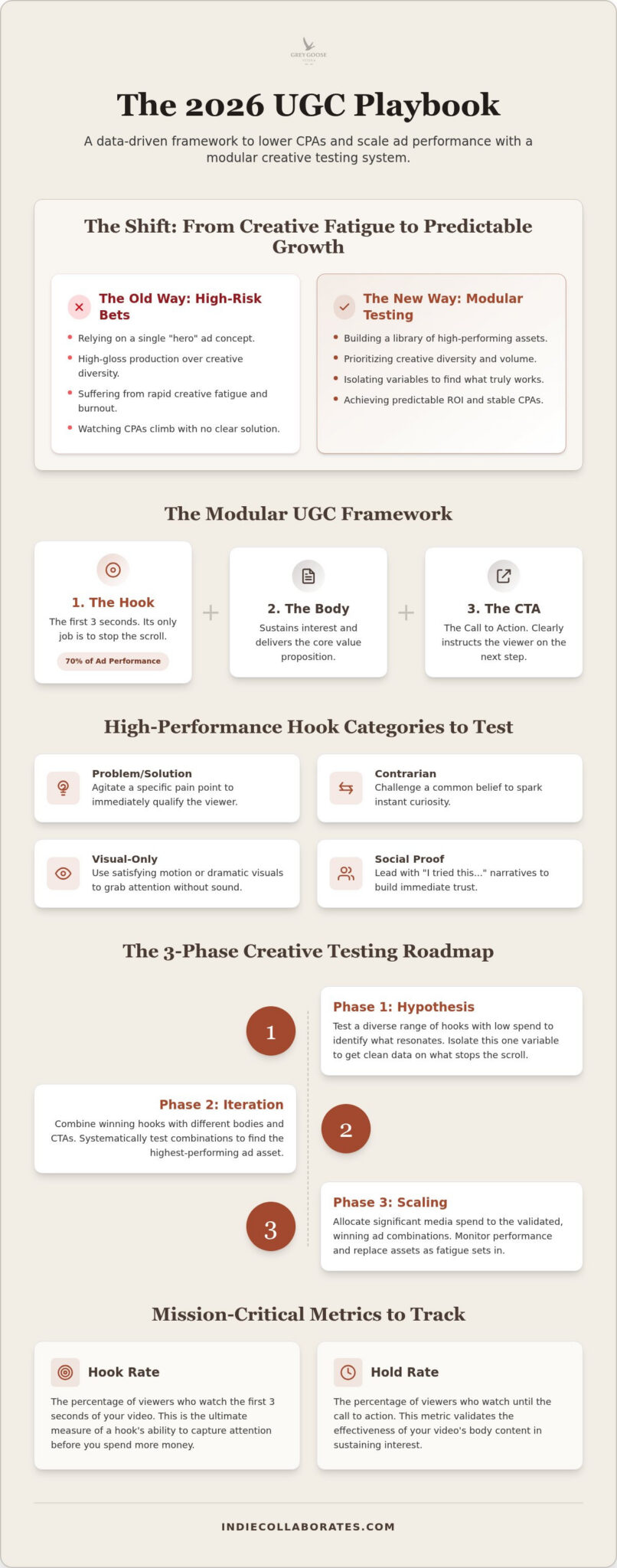
Success in 2026 requires a shift from monolithic videos to modular components. Every high-performing ad rests on three distinct pillars: the Hook, the Body, and the Call to Action (CTA). By deconstructing content into these independent parts, brands can implement a robust system of ugc for creative testing. This approach allows you to swap a failing hook for a winning one without discarding the entire asset. It’s about efficiency and precision. It’s about finding the exact combination that unlocks scale.
To achieve this, your creator content strategy must prioritise modularity from the initial briefing stage. Instead of asking for one finished video, instruct your creators to capture three distinct hooks and two unique CTAs in a single shoot. This provides the raw material needed to iterate quickly. The “Hook Isolation” method is vital here; data suggests the first three seconds determine up to 70% of an ad’s ultimate performance. If you fail to stop the scroll, the quality of your body content becomes irrelevant.
High-Performance Hook Categories
Different audiences respond to different psychological triggers. To find what works, you should test across several high-performance categories:
- Problem/Solution: Agitate a specific pain point immediately to qualify the viewer.
- Contrarian: Challenge a common industry belief or “status quo” to spark instant curiosity.
- Visual-only: Use fast movement, satisfying textures, or dramatic transformations to grab attention without sound.
- Social Proof: Lead with “I tried this so you don’t have to” narratives to build immediate trust through lived experience.
Body and CTA Variations
Once the hook successfully stops the scroll, the body must sustain interest by validating the viewer’s attention. Test different value propositions within the body, such as convenience versus price or quality versus ease of use. Similarly, experiment with the friction of your closing. “Soft” CTAs like “Learn more” often perform better for top-of-funnel awareness, while “Direct” CTAs like “Shop the sale” are essential for conversion-focused campaigns. Modular editing allows you to mix and match these elements across your entire library of assets. If you’re looking to build this library quickly, our specialised UGC production team can help you source creators who understand how to deliver these modular variations. This structure turns creative production into a predictable performance engine.
The 3-Phase Creative Testing Roadmap: From Hypothesis to Scaling
Moving from raw content to a scalable ad asset requires a disciplined, chronological approach. You cannot test every variable at once without muddying your data. A structured roadmap ensures that your media spend is always directed toward the highest probability of success. This process begins with isolating the variables that stop the scroll and ends with a validated asset ready for significant investment. By following this three-phase progression, brands can turn ugc for creative testing into a predictable engine for customer acquisition.
Phase 1, the Alpha Test, focuses exclusively on the hook. You should run multiple intro variations against a control body to see which concept achieves the highest stop rate. Once a winning hook is identified, you move to Phase 2, the Beta Test. Here, you refine the body content and visual style to optimise for retention and conversion. Finally, Phase 3 is the Scale Phase. This is where you double down on winning combinations with higher spend. It’s during this transition that many brands integrate their findings into a broader performance influencer marketing singapore strategy to maintain regional relevance and momentum.
Setting Your Testing Hypothesis
Every test must start with a clear, written hypothesis to avoid “gut feeling” decisions. A strong hypothesis might state: “Creator A will outperform Creator B because their visual hook uses a high-energy transformation that aligns with our target demographic’s aesthetic.” This clarity allows you to learn from failures just as much as successes. To achieve statistically significant results, allocate a budget of at least two to three times your target CPA per variant. Run these tests for four to seven days. If an asset hasn’t met your performance benchmarks by then, kill it and move to the next iteration.
Platform-Specific Testing Nuances
A winning creative on TikTok rarely performs identically on Meta without adjustment. TikTok’s algorithm rewards a “native” feel; content that looks like an ad often gets skipped immediately. In contrast, Meta audiences often respond better to a slightly more structured or “polished” UGC style that clearly defines the value proposition early. When conducting ugc for creative testing on TikTok, leverage Spark Ads. This allows you to test creator-led content through their own handles, providing a layer of authenticity that traditional brand accounts cannot replicate. This platform-specific sensitivity ensures your testing data is accurate for the specific environment where your ads live.
Beyond the Click: Analysing Performance Metrics that Signal a Winner
Winning creatives don’t just happen; they are measured into existence. Once your assets are live, the focus shifts from production to precision analysis. Understanding the nuances of ugc for creative testing requires looking past basic vanity metrics to identify the specific data points that signal long-term viability. By isolating these variables, we can move with confidence from a small test budget to a full-scale campaign. This analytical rigour ensures that every dollar spent is buying either a conversion or a valuable piece of market intelligence.
The first metric in your hierarchy is the Hook Rate, or the 3-second view-through rate. This is your ultimate indicator of attention. If your Hook Rate is below industry benchmarks, your body content never gets a chance to perform. Next, we examine the Hold Rate, which tracks video completion. This measures creative resonance and interest. A high Hook Rate paired with a low Hold Rate suggests your intro was clickbait that failed to deliver on its promise. To manage these complex data streams effectively, many brands rely on outsourced influencer campaign management to ensure reporting is both accurate and actionable.
The Hierarchy of Metrics
Hook Rate is your North Star during the initial Alpha Phase. In these early stages, it’s often wise to ignore ROAS. High-intent creative might have a lower ROAS initially due to small sample sizes, but superior engagement metrics indicate it will scale more efficiently later. Watch out for “False Winners.” These are assets with a high click-through rate (CTR) but zero conversions. Often, this happens when a creator’s hook is too disconnected from the actual product value, leading to curious clicks rather than qualified buyers. Tracking CPC and CPA against your break-even ROAS remains the final hurdle for any asset entering the scale phase.
Qualitative Data: Creator Research and Insights
Quantitative data tells you what is happening, but qualitative data tells you why. Analysing comment sentiment provides a window into your audience’s psyche. Are they asking about the price? Are they tagging friends? This feedback loop allows you to write better creator briefs for the next iteration of ugc for creative testing. Over time, this process helps you identify “unicorn” creators. These individuals possess a unique combination of relatability and persuasive power that consistently converts across multiple campaigns. If you’re ready to stop guessing and start growing, request a detailed performance report to see how we can professionalise your creative analysis.
Scaling ROI with Managed UGC Production and Vetted Creator Networks
Scaling a creative laboratory requires more than just a list of names; it demands a robust infrastructure. While managing a handful of creators might feel manageable in-house, the DIY approach typically breaks once you attempt to produce more than 10 unique assets per month. The administrative burden of briefing, tracking, and quality-controlling multiple creators often results in delayed testing cycles and inconsistent quality. To maintain a competitive edge, high-growth brands are shifting toward a scalable ugc production service that treats content as a high-volume performance variable. This ensures a steady stream of fresh assets for ugc for creative testing without overwhelming your internal team or sacrificing the rigour of your data.
Our Indie Collaborates ecosystem solves this bottleneck by providing direct access to over 1,600 vetted creators within the IC Inner Circle. This isn’t just a database; it’s a curated network where production skill is prioritised over mere follower counts. When you look to hire content creators in singapore, you need individuals who understand the nuances of a performance framework. They must know how to deliver modular hooks and follow a brief with technical precision to ensure every asset is ready for the auction.
The Vetted Creator Difference
There is a fundamental distinction between a traditional “influencer” and a “performance creator.” Selecting for production skill is vital. A creator must understand lighting, audio, and pacing to ensure their content is usable for ugc for creative testing. We invest heavily in creator research to ensure alignment between the creator’s persona and your brand’s voice. For those seeking niche talent, the IC Jobs Board serves as a specialised bridge, connecting brands with high-tier creative professionals who are already fluent in performance-led content. This vetting process removes the guesswork, ensuring that your testing phase starts with high-quality ingredients.
Managed Services vs. SaaS Platforms
Many brands initially turn to SaaS platforms for their speed, yet they quickly discover that a tool is only as effective as the person wielding it. High-growth brands require a strategic architect, not just a marketplace. Managed services provide end-to-end support, from the initial creator research and briefing to final production and performance reporting. This holistic approach allows you to focus on high-level strategy while we handle the operational complexities. By identifying your testing winners through this managed pipeline, you can eventually build a long-term creator affiliate salesforce. These proven partners become the backbone of your brand, driving predictable ROI month after month through content that has already been validated in the testing lab.
Transforming Creative Insights into Scalable Growth
Mastering ugc for creative testing marks the definitive shift from guesswork to a performance-led production engine. By adopting a modular framework and a disciplined three-phase roadmap, you move beyond the inherent risks of creative fatigue. You transition into a space where every asset serves as a validated building block for your brand’s long-term success. This systematic approach ensures that your media spend is always supported by data, allowing you to scale with precision and confidence across ever-changing social auctions.
We provide the architecture for this growth through our end-to-end managed UGC production and a specialised focus on Southeast Asia regional performance. With access to over 1,600 vetted creators in the IC Inner Circle, your brand can maintain a consistent testing cadence that outpaces the competition. It’s time to replace the uncertainty of one-off content with a reliable, data-driven strategy that delivers tangible value. Optimise your creative performance with Indie Collaborates today. Your next winning asset is just one structured test away.
Frequently Asked Questions
What is the ideal number of UGC variants to test per adset?
The ideal range is typically three to five variants per test. Testing too many assets simultaneously can dilute your budget and delay statistical significance; testing too few limits your ability to find a true outlier. We recommend keeping the body and CTA consistent while varying only the hook to isolate which opening concept drives the highest engagement before moving to the next phase of your campaign.
How much budget should I allocate for a UGC creative test?
You should allocate approximately two to three times your target CPA for each variant in the test. If your target acquisition cost is $50, then a budget of $100 to $150 per variant provides enough data for the algorithm to exit the learning phase. This investment ensures that your results are based on performance rather than random variance or small sample sizes during the early stages.
How long does it take to see results from a UGC testing programme?
Most brands see actionable data within four to seven days of launching a test. During this window, the platform’s algorithm identifies which content resonates best with specific audience segments. While initial indicators like hook rate appear almost immediately, you should allow the full week to pass to ensure your efficiency metrics like CPC and CPA remain stable before you decide to scale any winning assets.
Can I use the same UGC for creative testing on both Meta and TikTok?
It’s best to avoid using identical edits across both platforms. TikTok audiences generally prefer a “native” feel that looks like organic content, whereas Meta users often respond better to a slightly more structured or “polished” UGC style. While the core message can remain the same, you should customise the hook and pacing to suit the specific environment and user behaviour where the ad lives.
What is a “good” hook rate for a UGC ad in 2026?
A strong benchmark for hook rate, or your 3-second view-through rate, is currently between 25% and 30%. If your assets fall below a 15% hook rate, it indicates that your opening concept isn’t stopping the scroll effectively. Monitoring this metric during ugc for creative testing allows you to swap failing intros quickly without needing to re-record the entire body or call to action of the video.
How do I find high-quality creators for performance-led UGC?
Finding the right talent requires looking beyond follower counts to evaluate production skill and technical proficiency. We leverage a vetted community of over 1,600 creators in the IC Inner Circle to ensure every partner understands performance-led briefs. You can also use specialised platforms like the IC Jobs Board to connect directly with creative talent who are experienced in delivering modular assets for sophisticated paid social campaigns.
What is the difference between A/B testing and creative testing for UGC?
A/B testing is a binary comparison between two finished ads, while creative testing is a modular framework designed to isolate specific variables. In ugc for creative testing, you aren’t just comparing Video A to Video B. You are testing multiple hooks against a single body to find a winning concept that can then be iterated upon for long-term performance and sustainable scaling.
How often should I refresh my UGC creative testing library?
You should aim to refresh your testing library at least once a month to combat creative fatigue. High-growth brands often maintain a continuous cycle where new assets enter the Alpha Phase as winners from previous tests move into the scaling phase. This proactive rhythm prevents your CPAs from climbing and ensures your campaigns always have a pipeline of fresh, validated content ready for high-volume media spend.
